

, OH
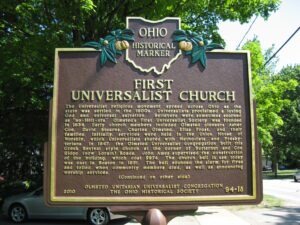
The Universalist religious movement spread across Ohio as the state was settled in the 1800s. Universalists proclaimed a loving God and universal salvation. Believers were sometimes scorned as “no-Hell-ers.” Olmsted’s First Universalist Society was founded in 1834. Early church members included Olmsted pioneers Asher Coe, David Stearns, Charles Olmsted, Elias Frost, and their families. Initially, services were held in the Union House of Worship, which Universalists shared with Methodists and Presbyterians. In 1847, the Olmsted Universalist congregation built this Greek Revival style church at the corner of Butternut and Coe Ridge (now Lorain) Roads. John Ames supervised the construction of the building, which cost $974. The church bell in use today was cast in Boston in 1851. The bell sounded the alarm for fires and tolled when community members died, as well as announcing worship services.
, OH
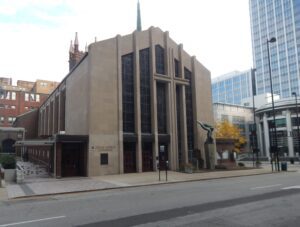
In 1817 twenty-two men, including future President William Henry Harrison, chartered Cincinnati’s first Episcopal parish, Christ Church. In 1835 members erected a Gothic Revival-style church on this site. The neighborhood evolved as the city grew with the influx of immigrants. Parish women raised funds to teach, feed, clothe, and shelter tenement families, and alleviate suffering during floods and disease outbreaks. In 1883 the women helped establish what became Cincinnati Children’s Hospital. In 1909 members opened the Late Gothic-style Parish House, a community center with kitchen, classrooms, library, auditorium, clinic, gymnasium, and bowling alley. By the parish’s centennial in 1917, music had expanded beyond worship to public concerts. In 1940 the annual Boar’s Head Festival of music and pageantry began. Since the 1960s, members have collaborated with local agencies to advocate for social and economic justice, a mission continuing into the 21st century. (Continued on other side)
, OH
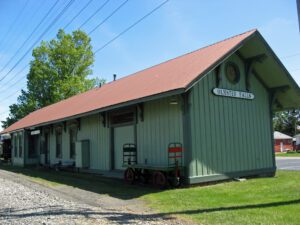
The Lakeshore and Michigan Southern Railroad built the Olmsted Falls Depot in 1876 as a part of major improvements made along the line between Cleveland and Toledo. The depot replaced a smaller flag stop station in Olmsted Falls at the Columbia Road railroad crossing. By 1909, the depot was moved from Mapleway Drive on rollers by a locomotive to this site to be closer to the heart of the village. In the early 20th century, ten trains a day stopped here. One was the “Plug,” which took commuters between Olmsted Falls and Cleveland. By mid-century, cars and planes had largely replaced train travel. The last regularly scheduled train stopped here in 1949 and service ended completely in 1960. The depot became the home of the Cuyahoga Valley and Westshore Model Railroad Club in 1977 and was listed on the National Register of Historic Places in 2000.
, OH
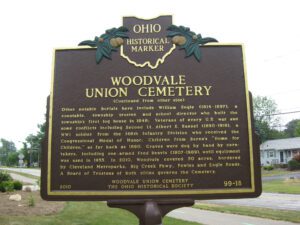
Woodvale Cemetery was established in the mid-1800s, in Middleburgh Township, Ohio. The oldest marked grave holds Fred G. Klink (1835-1858), whose family donated a half acre of land for burials. In 1876, Frank M. Stearns (1832-1911) suggested the unnamed cemetery be called Woodvale, after the wooded vale beside it. In 1908, a fire destroyed the caretaker’s house and many cemetery records. Woodvale became a non-profit, union cemetery in 1931, owned by Berea and the Village of Middleburg Hts. and covering 35 acres at 7535 Engle Road. Pioneer families buried here: Fowles, Kraft, Lovejoy, Sprague, and Stearns. Also buried here: John Baldwin (1799-1884) founder of Baldwin University and James Wallace (1878-1953) founder of German Wallace College (merged in 1913 to become Baldwin Wallace College) (Continued other side)
, OH
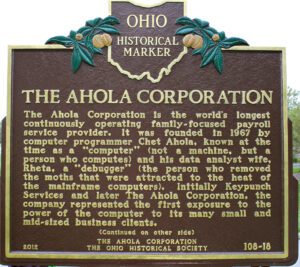
The Ahola Corporation is the world’s longest continuously operating family-focused payroll service provider. It was founded in 1967 by computer programmer Chet Ahola, known at the time as a “computer” (not a machine, but a person who computes) and his data analyst wife, Rheta, a “debugger” (the person who removed the moths that were attracted to the heat of the mainframe computers). Initially Keypunch Services and later the Ahola Corporation, the company represented the first exposure to the power of the computer to its many small and mid-sized business clients.
, OH
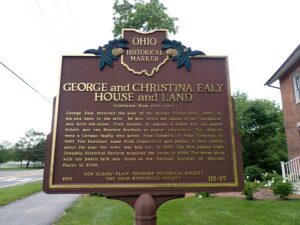
The George and Christina Ealy House is a testament to the prosperity of one of this area’s early residents and the skills of mid-nineteenth-century craftsmen. In 1830, members of the Ealy family moved from Pennsylvania to a 73-acre parcel where the house and six-acre Resch Park surrounding it are located. The Ealys were representative of a second wave of pioneers who settled Plain Township after 1812. The Ealys cleared land for farming and operated a sawmill on Rose Run. George prospered and in 1860 built this fine brick house. Architecturally, the house exhibits the transition between Greek Revival and Italianate styles. Its layout reflects the former; its proportions and decorative detail, the latter. (Continued on other side)
, OH
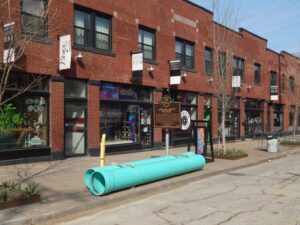
This block of W. 29th Street was home to Cleveland’s vibrant LGBT community and central to the development of the modern LGBT civil rights movement. In 1988, the Striebinger Building, at 1418 W. 29th, housed Cleveland’s Lesbian-Gay Community Services Center, which addressed the needs of the LGBT community. Cleveland’s first Pride Festival since the mid-1970s was held on the block in 1989, and in 1990 Cleveland’s first Pride Parade culminated here. During the HIV/AIDS crisis, The Living Room and ACT UP were located in the Striebinger Building and gave support to those with HIV/AIDs and provided a platform for political activism. It was on this block where many people could find their voices to “come-out” and advocate for their rights and their humanity. (Continued on other side)
, OH
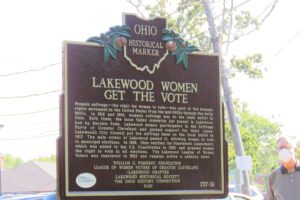
Women’s suffrage–the right for women to vote–was part of the women’s rights movement in the United States from the mid-1800s through the early 1900s. In 1912 and 1914, women’s suffrage was on the state ballot in Ohio. Both times, the issue failed statewide but passed in Lakewood. Led by Bernice Pyke, Lakewood women participated in the Suffrage Party of Greater Cleveland and gained support for their cause. Lakewood’s City Council put the suffrage issue on the local ballot in 1917. The male voters of Lakewood passed it, allowing women to vote in municipal elections. In 1919, Ohio ratified the Nineteenth Amendment, which was added to the U.S. Constitution in 1920 and granted women the right to vote in all elections. The Lakewood League of Women Voters was chartered in 1922 and remains active a century later.