

, OH
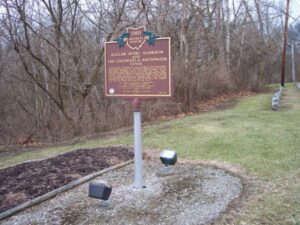
In 1837, Cincinnati merchants projected a branch canal to join the Whitewater Canal at West Harrison, Indiana, with the goal of tapping commerce from Indiana’s Whitewater Valley. The major obstacle on this route was the ridge between North Bend and Cleves, just northeast of this site. Engineer Darius Lapham designed a 1,782-foot tunnel though this barrier. Lined with brick made on site, the tunnel, 24 feet wide and 20 1/2 feet high, was the first canal tunnel in Ohio. Six workers died in its construction. The Cincinnati & Whitewater Canal opened in 1843 but was abandoned by 1856, after the main Whitewater Canal had been rendered useless by repeated flooding. The canal tunnel was subsequently used as a railroad tunnel from 1863 until 1888, illustrating the progression of transportation technology in the mid-nineteenth century.
, OH
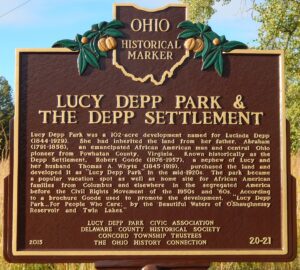
Lucy Depp Park was a 102-acre development named for Lucinda Depp (1844-1929). She had inherited the land from her father, Abraham (1791-1858), an emancipated African American man and central Ohio pioneer from Powhattan County, Virginia. Known historically as the Depp Settlement, Robert Goode (1876-1957), a nephew of Lucy and her husband Thomas A. Whyte (1845-1919), purchased the land and developed it as “Lucy Depp Park” in the mid-1920s. The park became a popular vacation spot as well as home site for African American families from Columbus and elsewhere in the segregated America before the Civil Rights movement of the 1950s and 60s. According to a brochure Goode used to promote the development, “Lucy Depp Park…For People Who Care; by the Beautiful Waters of O’Shaughnessy Resevoir and Twin Lakes.”
, OH
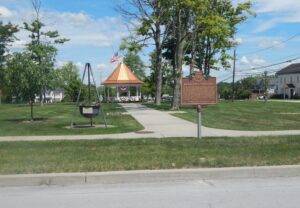
In 1798, Judge Samuel Hinckley of Northampton, Massachusetts, drew the 72nd draft in the land lottery held by the Connecticut Land Company and received 15,305 acres in Township 4, Range 1, for which he paid $12,903.23, less than one dollar per acre. The area had been inhabited for many years by trappers, missionaries, and Native Americans. One of the earliest settlers was James McMullen, who acquired the first 160-acre parcel from Hinckley in 1801. Brookfield Township became the crown jewel of Hinckley’s holdings. Hinckley named Brookfield after a city in England and set aside land for the village green and the cemetery stating that they were for public use forever. During the mid-1820s the Overland Stage Line had a run through Brookfield, linking it to Salem, Warren, and Youngstown in Ohio and Erie, Pennsylvania and Dunkirk, New York. (Continued on other side)
, OH
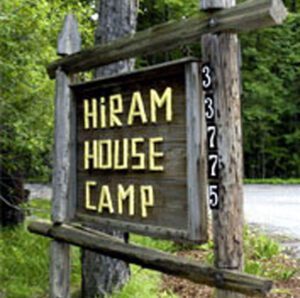
Hiram House was Ohio’s first settlement house and among the earliest in the nation, opening in October 1896 in Cleveland’s Whiskey Island neighborhood. Representing the ideals of a late-1800s urban progressive movement, settlement houses provided–through “service, not charity” –health, recreational, and self-development opportunities that were not widely available in this era. Founded by Hiram College divinity graduate George A. Bellamy (1872-1960), Hiram House administered a wide range of social services for people of different ethnic and economic backgrounds. Bellamy established the “Fresh Air Camp” circa 1900; Cleveland industrialist Samuel Mather donated this tract of land in 1903. In continuous operation since its founding, Hiram House has provided outdoor experiences and educational programs for thousands of Ohio children.
, OH
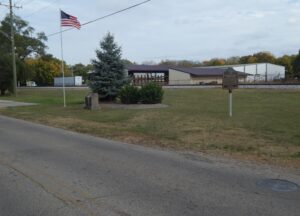
Carlisle Station Depot. The Carlisle depot for the Cincinnati, Hamilton & Dayton (CH&D) railroad was located nearby. The CH&D started operations in 1851 and was the second railroad through Warren County. Carlisle Station was a passenger and freight-shipping depot and was joined in 1872 by another, when Cincinnati & Springfield Railroad (later part of the Big Four and the New York Central Railroads) erected a depot in nearby Franklin. Carlisle was originally known as the “Jersey Settlement,” because many settlers in the early 1800s were from New Jersey. George Carlisle, vice-president of the CH&D, purchased a large tract of land here. After Carlisle and his wife Sarah donated a lot to the community in 1856, residents renamed the place “Carlisle Station.” The Carlisle Literary Association built a hall on the lot c. 1856, which, as of 2019, remains as the older section of Carlisle’s municipal building. Side B: Schenck-Stanton Rally, October 3, 1868.
, OH
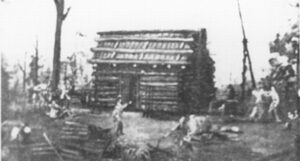
In the late 1790s General Benjamin Whiteman built near this site one of the first log cabins in Alpha, the first settlement in what would become Beavercreek Township of Greene County. The cabin, later owned by Whiteman’s father-in-law, Owen Davis, and leased for use as a tavern to Peter Borders, became the first courthouse of Greene County. Twenty-five feet square, it had one room below and a chamber above, serving as the family sleeping quarters. A small ladder through a hole in the ceiling reached the upper level. The building was constructed of burr oak logs with a roof made of clapboards held in place by long poles laid across them. Considered to be one of the finest houses in that part of the county, the cabin had one door, one window, and a huge fireplace with an outside chimney built of sticks, stones, and clay. (Continued on other side)
, OH
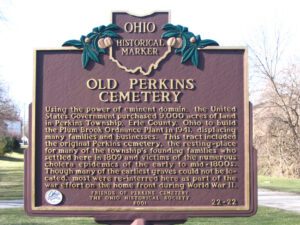
Using the power of eminent domain, the United States Government purchased 9,000 acres of land in Perkins Township, Erie County, Ohio to build the Plum Brook Ordnance Plant in 1941, displacing many families and businesses. This tract included the original Perkins cemetery, the resting-place for many of the township’s founding families who settled here in 1809 and victims of the numerous cholera epidemics of the early to mid-1800s. Though many of the earliest graves could not be located, most were re-interred here as part of the war effort on the home front during World War II.
, OH
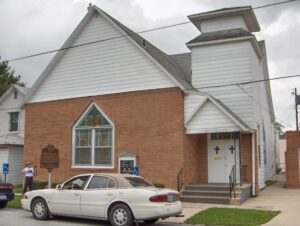
In spite of small numbers and being welcomed by the mostly white congregation of First Methodist Episcopal Church, African Americans in Findlay in the 1880s wanted to express their faith in ways that best reflected their freedoms and traditions. By the mid-1880s, the congregation was meeting in members’ homes and the Odd Fellows Hall, but began fund raising to build their own church in 1885. The congregation was admitted to the North Ohio Conference of the Third Episcopal District of the African Methodist Church in 1885, one of the first churches to be so admitted. The building on Liberty Street was well underway by the end of 1887 on a lot donated by Judge D. J. Cory. The original twenty foot by forty foot building cost $2,000 and immediately became a focal point for religion and social events for Findlay’s African American community. (Continued on other side)