

, OH
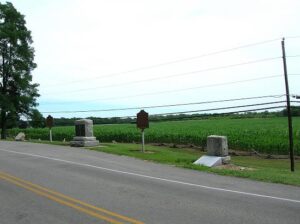
In the mid-1700s, France found its influence waning among midwestern tribes as it contested for Native American trade and military alliances with Great Britain. Shortly after Miami chief Memeskia (also known as Old Britain or La Demoiselle) moved his village to Pickawillany, British traders were given permission to establish a small post in the village, which was deep in the territory claimed by France. When French demands to evacuate the post failed, Charles Langlade led a party of 250 Ottawa and Ojibwe warriors and French Canadians in a surprise attack on the Miami village on June 21, 1752. The trading post was destroyed, British traders were taken to Detroit as prisoners, and Memeskia was executed. Pickawillany was completely abandoned soon after. As a prelude to the French and Indian War, the Battle of Pickawillany fueled land claim and trading right conflicts between France and Britain.
, OH
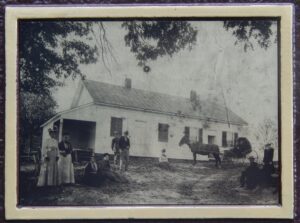
Congregations of the Religious Society of Friends (Quakers), called “meetings”, worshiped in plain meeting houses. On this site stood the last Richland Friends Meeting House, built in 1872. Ninety-four Friends established the meeting in 1826 and it endured for 147 years. The cemetery is where many generations of members of this meeting are buried. The faith, based on pacifism and simplicity, blossomed in the region during the first half of the 19th century. (Continued on other side)
, OH
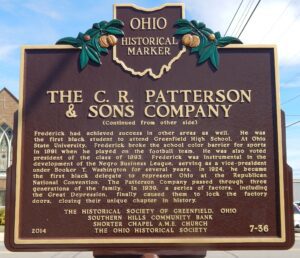
The factory of the C. R. Patterson & Sons Company once stood near here at 138 N. Washington Street. Established in the mid-nineteenth century by the black businessman Charles Richard (C. R.) Patterson and his white partner, J. P. Lowe, the business, originally known as J. P. Lowe & Company, became a successful carriage firm. Patterson became the sole owner in 1893 and changed the name to C. R. Patterson & Sons. After succeeding his father as owner, C. R.’s son, Frederick, became the first known African-American automobile manufacturer. Under his leadership, the company transitioned from building carriages to automobiles, then to trucks and buses to keep up with the changing demands of the transportation industry. (Continued on other side)
, OH
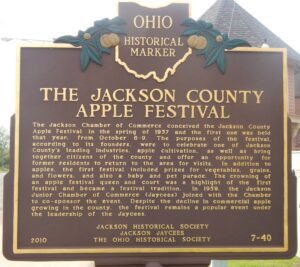
The Jackson Chamber of Commerce conceived the Jackson County Apple Festival in the spring of 1937 and the first one was held that year, from October 6-9. The purposes of the festival, according to its founders, were to celebrate one of Jackson County’s leading industries, apple cultivation, as well as bring together citizens of the county and offer an opportunity for former residents to return to the area for visits. In addition to apples, the first festival included prizes for vegetables, grains, and flowers, and also a baby and pet parade. The crowning of an apple festival queen and court was a highlight of the first festival and became a festival tradition. In 1959, the Jackson Junior Chamber of Commerce (Jaycees) joined with the Chamber to co-sponsor the event. Despite the decline in commercial apple growing in the county, the festival remains a popular event under the leadership of the Jaycees.
, OH
In 1817 the United States government signed a treaty with a number of Native American tribes in northern Ohio, including the Seneca Indians. The Fort Meigs or Maumee Rapids Treaty bound the Seneca tribe to cede all claims to land north of the Greenville Treaty line, and in return they received a 40,000 acre reservation at Lower Sandusky (Fremont) and a $500 annuity to be paid each year in perpetuity. The reservation’s boundary began 1.5 miles north of here and extended 6.5 miles to the south. The width of the reservation was 8 miles with the western boundary at the Sandusky River. Beginning in 1830, with a policy of Indian removal developed by the administration of Andrew Jackson, tribes east of the Mississippi River were pressured to move to reservations in the West. The Seneca Indians moved to northeast Oklahoma in 1831.
, OH
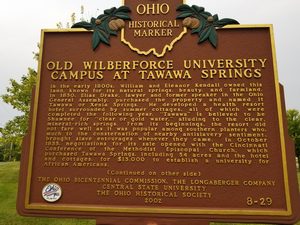
In the early 1800s, William and Eleanor Kendall owned this land, known for its natural springs, beauty, and farmland. In 1850, Elias Drake, lawyer and former speaker in the Ohio General Assembly, purchased the property and named it Tawana or Xenia Springs. He developed a health resort hotel surrounded by summer cottages, all of which were completed the following year. “Tawana” is believed to be Shawnee for “clear or gold water,” alluding to the clear, mineral-rich springs. From its beginnings, the resort did not fare well as it was popular among southern planters who, much to the consternation of nearby antislavery sentiment, brought slave entourages whenever they came. In October 1855, negotiations for its sale opened with the Cincinnati Conference of the Methodist Episcopal Church, which purchased Tawana Springs, including 54 acres and the hotel and cottages, for $13,000 to establish a university for African Americans. (Continued on other side)
, OH
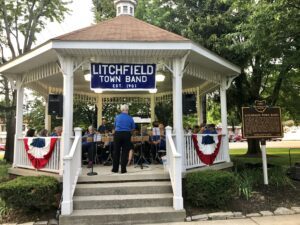
Around 1900, the newly formed Litchfield Cemetery and Park Association needed a band to lead processions to and from the town cemetery on Memorial Day. The Litchfield Town Band was born. Urial Crow served as its first director, so the group was sometimes known as “The Crow Band”. Although there were periods when the band was inactive, it has been a community institution for more than a century. The group plays a broad repertoire of standards and marches by John Philip Sousa at Memorial Day and other commemorations, ice cream socials, and various community events. Directors have included Urial Crow, Loren Hayes (c. 1915), Floyd Koons (mid-1920s), Raymond Bradley (1935-1939), Hal Leach (1939-1945), Kenneth Bradley (1946-2011) and Cynthia Bennett (since 2012).
, OH
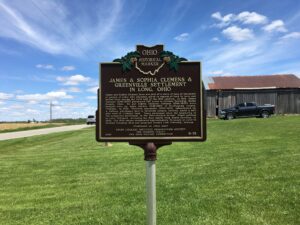
James and Sophia Clemens’ lives are part of a story of tens of thousands of people of color who migrated north in search of land to farm and better lives during the first half of the 19th century. In 1818, James Clemens (1781-1870) purchased 387 acres in German Township, Darke County, Ohio. He and Sophia (Sellers) Clemens (1786-1875) were brought here by Adam Sellers (1742-1821) of Rockingham County, Virginia. In 1822, Thornton Alexander (1783-1851), emancipated by A. Sellers, purchased land in Randolph County, Indiana, about a half mile west of Clemens’ land. These purchases were the beginning of the Greenville Settlement on the Ohio-Indiana border. Other settlers of color followed, including the Bass family from North Carolina, in 1828. The 1830 census enumerated approximately 78 people of color in German Township Ohio and adjacent Green’s Fork Township, Indiana. (Continued on other side)