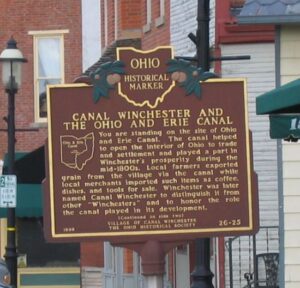
You are standing on the site of Ohio and Erie Canal. The canal helped to open the interior of Ohio to trade and settlement and played a part in Winchester’s prosperity during the mid-1800s. Local farmers exported grain from the village via the canal while local merchants imported such items as coffee, dishes, and tools for sale. Winchester was later named Canal Winchester to distinguish it from other “Winchesters” and to honor the role the canal played in its development. (Continued on side two)
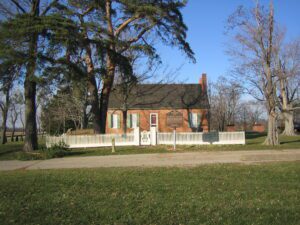
As Oxford Township was developing in the mid-1800s, a cluster of farmsteads near its northern border developed and was designated the “Doty Settlement.” As was the custom, the community took its name from a prominent family in the area. In or near the settlement were a church and cemetery, a school, a blacksmith shop, a sawmill, a distillery, a furniture shop, and a fulling mill for cleansing, shrinking, and thickening cloth. With the frontier spirit of self-reliance, it was seldom necessary to travel several miles into Oxford village for additional goods or services. Working together, the community farmed local fields and bartered for other items. Men, women, and children worked long, hard hours in the fields harvesting corn and wheat. It is evident that these families, living in an agricultural society, possessed many useful skills for surviving in the Ohio country.
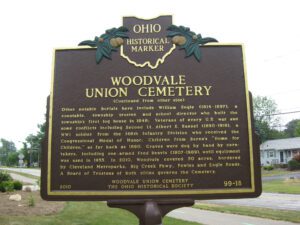
Woodvale Cemetery was established in the mid-1800s, in Middleburgh Township, Ohio. The oldest marked grave holds Fred G. Klink (1835-1858), whose family donated a half acre of land for burials. In 1876, Frank M. Stearns (1832-1911) suggested the unnamed cemetery be called Woodvale, after the wooded vale beside it. In 1908, a fire destroyed the caretaker’s house and many cemetery records. Woodvale became a non-profit, union cemetery in 1931, owned by Berea and the Village of Middleburg Hts. and covering 35 acres at 7535 Engle Road. Pioneer families buried here: Fowles, Kraft, Lovejoy, Sprague, and Stearns. Also buried here: John Baldwin (1799-1884) founder of Baldwin University and James Wallace (1878-1953) founder of German Wallace College (merged in 1913 to become Baldwin Wallace College) (Continued other side)
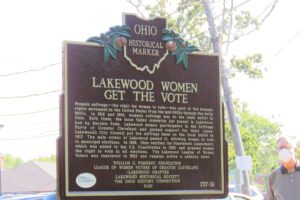
Women’s suffrage–the right for women to vote–was part of the women’s rights movement in the United States from the mid-1800s through the early 1900s. In 1912 and 1914, women’s suffrage was on the state ballot in Ohio. Both times, the issue failed statewide but passed in Lakewood. Led by Bernice Pyke, Lakewood women participated in the Suffrage Party of Greater Cleveland and gained support for their cause. Lakewood’s City Council put the suffrage issue on the local ballot in 1917. The male voters of Lakewood passed it, allowing women to vote in municipal elections. In 1919, Ohio ratified the Nineteenth Amendment, which was added to the U.S. Constitution in 1920 and granted women the right to vote in all elections. The Lakewood League of Women Voters was chartered in 1922 and remains active a century later.