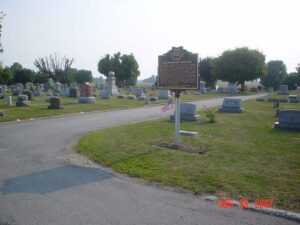
The Bloomingburg Presbyterian Church and cemetery were established in the northwest corner of the current cemetery grounds on March 7, 1818. Several years later it became a center for anti-slavery activity. The Reverend William Dickey, who presided over the church and other members, devoted their lives to the anti-slavery cause not only in voice but also in abolitionist activity. By the mid-1800s, their work, as well as the fact that Bloomingburg had become home to a vibrant African American community, led to the town becoming the area center for the Underground Railroad, which helped transport many fugitive slaves to freedom in the north. Six soldiers from the American Revolutionary War, nineteen from the War of 1812, and over 100 from the Civil War and Spanish-American War are buried in the Bloomingburg Cemetery, including Henry Casey, who was awarded the Congressional Medal of Honor for his valor at Vicksburg.
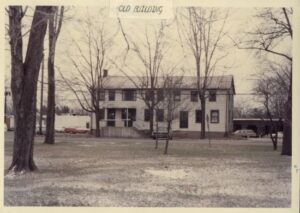
The Independent Order of Odd Fellows (IOOF) traces its origins to mid-18th-century England, where it served as a mutual benefit society for traveling workmen. Odd Fellowship moved to the United States in 1819; the first Ohio lodge was established in 1830, and the Canfield Lodge was instituted in 1850. The charter members of this lodge were E.J. Estep, John G. Kyle, James Powers, W. M. Prentice, and William W. Whittlesey. Many of the early members of this lodge were businessmen, lawyers, physicians, and tradesmen. Lodge 155 remains one of the oldest active lodges in northeastern Ohio. (continued on other side)
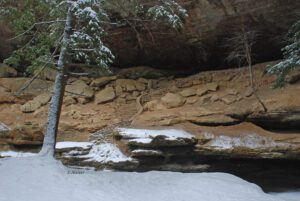
This recess cave was named for the “old man” Richard Rowe, a recluse who made the cave his home in the 1800s and is a part of scenic Hocking Hills State Park. Hocking comes from the Wyandot Indian word “hockinghocking,” referring to the Hocking River’s bottle-shaped gorge near Lancaster. Streams and percolating groundwater carved the hollows and caves in this area from layers of sandstone bedrock that vary in hardness. The hollow’s moist, cool climate preserves more typically northern tree species such as eastern hemlock trees and Canada yew, which have persisted since the glaciers retreated 15,000 years ago.
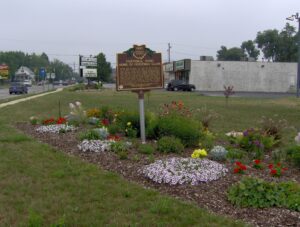
Fostoria’s glass era began when natural gas was discovered in the mid 1880s at “Godsend,” five miles west of town. Aided by former governor Charles Foster, Fostoria attracted more than a dozen companies that manufactured utilitarian and decorative glassware from 1887 to 1920. These companies produced windows, bottles, tableware, lamps, shades, and electric incandescent lamps. The Fostoria Glass Company was the best-known manufacturer of glass in Fostoria. From 1887 to 1891, it made a wide variety of decorative glass including its famous “Victoria” pattern tableware. Even after the company relocated to Moundsville, West Virginia following the depletion of natural gas in the area, it retained the name “Fostoria, ” which is still synonymous with excellence in the glass-making art.
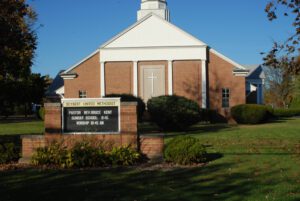
Born in Pennsylvania in 1791, Bishop John Seybert came to Ohio in 1822 and preached throughout the mid-west. Seybert served the faith for forty years as an itinerant preacher, a presiding elder, and the first bishop of the Evangelical Association, one of the original denominations that is now part of the United Methodist Church. As a circuit rider, he traveled on foot, horseback, and spring wagon a distance of 175,000 miles, preached 9,850 sermons, held 8,000 prayer and class meetings, and made about 46,000 pastoral calls and 10,000 calls on the sick. Seybert often paid his own expenses on the meager salary of $100 per year. He died in 1860 and is buried in the Bellevue – Flat Rock area.
SE corner of E Marietta Street and Creamery Street
Woodsfield
, OH
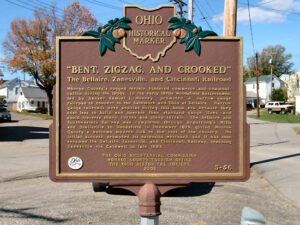
Monroe County’s rugged terrain hindered commerce and communication during the 1800s. In the early 1870s Woodsfield businessmen, led by banker Samuel L. Mooney, promoted a narrow-gauge railroad to connect to the Baltimore and Ohio at Bellaire. Narrow gauge railroads were popular during this boom era because they cost less to build and operate than standard-gauge lines and could traverse sharp curves and steep terrain. The Bellaire and Southwestern Railway was completed through Armstrong’s Mills and Beallsville to Woodsfield in December 1879, giving Monroe County a welcome modern link to the rest of the country. Its initial success prompted its extension westward, and it was soon renamed the Bellaire, Zanesville, and Cincinnati Railway, reaching Zanesville via Caldwell in late 1883.
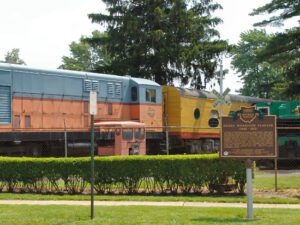
A founder of the Standard Oil Company, Henry Morrison Flagler spent his formative years in Bellevue and began his business career here in 1844, building his home near this site in 1858. He first became associated with John D. Rockefeller as a fellow grain merchant. The two later formed the Standard Oil Company in 1870 with capital partially furnished by members of the local Harkness family. Standard Oil became America’s largest and most powerful corporation in the late 1800s, and Flagler used his wealth to develop the state of Florida. His Florida East Coast Railroad, known as “the railroad over the sea,” extended from Jacksonville to Key West, Florida. The cities of Miami, Palm Beach, Fort Lauderdale, and St. Augustine grew with Flagler’s intensive development efforts.
4401 Elk Creek Road (intersection of Howe & Elk Roads)
Middletown
, OH
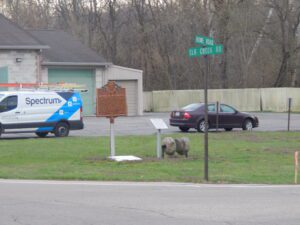
The village of Miltonville, located along the banks of Elk Creek, was platted in 1816 by George Bennett, Theophilus Eaglesfield, and Richard V. V. Crane. The creek served two grist mills, one built around 1804 and operated by a free black, Bambo Harris, and the second was built by George Bennett in 1815. An Indian burial ground was located on the east bank of Elk Creek near the site of Huff’s Ferry. Eagle Tavern, the area’s first three-story brick inn, was a stopover for stagecoach lines traveling the Miltonville-Trenton Turnpike. The village was known for pottery factories, vineyards and wineries, and Frisch’s brickyard, established in 1880. The United Brethren Church, organized in 1811, and Miltonville Cemetery were the sites of church conferences and celebrations. The Miltonville School operated from the 1800s to 1936, and the local post office was in service during the years 1889-1904.