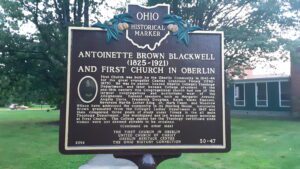
First Church was built by the Oberlin Community in 1842-44 for the great evangelist Charles Grandison Finney (1792-1875). He was its pastor, headed Oberlin College’s Theology Department, and later became College president. In the mid-19th century this Congregational church had one of the largest congregations and auditoriums west of the Alleghenies. Eminent speakers such as Margaret Atwood, Angela Davis, Frederick Douglass, Ralph Waldo Emerson, Reverend Martin Luther King, Jr., Mark Twain, and Woodrow Wilson have addressed the community in its Meeting House. Antoinette Brown graduated from the College’s Ladies’ Department in 1847 and then completed three years of study under Finney in the all male Theology Department. She worshipped and led women’s prayer meetings at First Church. The College denied her the Theology certificate since women were not deemed suitable to be ordained. (continued on other side)
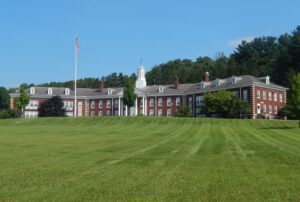
Tuberculosis, or TB, is a contagious disease that was responsible for the deaths of one out of every seven people in the U.S. in the early 20th century. The Licking County Tuberculosis Sanatorium, known as the TB San, was constructed in 1931-1932 at a cost of $250,000. The facility kept TB patients separate from the general population, controlling the spread of disease. The location provided patients with rest, fresh air, food, and exercise, the main treatments for TB in the 19th through mid-20th centuries. (Continued on other side)
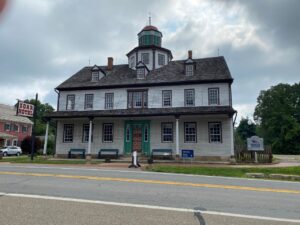
Zoar Separatists built the hotel in 1833 to accommodate overflow travelers from their original Ohio & Erie Canal inn. The hotel proved an economic boon to the Zoar community, but, by bringing the outside world into Zoar, ultimately became a source of discontent for members. During its heyday, the Zoar Hotel catered to curiosity-seekers, visiting artists, and families escaping the summer heat of nearby cities. Notable guests included Marcus Hanna and President William McKinley. The original structure was enlarged several times, including the now demolished 1892 Queen Anne addition which doubled the accommodations. By the mid-twentieth century, the hotel remained open as a popular restaurant with Rathskeller bar until closing to the public in July 1983. The exterior was restored by the Ohio History Connection in 2001-2002.
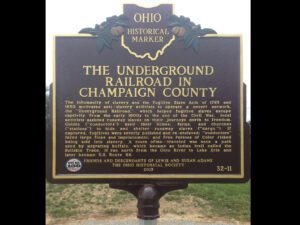
The inhumanity of slavery and the Fugitive Slave Acts of 1793 and 1850 motivated anti-slavery activists to operate a covert network, the “Underground Railroad,” which helped fugitive slaves escape captivity. From the early 1800s to the end of the Civil War, local activists assisted runaway slaves on their journeys north to freedom. Guides (“conductors”) used their homes, farms, and churches (“stations”) to hide and shelter runaway slaves (“cargo.”) If captured, fugitives were severely punished and re-enslaved; “conductors” faced large fines and imprisonment, and Free Persons of Color risked being sold into slavery. A route often-traveled was once a path used by migrating buffalo, which became an Indian trail called the Bullskin Trace. It ran north from the Ohio River to Lake Erie and later became U.S. Route 68.
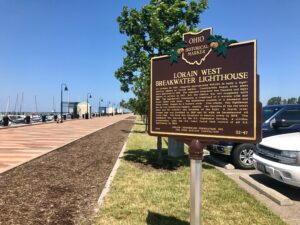
On October 22, 1913, Congress appropriated $35,000 to build a light-and-fog station at Lorain harbor. Construction began after plans were approved in 1916. The concrete structure was finished and light placed in service in 1917, but the station was not completed until 1919. The lighthouse’s foundation is comprised of a wooden crib and boxes filled with stone. The lighthouse consists of a basement and three floors, topped by a lantern room. Like others, this lighthouse had its own identifying signals, namely, the duration of the fog horn’s blast and the rotation and duration of the light. A fourth order Fresnel lens was installed in 1919 and lit with an incandescent oil vapor lamp. The lamp was converted to electric power in 1932. The lighthouse was manned by the U.S. Lighthouse Service, a civilian organization, until the U.S. Coast Guard took control of all U.S. lighthouses in 1939.
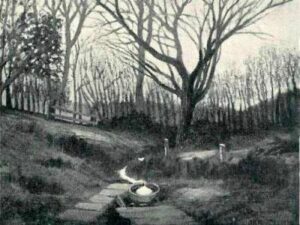
A salt spring, located about a mile west of this site, was the primary attraction for immigrants to the Western Reserve territory in the mid-1700s. Prior to European-American settlement, Indians used the springs, boiling the water to extract the salt and using it for preserving meat among other uses. In 1755, surveyor Lewis Evans underscored the importance of the springs by noting it on his “General Map of the Middle British Colonies in America.” This enticed immigrants from western Pennsylvania to the region. In addition to the salt itself, the abundance of wildlife near the spring ensured good hunting in the area. (Continued on other side)
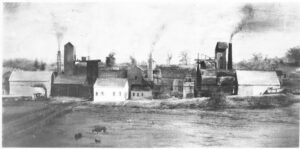
The discovery in the mid-19th century of iron-rich black band ore in this region helped revitalize Mahoning Valley’s iron industry. The land now called Mineral Ridge was primarily a farming community before the 1850s. In the 1830s, coal was discovered and mining began on a small scale. For years, it was believed that the coal seam sat on top of a layer of slate, which was considered to be of little worth. In the mid-1850s, however, John Lewis, superintendent of the Mineral Ridge Coal Mines, identified what was previously thought to be slate as valuable black band ore instead. (Continued on other side)
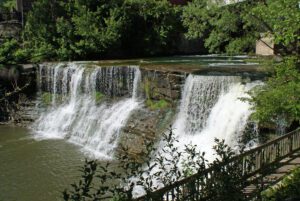
The Chagrin River was named for Francois Seguin, a Frenchman who traded with Native Americans in Northeast Ohio circa 1742. The “High Falls” of the Chagrin River primarily attracted settlers from New England (circa 1833) seeking a location with ample waterpower. By the mid-nineteenth century an axe factory, a foundry, 2 flour mills, 4 woolen mills, 2 sawmills, 3 paper mills, and a woodenware factory had been built along the riverbanks in Chagrin Falls. The “High Falls” provided a power source for a gristmill, built in 1836 at this location. Today, only one factory remains in operation in the Village of Chagrin Falls.