

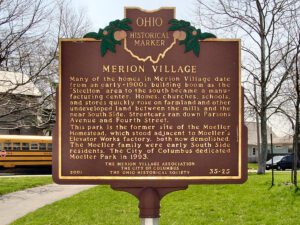
, OH
Merion Village was named for the Nathaniel Merion family, who in 1809 settled what is now the South Side of Columbus on 1800 acres of the Refugee Lands. Entrepreneur William Merion operated “Merion’s Landing” in the 1830s to capitalize on the canal trade from the Columbus Feeder Canal. This area saw a large influx of German immigrants as the South Side industrialized in the mid-nineteenth century. Later, many Irish, Italian, and eastern European immigrants who worked in the local steel mills and foundries made their homes here.
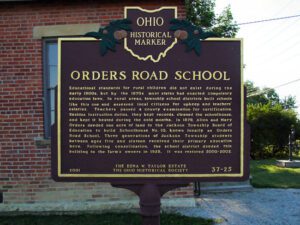
, OH
Educational standards for rural children did not exist during the early 1800s, but by the 1870s most states had enacted compulsory education laws. In rural areas, township school districts built schools like this one and assessed local citizens for upkeep and teacher’s salaries. Teachers passed a county examination for certification. Besides instruction duties, they kept records, cleaned the schoolhouse, and kept it heated during the cold months. In 1879, Allen and Mary Orders deeded one acre of land to the Jackson Township Board of Education to build Schoolhouse No. 10, known locally as Orders Road School. Three generations of Jackson Township students between ages five and sixteen received their primary education here. Following consolidation, the school district deeded this building to the farm’s owners in 1928. It was restored in 2000-2002.
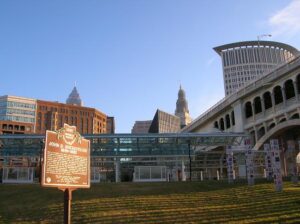
, OH
Born at Richford, New York, John D. Rockefeller moved to the Cleveland area with his family at age 14. He began his business career as a bookkeeper in 1855. From modest beginnings he became one of the richest men of his era by developing the world’s largest oil corporation, the Standard Oil Company, which was founded here in the Flats of Cleveland. Rockefeller moved to New York City in 1884 but maintained two homes in Cleveland, returning often with his wife Laura (1839-1915). Although he was a controversial businessman, Rockefeller donated millions of dollars to Cleveland charities and institutions, and land for Rockefeller and Forest Hills parks. John and Laura Rockefeller are interred in Lake View Cemetery.
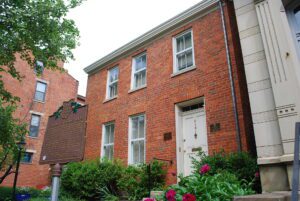
, OH
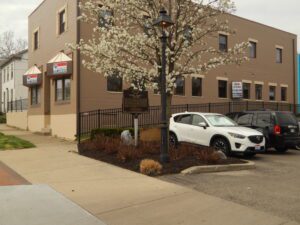
The oldest building in Cincinnati’s basin area, the Betts House exemplifies a national trend on the expanding frontier of impermanent log and frame structures giving way to more permanent brick architecture. It is the earliest surviving brick building in the city. During Cincinnati’s period of settlement in the early 1800s, the William and Phebe Betts family established a brickyard here that supplied building materials for the rapidly growing frontier city. The Betts House lends its name to the Betts-Longworth Historic District. Established in 1983, the district represents the last nineteenth century remnant of Cincinnati’s lower West End and surrounds the older Betts House with tall, narrow mid-and late-nineteenth century buildings. The Betts house is oriented to the cardinal directions, rather than to the city’s slightly skewed grid.
, OH
Raised and educated in St. Louis, author Fannie Hurst (1885-1968) was born in Hamilton at 918 Central Avenue, the home of her maternal grandparents. She was the daughter of Rose Koppel and Samuel Hurst. Already a writer as a student at Washington University (Class of 1909), Fannie moved to New York in 1910 to begin her career. Success came after repeated rejection. Stories for popular magazines brought her attention in the mid-1910s; by the mid-1920s she had become a best-selling, highly-regarded, and well-paid author. Between 1912 and 1964, Hurst wrote 18 novels, eight short story collections, and many other pieces. Hurst’s short story “Humoresque” (1919) and the novels Back Street (1931) and Imitation of Life (1933) were three of 32 films based on her writings. The film adaption of Imitation of Life received an Oscar nomination for Best Picture in 1934. (Continued on other side)
, OH
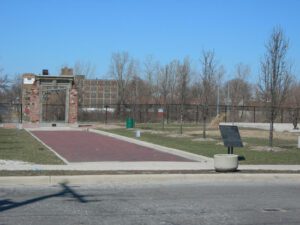
In 1934, workers at the Electric Auto-Lite Company and other automotive-related manufacturers secretly organized the Automobile Workers Federal Union Local 18384, American Federation of Labor (AFL), which became the United Auto Workers (UAW) Local 12. Anti-unionism, broken pledges by management, and abuse of workers had festered locally for generations. Workers bitterly resented the fact that management took advantage of the Depression’s high unemployment to decrease wages. In February, workers struck at Auto-Lite, Bingham Stamping, Logan Gear, and Spicer Manufacturing Company. When management refused to negotiate in good faith, the workers, including a large number of women, struck the Auto-Lite in mid-April. Auto-Lite management secured a court order limiting the number of strikers to twenty-five. The strike appeared to be lost until the Lucas County Unemployed League organized fierce resistance to the court injunction as the crowd around the plant grew to ten thousand. (continued on other side)
, OH
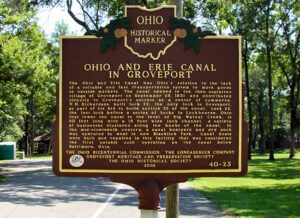
The Ohio and Erie Canal was Ohio’s solution to the lack of a reliable and fast transportation system to move goods to outside markets. The canal opened in the then unplatted village of Groveport on September 25, 1831 and contributed directly to Groveport’s success as a center of commerce. W.H. Richardson built lock 22, the only lock in Groveport, as part of his bid to build section 52 of the canal. Lock 22, the last lock before a series of locks in Lockbourne, Ohio that lower the canal to the level of Big Walnut Creek, is 90 feet long with a 15 foot wide lock channel. A variety of businesses clustered along the banks of the canal. In the mid-nineteenth century, a canal boatyard and dry dock was operated in what is now Blacklick Park. Canal boats were built and repaired in this facility that was considered the first notable such operation on the canal below Baltimore, Ohio.
, OH
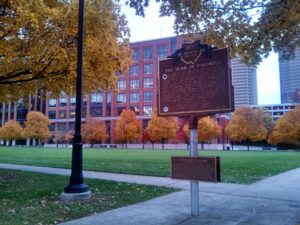
Thousands of Irish immigrants came to Columbus to seek personal and religious freedom. With the “Great Hunger” in Ireland and the completion of the Ohio and Erie Canal and the National Road, immigration to Columbus increased in the mid nineteenth century. They initially settled in the north side of the city in the swamp flats, where inexpensive land was available and work could be had on the railroads. Settlement spread to Franklinton, on Naghten Street, later known as “Irish Broadway”- part of which is now Nationwide Boulevard, and to nearby Flytown. The immigrants became domestic workers, civil servants, entrepreneurs, and served the city in police and fire departments. Others were leaders in government, law, medicine, and education. Their legacy continues today in the Irish-American population of Columbus, Ohio.