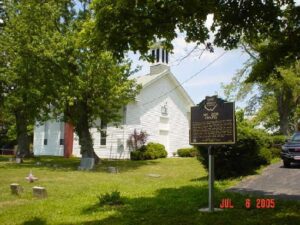
The Mount Zion Chapel of the Christian Church was built in 1872 on this hill adjacent to the members’ cemetery outside of Clermontville. The site was part of a two-acre parcel that had been secured from the farm of William R. Clark, Sr. for church and cemetery purposes. The Mount Zion Chapel replaced the Boat Run Christian Church that was organized in 1842 by a sect called the Christians, or the New Lights. Their first meeting house in Clermontville was dedicated on June 4, 1843 and damaged by floods in 1871. Worship was first held in the new frame church with the new name on October 6, 1872 and the church remains active today.
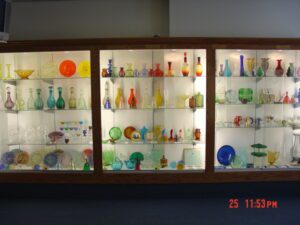
With ready access to raw materials, fuel, skilled labor, and transportation, the Ohio Valley became the center of the American glass industry during the late 1800s. Among dozens of local manufacturers, the Imperial Glass Company, founded in 1901 by river man and financier Edward Muhleman, first made glass in 1904 and distinguished itself for mass production of attractive and affordable pressed glass tableware using continuous-feed melting tanks. One of the largest American handmade glass manufacturers during the 20th century, Imperial also produced blown glass, several lines of art glass, and its trademark “Candlewick” pattern. Bellaire’s glassmaking era ended when the “Big I” closed its doors in 1984, and the building was razed in 1995. Its diverse products remain highly prized by glass collectors.
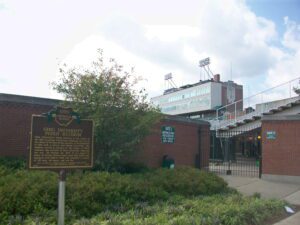
Ohio University’s Peden Stadium is the oldest of the Mid-American Conference stadiums and one of the oldest of its type in the country. It was dedicated in 1929 with a victory over Miami University. The stadium served as housing for the influx of WWII veterans who enrolled at Ohio University following the war. On October 22, 1960, it was named in honor of former Bobcat head coach Don Peden who coached from 1929 to 1946 and compiled a record of 121 wins, 46 losses, and one tie.
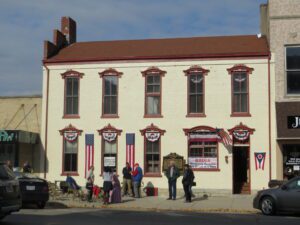
This mid-19th-century structure, built in the Federal style with Italianate detail added later, was once owned by town pioneer and merchant Cornelius Van Ausdal. It was later the home of his daughter Lucinda, her husband Joseph Donohoe, and their four children. Presidential candidate William Henry Harrison reportedly stayed here while he was in Eaton to deliver a campaign speech on September 8, 1840. Lucinda Donohoe reputedly also hosted circuit-riding preachers here and owned the area’s first piano. From 1938 to 1966, this building housed Mrs. Wagner’s Colonial Kitchen, a nationally recognized restaurant.
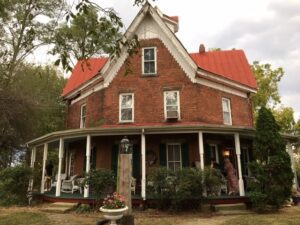
Zimmerman-Bury Octagon House. The Zimmerman-Bury Octagon House was built by Ezekiel B. Zimmerman (1843-1935) and Francis B. Hess Zimmerman (1848-1920) in 1883. Ezekiel graduated from Smithville Academy and was an avid reader. One of Ezekiel’s sons, Ernest Zimmerman (1888-1973), remembered that his father had encountered Orson Fowler’s manifesto A Home for All, or the Gravel Wall and Octagon Mode of Building (1853) and surmised that his father patterned the house after Section V of the book. The approximate 99,000 bricks comprising the house were made on the property, creating exterior walls and a center stairway which are three bricks or about 12 inches thick. Ernest noted the house’s “Russian Tin” roof, referring to its metal standing seam construction. The roof and architectural ornament make the house stand out compared to other octagon structures in Ohio. (Continued on other side)
Intersection of National Road (U.S. 40) and Old National Road
Morristown
, OH
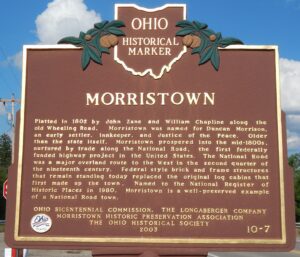
Platted in 1802 by John Zane and William Chapline along the old Wheeling Road, Morristown was named for Duncan Morrison, an early settler, innkeeper, and Justice of the Peace. Older than the state itself, Morristown prospered into the mid-1800s, nurtured by trade along the National Road, the first federally funded highway project in the United States. The National Road was a major overland route to the West in the second quarter of the nineteenth century. Federal style brick and frame structures that remain standing today replaced the original log cabins that first made up the town. Named to the National Register of Historic Places in 1980, Morristown is a well-preserved example of a National Road town.
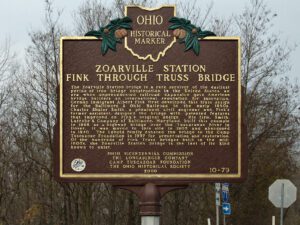
The Zoarville Station Bridge is a rare survivor of the earliest period of iron bridge construction in the United States, an era when unprecedented railroad expansion gave American bridge builders an international reputation for innovation. German immigrant Albert Fink first developed this truss design for the Baltimore & Ohio Railroad in the early 1850s. Charles Shaler Smith, a prominent civil engineer and Fink’s former assistant, designed the bridge with patented features that improved on Fink’s original design. His firm, Smith, Latrobe & Company of Baltimore, Maryland, built this example in 1868 as a highway bridge over the Tuscarawas River in Dover. It was moved to this site in 1905 and abandoned in 1940. The Lebold family donated the bridge to the Camp Tuscazoar Foundation in 1997 for preservation and restoration. Of the hundreds of Fink Truss bridges built in the mid-1800s, the Zoarville Station Bridge is the last of its kind known to exist.
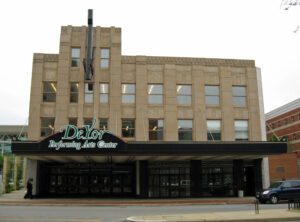
The Warner Brothers – Harry, Albert, Sam, and Jack – were members of a Jewish immigrant family from Poland that settled in Youngstown in the mid-1890s. The brothers attended local schools and worked in their father’s shoe repair shop and meat market before entering the motion picture business. They purchased a projector and opened the first of several theaters in the Mahoning Valley in 1905. The brothers left Youngstown for New York and Hollywood as their company developed into an industry leader. Warner Brothers Pictures, founded in 1923, released Don Juan in 1926, the first “talking picture” using Vitaphone technology. On May 14, 1931, the family gathered in Youngstown to dedicate a luxurious new Warner Theater to the people of the city where it all started, and to memorialize Sam, who died in 1927.