The Hines Farm Blues Club started on this site in 1949 as a party in Frank and Sarah Hines’s basement. The Club grew to become one of Ohio’s premiere blues and rhythm & blues venues until closing in 1976. A virtual “Who’s Who of African-American Artists” played here, first in a picnic shelter in the woods and then in the main building, erected in 1956. “Mr. Luke’s Outdoor Pavilion” that doubled as a skating rink was the last major addition. Holding as many as a thousand fans, Count Basie and his entire orchestra marked its opening with a performance under the stars in August 1961. Bobo Jenkins, Little Esther Phillips, B.B. King, Jimmy Reed, Buddy Lamp, and John Lee Hooker were among the musical greats who played Hines Farm. Important local blues artists Big Jack Reynolds, Curtis Grant, and the Griswold Brothers were regulars as well. (continued on other side)
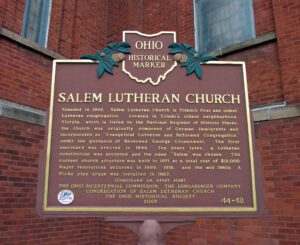
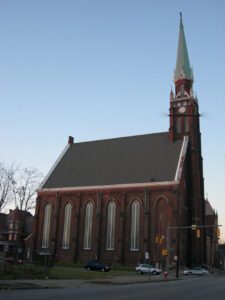
Founded in 1842, Salem Lutheran Church is Toledo’s first and oldest Lutheran congregation. Located in Toledo’s oldest neighborhood, Vistula, which is listed on the National Register of Historic Places, the church was originally composed of German immigrants and incorporated as “Evangelical Lutheran and Reformed Congregation” under the guidance of Reverend George Cronenwett. The first sanctuary was erected in 1844. Ten years later, a Lutheran constitution was accepted and the name “Salem” was chosen. The current church structure was built in 1871at a total cost of $12,000. Major renovations occurred in 1889, 1916, and the mid 1960s. A Wicks pipe organ was installed in 1967. (continued on other side)
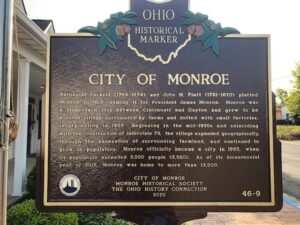
Nathanial Sackett (1768-1854) and John H. Piatt (1781-1820) platted Monroe in 1817, naming it for President James Monroe. Monroe was a stagecoach stop between Cincinnati and Dayton and grew to be a rural village surrounded by farms and dotted with small factories, incorporating in 1907. Beginning in the mid-1950s and coinciding with the construction of Interstate 75, the village expanded geographically, through the annexation of surrounding farmland, and continued to grow in population. Monroe officially became a city in 1995, when its population exceeded 5,000 people (5,380). As of its bicentennial year of 2017, Monroe was home to more than 13,000.
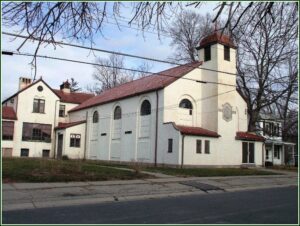
Construction for the current St. Anthony Church began in 1890 after the original wood-frame church became too small to serve the steadily growing congregation of Polish immigrants coming into the Toledo area. Completed in 1894, St. Anthony was the second Polish church built in Toledo and became known as the “mother” church for the local Polish community serving as many as 8,000 parishioners piror to the 1970s. The first Mass was celebrated on March 4, 1894. (continued on other side)
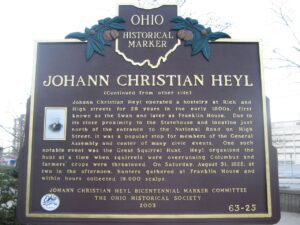
Johann Christian Heyl (1788-1877), the first German and first Lutheran to settle in Columbus, was one of the original 15 settlers of the city. A baker by trade, Heyl came to bake for the soldiers quartered in Franklinton during the War of 1812. He founded the city’s first Lutheran Church and helped financially underwrite the German Theological Seminary, which later became Capital University. An early civic leader, Heyl served on City Council for 14 years, was County Treasurer for 8 years, an associate judge in the Court of Common Pleas for 14 years, was appointed to the first public school board, and was the first Chief of the Fire Department. His Sunbury Road home was a stop on the Underground Railroad. (continued on other side)
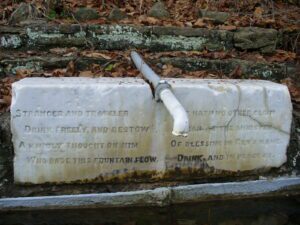
This spring fed watering trough was erected by Giles Richards (1792-1876) in 1867 and has provided water to travelers and livestock ever since. Richards owned and operated a number of enterprises in Colerain Township starting in the early 1800s. Upon the marble slab just above the iron trough is engraved: Stranger and traveler Drink freely and bestow A kindly thought on him Who bade this fountain flow Yet hath no other claim Than as the minister Of blessings in God’s name Drink and in peace go
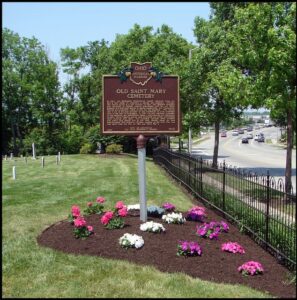
In 1801, the Springdale Presbyterian Church acquired these two and a half acres to construct a church and cemetery. Although the church moved to a new location in 1833, the cemetery remained and continued to receive regular internments until the mid 1950s. Because of a continued decline in church membership, the Presbyterian Church was eventually unable to care for the cemetery. The church felt it was in the best interest of the community to turn ownership over to the City of Springdale. In 1987, the city received ownership of the cemetery and immediately began a maintenance and restoration project. Many forgotten graves were uncovered and broken gravestones were restored and reset. The cemetery contains seven hundred and thirty nine graves and is the final resting place for nine Revolutionary War veterans, thirteen veterans of the Civil War, and one each from the War of 1812 and World War I.
Eckstein Elementary School operated on this site from 1915 to 1958, serving Glendale’s Negro children from Kindergarten through eighth grade. The school was named in honor of Eleanor Eckstein, who taught the children at various locations in the village during the time of segregation in America. Upon completing eighth grade, Eckstein School’s students were integrated with their white counterparts in grades nine through twelve at Congress Avenue School. The Eckstein School building evolved from a single family dwelling into its present structure through a series of expansions, the last of which was the addition of the gymnasium in 1928. In the mid-1950s Glendale became a part of the Princeton School District. A new consolidated high school opened in 1958, the Congress Avenue School became Glendale Elementary, and Eckstein was closed. This commemorative text was composed by alumni of the Eckstein School.