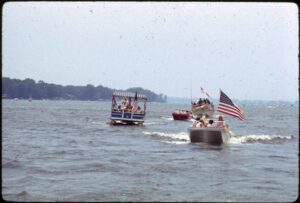
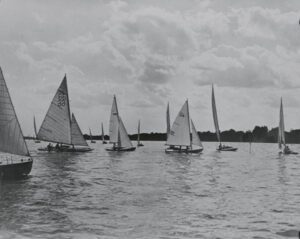
Using a four-mile long dam, the state of Ohio impounded the Licking Summit Reservoir in the mid-1820s to supply water for the Ohio and Erie Canal. In 1894, the state renamed it Buckeye Lake and developed it for recreational use. The Columbus, Buckeye Lake, and Newark Traction Company developed an “electric park” here, bringing in excursionists on interurban cars between 1904 and 1929 and creating one of the region’s most popular resorts. Hotels and summer cottages proliferated on leased ground. Nine acres in size, the park featured daily free admission during the summer. (continued on other side)
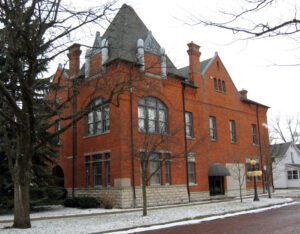
Completed in 1892 at the height of the region’s oil boom, the Pemberville Town Hall followed a late-1800s municipal trend to house many civic functions under one roof. The fire station, jail, and council chambers occupied the ground level, while the entire second floor hosted a public auditorium, or “opera house,” that seated 250. The 1897 debut of The Mikado featured new electric lighting. The ornate Opera House was the center of Pemberville’s social activities for decades, hosting dances, plays, socials, graduation ceremonies, political meetings, lectures, and husking bees. Traveling companies performed concerts, vaudeville, minstrel, and medicine shows. Following World War II the Opera House fell into disuse. It was restored in 1999 to both its former grandeur and its place in Pemberville’s cultural life.
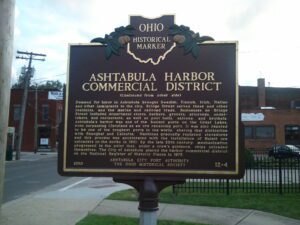
When the Pittsburgh, Youngstown and Ashtabula Railroad was finished in 1873, Ashtabula’s harbor became a direct route to ship iron ore to the booming steel mills of Youngstown and Pittsburgh. On the west side of the Ashtabula River, a brush-filled gulley became Bridge Street. New buildings and bridges attest to the harbor’s importance as a commercial and shipping hub from the late 19th through mid 20th centuries. Fires destroyed wood-frame buildings on the block closest to the river. A fire in 1886 nearly cleared the north side of Bridge Street. Another fire swept over the south side in 1900. Fire resistant brick buildings replaced frame structures and over the course of rebuilding, the level of the street rose approximately eight feet. In 1889, a swing-span bridge replaced the original pontoon bridge over the river. A bascule lift (draw) bridge replaced the swing bridge in 1925.
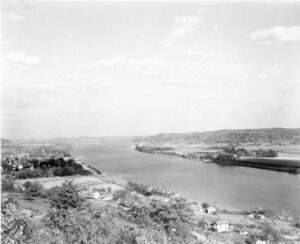
On April 1, 1818, six families from the Cilcennin area of Mid-Wales sailed from Aberaeron, Wales to Baltimore. The group of 36 people was led by John Jones Tirbach. From Baltimore they traveled to Pittsburgh and then by flatboats down the Ohio River toward their destination-Paddy’s Run in Butler County in the southwest corner of Ohio. They stopped in Gallipolis for provisions where their boats were cut loose by either travel-weary women or citizens of Gallipolis who wanted them to stay. The men found work on the Gallipolis to Chillicothe road that was under construction. The terrain reminded them of Mid-Wales, so they purchased land near Centerville and remained. These Welsh prospered and wrote home to Wales with news of their success, prompting others to come. (continued on other side)
On July 3, 1872, 16 men and a 9-year old boy descended the 170 foot shaft in the Atwater Coal Company Mine located in Atwater Township south of Route 224 and East of Route 225. The mine was situated on the property known as the S.G. Shaffer Farm. By mid-day, 7 miners survived the brutal fire in the mine. Richard Roberts, Robert Roberts, William Roberts, Thomas Maines, Joseph Otey, John Williams, John Howells, John Jones and 9-year old George Hufford gave their lives to the first Mining Disaster in Ohio and the 19th mining disaster in the United States since 1839 with more than 5 fatalities. In 1873, Ohio was the second State to pass a law for the safety of Miners.
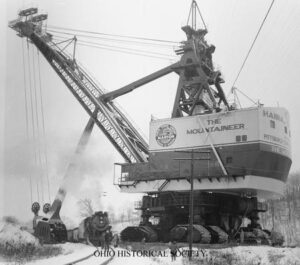
The Marion Steam Shovel Company built the primary tools for America’s civil engineering for more than 100 years. Founded in 1884 by Henry M. Barnhart, George W. King, and Edward Huber, the company’s patent steam shovels helped revolutionize railway and road construction, and were used in the building of the Panama Canal, Hoover Dam, and the Holland Tunnel. “The Shovel” also built ditchers, log loaders, dredges, and draglines, including some of the largest land vehicles ever built. The first electric machine was built in 1915, but it was not until 1946 that the name was changed to Marion Power Shovel. In the mid-twentieth century, “The Shovel” employed 2,500 workers. In the 1960s, the National Aeronautics and Space Administration selected Marion to build the crawlers that transport spacecraft to their launch pads. Hundred-year rival Bucyrus International acquired and closed the company in 1997.
Formed by the retreating glacier more than 14,000 years ago, Buckeye Lake first existed as a shallow, swampy pond, named “Buffalo Swamp” by Ohio Company explorer Christopher Gist in 1751. Beginning in 1826 the State developed it as a water source for the Licking Summit of the Ohio and Erie Canal, it being the highest level between the Scioto and Licking rivers. Engineers dammed the north and west sides of the swamp, inadvertently creating a unique floating sphagnum-heath bog surrounded by water. Cranberry Bog, with boreal vegetation typical of glacial-era Ohio, is a registered National Natural Landmark. (continued on other side)
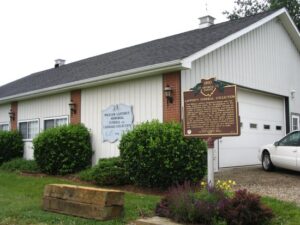
The William Lafferty Memorial Funeral and Carriage Collection shows the development of the funeral business since the mid-1800s through an exhibit of caskets, funeral clothing, and hearses collected and preserved by James William Lafferty (1912 – 1987). William was a member the fourth generation of Laffertys to serve West Union and Adams County. Characteristic of the early history of the profession, William Voris (W.V.) Lafferty (1830-1922) founded the business in 1848 to meet the demand for caskets, which he, as a furniture and cabinetmaker, was often asked to build. (Continued on other side)