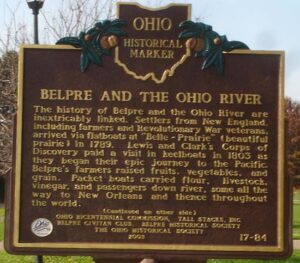
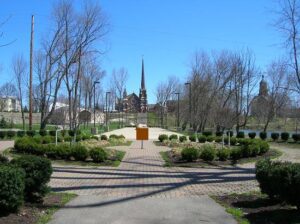
The history of Belpre and the Ohio River are inextricably linked. Settlers from New England, including farmers and Revolutionary War veterans, arrived via flatboats at “Belle-Prairie” (beautiful prairie) in 1789. Lewis and Clark’s Corps of Discovery paid a visit in keelboats in 1803 as they began their epic journey to the Pacific. Belpre’s farmers raised fruits, vegetables, and grain. Packet boats carried flour, livestock, vinegar, and passengers down river, some all the way to New Orleans and thence throughout the world. (Continued on other side)
One of America’s most inventive twentieth century writers, Kenneth Patchen was born in Niles and graduated Warren G. Harding High School in 1929. He first published his poetry while studying at an experimental college at the University of Wisconsin in 1929. A pacifist deeply concerned with the human condition in mid-twentieth century America, Patchen blended linguistic and visual elements to create avant-garde works that defied literary conventions of the period, presaging both the “beat” and “concrete” movements of the 1950s. The Journal of Albion Moonlight (1941) and Hallelujah Anyway: Picture Poems (1966) are among the best known of his more than forty works of poetry, prose, and drama.
The Ghent Woolen Mill was one of at least thirteen mills built in the Yellow Creek Valley to take advantage of the water power available in the creek’s 400-foot fall across Bath Township. Erected by Messrs. Allen and Bloom in 1832, it was a marginal commercial success and changed hands several times during the 1800s – reportedly because an abundant wolf population in this region made raising sheep a risky venture. In its peak years of operation during the Civil War era the Ghent mill processed as much as 10,000 pounds of wool into finished cloth and yarn annually. It was converted to a machine shop circa 1889 and subsequently into private residences in the late 1890s. The oldest known woolen mill still standing in Ohio, it retains many of its original architectural features.
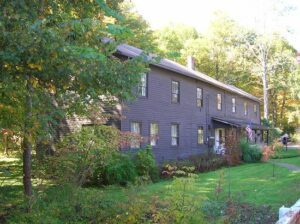
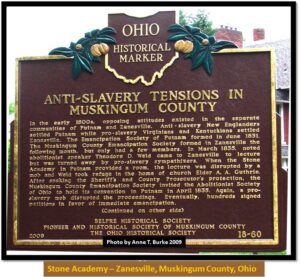
In the early 1800s, opposing attitudes existed in the separate communities of Putnam and Zanesville. Anti-slavery New Englanders settled Putnam while pro-slavery Virginians and Kentuckians settled Zanesville. The Emancipation Society of Putnam formed in June 1831. The Muskingum County Emancipation Society formed in Zanesville the following month, but only had a few members. In March 1835, noted abolitionist speaker Theodore D. Weld came to Zanesville to lecture but was turned away by pro-slavery sympathizers. When the Stone Academy in Putnam provided a room, the lecture was disrupted by a mob and Weld took refuge in the home of church Elder A.A. Guthrie. After seeking the Sheriff’s and County Prosecutor’s protection, the Muskingum County Emancipation Society invited the Abolitionist Society of Ohio to hold its convention in Putnam in April 1835. Again, a pro-slavery mob disrupted the proceedings. Eventually, hundreds signed petitions in favor of immediate emancipation. [continued on other side]
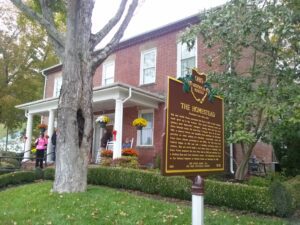
The Homestead was built in 1820 by Nehemiah Wood with an addition completed in 1822 by his son, Harrison. The Wood family, a pioneer family of Gallia County, arrived in 1805. The Homestead remained in the Wood family for over 100 years. The two-story Federal style building is constructed of bricks made on site by freed slaves who accompanied Nehemiah Wood from Virginia. The lane just below the house was a stagecoach route that ran between Chillicothe and Gallipolis. In the mid-1800s the Homestead served as an inn and stagecoach stop. The Wood family sold the farm to Rio Grande College in 1938 which used the land for college gardening and farming programs. (Continued on other side)
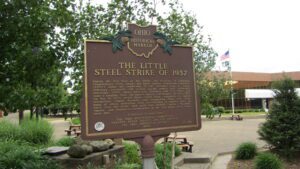
During the New Deal of the 1930s, the Congress of Industrial Organizations (CIO) formed the Steel Workers Organizing Committee (SWOC) under the leadership of CIO president John L. Lewis. Following successful CIO strikes in the rubber and automobile industries, SWOC signed hard-won contracts with U.S. Steel and Jones & Laughlin Steel, the nation’s largest steelmakers, in early 1937. On May 26 SWOC struck three “Little Steel” companies for similar recognition: Inland, Republic, and Youngstown Sheet and Tube, many of whose operations were concentrated in eastern Ohio. By early June the strike idled more than 28,000 Canton, Massillon, Warren, and Youngstown steelworkers in the first major steel strike since 1919. (continued on other side)
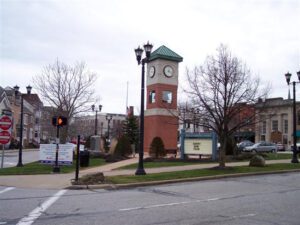
The Triangle, one of the most historic places in Berea, has been the center of the city’s civic life since the mid-19th century. Just beneath lie the solid layers of the famous Berea Sandstone that brought prosperity to Berea during its early years. Quarry owner and Berea Seminary founder John Baldwin obtained much of what is now Berea from Gideon Granger, Postmaster General under President Thomas Jefferson and original owner of Township 6, Range 14 (later Middleburg Township) of the Western Reserve. When the seminary trustees transferred the Triangle tract to the people of Berea in 1847, they designated it by deed as a public promenade. This farsighted stipulation preserved it from commercial development during the 20th century. (continued on other side)
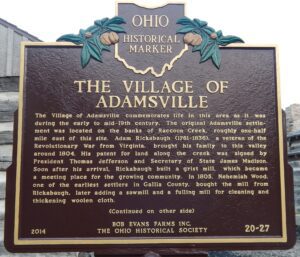
The Village of Adamsville commemorates life in this area as it was during the early to mid-19th century. The original Adamsville settlement was located on the banks of Raccoon Creek, roughly one-half mile east of this site. Adam Rickabaugh (1761-1836), a veteran of the Revolutionary War from Virginia, brought his family to this valley around 1804. His patent for land along the creek was signed by President Thomas Jefferson and Secretary of State James Madison. Soon after his arrival, Rickabaugh built a grist mill, which became a meeting place for the growing community. In 1805, Nehemiah Wood, one of the earliest settlers in Gallia County, bought the mill from Rickabaugh, later adding a sawmill and a fulling mill for cleaning and thickening woolen cloth. (Continued on other side)