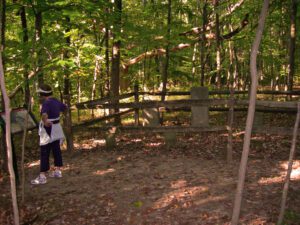
Congress established the United States Military District in 1796 by an act to provide bounty land for Revolutionary War officers and soldiers. District lands consisted of 2.6 million acres in twelve Ohio counties, including Delaware County. The Union Land Company, organized by James Kilbourne of Connecticut in 1806, was formed to purchase Military District land. Kilbourne purchased 4,000 acres in southeast Liberty Township, Delaware County for $7,000, and, in turn, sold the land to 26 Union Land Company members for $2.00 per acre. Five members were from the Case family, and they purchased 950 acres–Ambrose, George, Jonathan, Seth, and Silas. George and Seth were Revolutionary War veterans who did not claim their bounty lands. George purchased lot 11, a part of which is in northwest Highbanks Park today, and Seth purchased 300 acres north of this site. By 1849 the Case family owned over 1,000 acres.
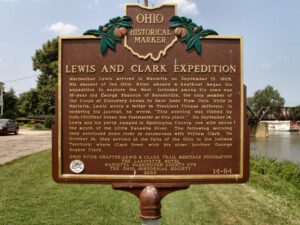
Meriwether Lewis arrived in Marietta on September 13, 1803. His descent of the Ohio River aboard a keelboat began his expedition to explore the West. Included among his crew was 18-year old George Shannon of Barnesville, the only member of the Corps of Discovery known to have been from Ohio. While in Marietta, Lewis wrote a letter to President Thomas Jefferson. In updating his journal, he wrote,”This evening was visited by Colo. [Griffen] Green the Postmaster at this place.” On September 14, Lewis and his party camped in Washington County, one mile above the mouth of the Little Kanawha River. The following morning they continued down river to rendezvous with William Clark. On October 14, they arrived at the Falls of the Ohio in the Indiana Territory, where Clark lived with his older brother George Rogers Clark.
Marathon Center for the Performing Arts, 200 W. Main Cross Street
Findlay
, OH
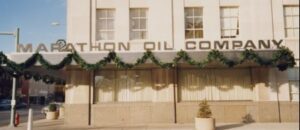
Site of the first Findlay Field Office for what was to become a world-wide oil company, formerly locally owned and operated. 1887: The Ohio Oil Company was incorporated by five independent oil producers in the Lima field. 1901: J.C. Donnell elected President of the Ohio Oil Company. Company’s ‘big well,’ the “Hugh McMurray,” comes in. 1929: Construction begins on new office building at South Main Street and Hardin Streets. 1962: Name changed to Marathon Oil Company to reflect international operations.
In 1810, early settlers here were Major Amos Spafford (1753-1818), his wife Olive (1756-1823), and their children Samuel, Aurora , Chloe (Mrs. Almon Gibbs), and Anna (Mrs. Richard Craw). In 1796, Spafford, a native of Connecticut, was a surveyor for the Connecticut Land Company. He drew the first map laying out Cleveland and named the city. He left there in 1810 following appointment as custom’s collector and postmaster for the new port at the foot of the Maumee River rapids, Port Miami of Lake Erie. Spafford was granted a 160 acre land patent on River Tracts #64 and #65 in Waynesfield township, signed by President James Monroe and was able to purchase it following the 1817 Treaty of the Rapids that extinguished Native American claim. Two years later, 67 families lived in the area, but most fled at the outbreak of the War of 1812.
One of the earliest and largest amusement parks in Northwest Ohio dedicated in 1906 on site of old waterworks. Trains brought visitors from as far away as Cleveland. 1907: Dance Pavilion and 2,000 seat auditorium built. 1908: Bathing beach made in old reservoir. 1925: Green Mill Dance Hall built on side near dam. Big name bands highlight entertainment. 1936: Shelters, band shell, and pool bath house made from bricks of old waterworks. 1978: Renovation of waterfront begins new era.
During the War of 1812, Northwestern Army Commander General William Henry Harrison led troops through northwest Ohio on the way to Detroit and Ft. Malden in Michigan. After the decimation of General James Winchester’s division at Frenchtown (Monroe, Michigan) by British and Indian forces, Harrison retreated and led his troops southward to the Portage River. Near this site, now the William Henry Harrison Park, Harrison’s men waited for supplies and reinforcements, which were delayed due to heavy rains and flooding in the Black Swamp. With the addition of General Leftwich’s brigade at the end of January 1813, Harrison’s forces reached approximately 1,700. The troops endured the harsh, wet weather and several soldiers died of exposure and were buried at the camp. Once the winter freeze set in, Harrison led the remaining troops to the rapids of the Maumee River where construction of Fort Meigs began.
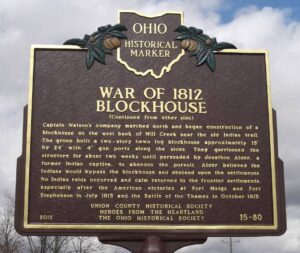
Following the American surrender of Fort Detroit in August 1812, panic spread along the Ohio frontier in fear of possible Indian attacks. The boundary of the Indian territory lay approximately 14 miles to the north at the Greenville Treaty line. Ohio Governor Return Jonathan Meigs, Jr. called out the Ohio Militia to defend the frontier and to construct blockhouses to guard against Indian attacks. A local militia company of 70 men was raised in present Union and Madison Counties to protect the settlements along Big Darby Creek. David Watson served as captain with Frederick Lloyd as first lieutenant.
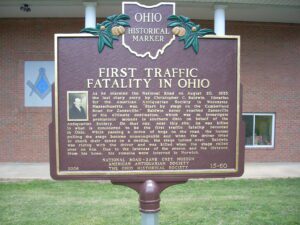
As he traveled the National Road on August 20, 1835, the last diary entry by Christopher C. Baldwin, librarian for the American Antiquarian Society in Worcester, Massachusetts, was, “Start by stage on the Cumberland Road for Zanesville.” Baldwin never reached Zanesville or his ultimate destination, which was to investigate prehistoric mounds in southern Ohio on behalf of the Antiquarian Society. On that day, near this site, he was killed in what is considered to be the first traffic fatality recorded in Ohio. While passing a drove of hogs on the road, the horses pulling the stage became unmanageable and when the driver tried to check their speed on a decline, the stage turned over. Baldwin was riding with the driver and was killed when the stage rolled over on him. Due to the lateness of the season and the distance from his home, his remains were interred in Norwich.