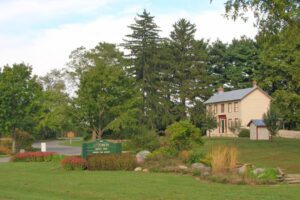
This area of western Hancock County is a part of the Maumee River Watershed known as “Indian Green.” Wyandot Indians chose this area for hunting and ceremonial grounds along the Blanchard River in the 1700s because it was next to the river, yet high enough to avoid frequent flooding. One-half mile east of this location is a Liberty Township cemetery. It is located upon a sand ridge once used as a burial ground by Indians, hence the name “Indian Green.”
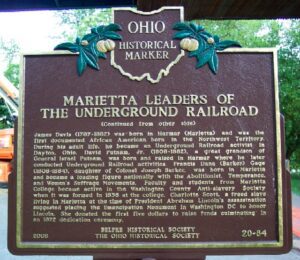
People living in Marietta and along the Muskingum River shared a history of slavery opposition. Manasseh Cutler, from Massachusetts and an Ohio Land Company agent, helped draft the Ordinance of 1787 that prohibited slavery in the Northwest Territory. General Rufus Putnam, Captain Jonathan Stone, and other Ohio Land Company Revolutionary War veterans, founded Marietta at the mouth of the Muskingum River in 1788 bringing with them their anti-slavery sentiments. A proposal to legalize slavery in the proposed state of Ohio was vetoed largely due to the efforts of Marietta’s Ephraim Cutler and General Putnam at the 1802 Ohio Constitutional Convention. These conditions were precursors toward the formation of the Underground Railroad as fugitive slaves crossed the Ohio River seeking freedom. From 1812 through 1861, large numbers of fugitive slaves fleeing toward Canada, were aided by descendants of early settlers who operated Underground Railroad Stations along the Muskingum River. (Continued on other side)
Near this site on July 4, 1825 ground was broken in Ohio for the National Road. The National Road was America’s first federally planned and funded highway and linked the east coast of the United States to Old Northwest Territory. Albert Gallatin, President Thomas Jefferson’s Secretary of the Treasury, conceived the idea for the road and advocated for it. Construction began in 1811 at Cumberland, Maryland, but was interrupted by the War of 1812. The road reached Wheeling in 1818, but was again delayed until 1825 because of debates over the constitutionality of federal funding for road and infrastructure projects. The National Road in Belmont County began at Bridgeport on the Ohio River and ran 28.5 miles to the western end of the county at Fairview.
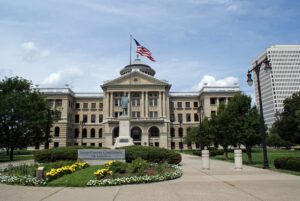
Lucas County was named for Governor Robert Lucas who championed Ohio’s cause in the “Toledo War,” a boundary dispute arising when both Ohio and the Michigan Territory claimed this area. The Ohio legislature created Lucas County on June 20, 1835. The first court session convened in a Toledo schoolhouse during the pre-dawn hours of September 7 to avoid the Michigan militia.
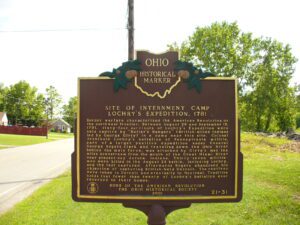
Border warfare characterized the American Revolution on the northwest frontier. Between August 26 and September 15, 1781, sixty-four survivors of Lochry’s Expedition were held captive by “Butler’s Rangers” (British-allied Indians led by George Girty) in a camp near this site. Colonel Archibald Lochry’s battalion of Pennsylvania militia, part of a larger punitive expedition under General George Rogers Clark and traveling down the Ohio River behind the main force, was attacked by Girty’s men ten miles downstream from the mouth of the Great Miami River near present-day Aurora, Indiana. Thirty-seven militiamen were killed in the August 24 battle, including Lochry, and the rest captured. Afterwards Rogers abandoned his objective of capturing British-held Detroit. The captives were taken to Detroit and eventually to Montreal. Tradition holds that fewer than twenty of Lochry’s battalion ever returned to their homes.
Frances Dana (Barker) Gage was born on October 12, 1808, in Marietta. She married James L. Gage in 1829 and they raised eight children, including four sons who served with Union forces during the Civil War. Throughout much of her life, Frances was deeply involved with the Temperance and Anti-Slavery movements and Women’s Rights issues. Presiding over the Women’s Rights Convention in Akron in 1851, she invited Sojourner Truth to give her famous “Ain’t I a Woman” speech. The Gage family moved in 1853 to St. Louis, the western extension of the Mason-Dixon Line, where her life was threatened whenever she spoke out against slavery. During the Civil War, she traveled south to aid Union soldiers and teach freed slaves. Though crippled and permanently disabled by a stroke, she continued to lecture on social issues until 1867. Frances Dana Gage died on November 10, 1884, in Greenwich, Connecticut.
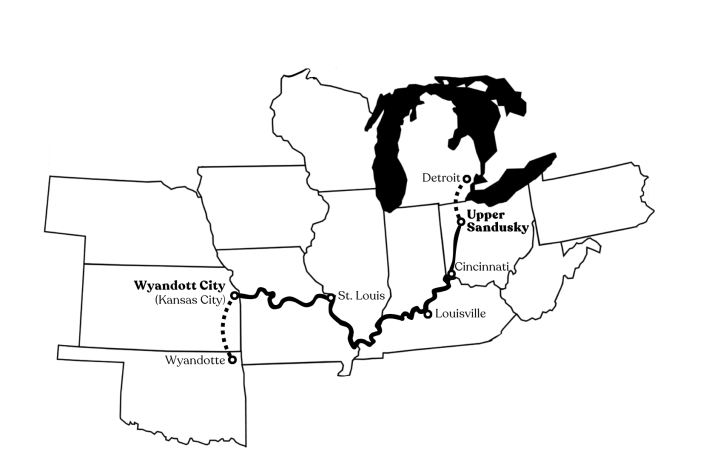
After decades of resistance and failed negotiations, the Wyandot were the last tribe removed from Ohio in 1843. Their removal route began on the Grand Reserve in Upper Sandusky and extended 150 miles to Cincinnati where nearly 700 Wyandots boarded steamboats bound for Kansas Territory. There, new settlers continued to place pressure on Wyandot lands. The Wyandotte Nation is now headquartered in Oklahoma.
The Black community of Gallipolis pooled their resources and expertise to open Gallipolis Union Colored School in 1868. Located on the northwest corner of Third Avenue and Olive Street, the public school offered primary education until, around 1877, a high school curriculum was added. In 1882, the first four students to graduate high school were W.H. Haskins, Minnie Battles, Idella Black, and Mary Nease. By 1890, the school had been renamed for President Abraham Lincoln. Valuing their public education, many Lincoln School graduates became teachers; of 33 high school graduates in the first 8 classes, 11 would become schoolteachers. Dr. Edward Alexander Bouchet (Principal 1908-1913) added an intellectual rigor to Lincoln’s curriculum. The nation’s first Black Ph.D., Bouchet earned a doctorate in physics from Yale University in 1876. (Continued on other side)