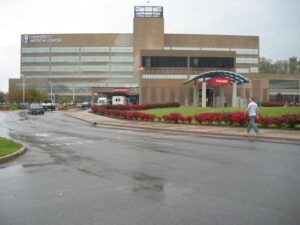
State interest in medical education for northwest Ohio became a reality when the Medical College of Ohio at Toledo was established in December, 1964. Located initially at South Detroit and Arlington on Lucas County property, MCO moved to the present 350-acre campus starting in 1972. It is the area’s first medical school since the closing of the Toledo Medical College (1882-1914).
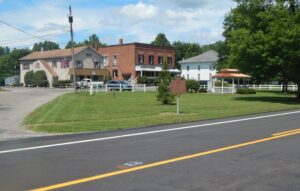
Originally called Westfield Township, Samuel Fowler purchased this area in 1798 from the Connecticut Land Company for $12,903.23 while living in Westfield, Massachusetts. His brother Abner arrived the following year to survey the land and separate it into smaller plots that could be sold to people wanting to settle here. A Revolutionary War veteran, Abner was the first to arrive here and also the first recorded death in 1806, the same year that his son Abner Fowler II married the first school teacher in Fowler Ester Jennings. In 1817, Samuel Fowler gave five acres of land to Fowler Center to be used as a park or “common” with the provision that no permanent building ever be built on it. At about the same time, the township name was changed to Fowler to honor its founding family. Agriculture was and remains the main occupation in the Fowler area.
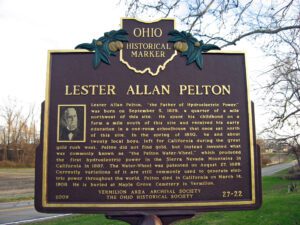
Lester Allan Pelton, “the Father of Hydroelectric Power,” was born on September 5, 1829, a quarter of a mile northwest of this site. He spent his childhood on a farm a mile south of this site and received his early education in a one-room schoolhouse that once sat north of this site. In the spring of 1850, he and about twenty local boys, left for California during the great gold rush west. Pelton did not find gold, but instead invented what was commonly known as “the Pelton Water-Wheel,” which produced the first hydroelectric power in the Sierra Nevada Mountains in California in 1887. The Water-Wheel was patented on August 27, 1889. Currently variations of it are still commonly used to generate electric power throughout the world. Pelton died in California on March 14, 1908. He is buried at Maple Grove Cemetery in Vermilion.
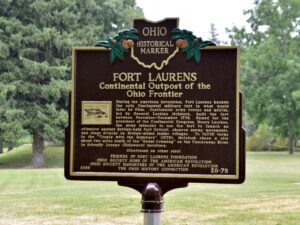
During the American Revolution, Fort Laurens became the only Continental military fort in what would later be Ohio. Continental army troops and militia, led by General Lachlan McIntosh, built the fort between November-December 1778. Named for the president of the Continental Congress, Henry Laurens, the army intended to use the fort to launch an offensive against British-held Fort Detroit, observe enemy movements, and stage attacks on British-allied Indian villages. To fulfill terms in the “Treaty with the Delaware” (1778), McIntosh chose a site about two miles south of the “Great Crossing” on the Tuscarawas River in friendly Lenape (Delaware) territory. (Continued on other side)
Abraham Lincoln spoke from the rear of a Cincinnati, Hamilton & Dayton Railroad passenger train on Saturday, September 17, 1859, to about 1000 people at South Fourth and Ludlow streets (about 785 feet south of here). Lincoln, elected president of the United States a year later, made five Ohio speeches, considered an extension of his 1858 debates with Stephen A. Douglas while they competed for a U.S. Senate seat from Illinois. After Douglas defeated Lincoln, he toured Ohio supporting 1859 Democratic candidates. The Republican response was to ask Lincoln to do the same for his party. He spoke twice in Columbus on September 16, and in Dayton, Hamilton, and Cincinnati the next day. Later, Republicans swept the 1859 elections, selecting William Dennison Jr., an 1835 Miami University graduate, as governor and winning majorities in the legislature. When Lincoln became president, he appointed Dennison postmaster general in 1864. [Continued on other side]
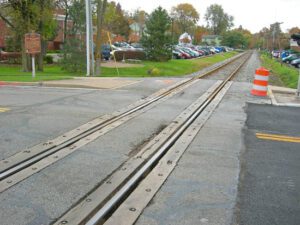
This rail line was the original route of the Erie and Kalamazoo Railroad, the first railroad to operate west of the Allegheny Mountains. The train made its initial run on October 3, 1836 from Toledo to Adrian, a total of approximately thirty miles. In 1837, a steam locomotive replaced horses as the train’s engine. The E. & K. R.R. opened markets from Lake Erie to the Michigan Territory.
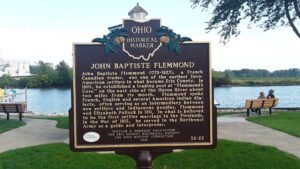
John Baptiste Flemmond (1770-1827), a French Canadian trader, was one of the earliest Euro-American settlers in what became Erie County. In 1805, he established a trading post at “Flemmond’s Cove” on the east side of the Huron River about two miles from its mouth. Flemmond spoke French, English and several American Indian dialects, often serving as an intermediary between new settlers and indigenous peoples. Flemmond wed Elizabeth Pollock in 1811, in what is believed to be the first settler marriage in the Firelands. In the War of 1812, he served in the Northwest Army as a guide and interpreter.
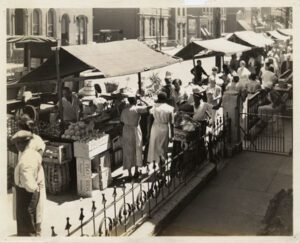
Public markets housing butchers, fish merchants, and produce vendors were once the primary source of perishable foods for residents of America’s cities. Cincinnati operated nine in 1859. Only Findlay Market, built here in 1852, survives. Cincinnati’s lost indoor markets include: Fifth Street Market: 1829 to 1870, Fifth between Vine and Walnut Wade Street Market: 1848 to 1898, corner of Wade and Bauer Avenue Canal Market: 1829 to 1864, Court between Vine and Walnut Court Street Market: 1864 to 1914, replaced Canal Market Jabez Elliott Flower Market: 1890 to 1950, Sixth between Elm and Plum Sixth Street Market: 1895 to 1960, Sixth between Plum and Western Row Pearl Street Market: 1901 to 1934, Market between Sycamore and Broadway