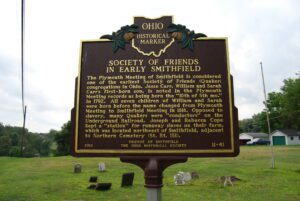
The Plymouth Meeting of Smithfield is considered one of the earliest Society of Friends (Quaker) congregations in Ohio. Jesse Carr, William and Sarah Carr’s first born son, is noted in the Plymouth Meeting records as being born the “10th of 5th mo.” in 1792. All seven children of William and Sarah were born before the name changed from Plymouth Meeting to Smithfield Meeting in 1818. Opposed to slavery, many Quakers were “conductors” on the Underground Railroad. Joseph and Rebecca Cope kept a “station” for runaway slaves on their farm, which was located northwest of Smithfield, adjacent to Northern Cemetery (St. Rt. 151).
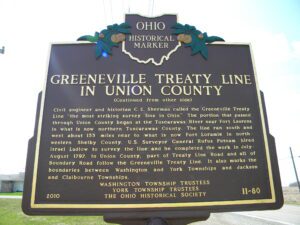
The Treaty of Greeneville created the Greeneville Treaty Line. It was the boundary between lands in the original possession of the Indians and those they ceded to the United States, which were south and east of the boundary. Major General “Mad” Anthony Wayne negotiated the treaty with the tribes his army defeated at the Battle of Fallen Timbers on August 20, 1794. Leaders of 12 tribes, including Wyandots, Delawares, Shawnees, Ottawas, and Miamis, signed the Treaty of Greeneville on August 3, 1795 with General Wayne, William Henry Harrison, and other representatives of the United States. Treaties that followed Greeneville up to the Treaty with the Miamis in 1818 extinguished the various tribes’ original claims and created Indian reservations on the lands northwest of the Greeneville Treaty Line, making it obsolete. (Continued on other side)
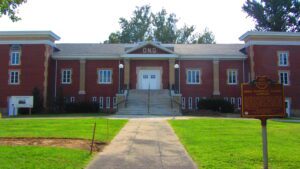
With a mission to protect citizens at home and aboard, the Ohio National Guard was originally established as the Northwest Territory Militia in Marietta on July 25, 1788, and has fought in every war since the War of 1812. Built in 1914, this Ohio National Guard Armory served both as Regimental and Company B, 7th Infantry, O.N.G. Headquarters. Later Company A, 166th Infantry, 37th Division, occupied the dual-purpose armory. The armory served Washington County as a departure point for soldiers leaving for service in World War I, World War II, and Korea. The armory also served the area in times of crisis and celebration, often used by the Red Cross, Marietta College, and other civic groups.
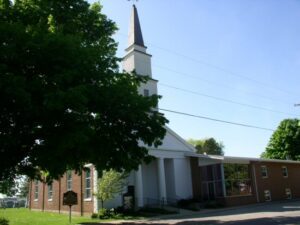
The founders of what would become the Kings Creek Baptist Church first met on June 29, 1805 in the log home of local residents James and Ann Turner. The Baptist congregation continued to meet in people’s homes until 1816 when Taylortown founder John Taylor donated an acre of land to establish a burying site and a meetinghouse. Constructed of logs, this meetinghouse is considered to be the third Baptist church built in Ohio and the Northwest Territory. The original structure was replaced by a more substantial brick building in 1832, and the present Kings Creek Baptist Church was built on the original foundation in 1849. The church features classic Greek design and a grand steeple inspired by the work of the English architect Sir Christopher Wren. An educational wing was added in 1969. (continued on other side)
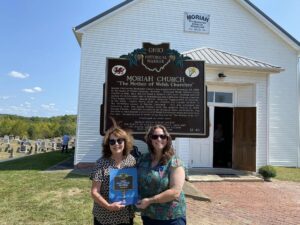
Moriah Calvinistic Methodist Church was organized on November 23, 1835, in the home of Daniel Edwards, Brynele. Although Welsh settled Gallia County in 1818, they did not build a church until more families arrived during the 1830s Welsh tide of immigration into Gallia and Jackson counties. They named their new church Moriah, meaning “appearance of Jehovah” in the Bible. Joshua Parry built the original log church in 1836 in the northwest corner of Moriah Cemetery. This was enlarged the following year and Enoch Thomas built the present church in 1846. Moriah Church, centrally located in the growing Welsh settlements, was the first in what became a circuit of 12 Welsh Calvinistic Methodist churches. For this, Moriah Church is known as Ein Mam ni oll or “the Mother of Us All.” (Continued on other side)
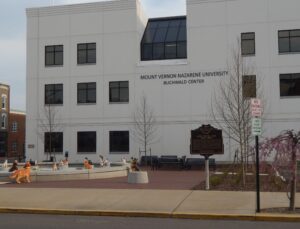
Side A: Jane Payne, M.D. (1825-1882). Dr. Jane Payne’s family migrated from Bristol, England in 1825. Her father Henry served as an Episcopal priest in Ohio, finally settling in Mount Vernon. Although her sight was impaired and she was challenged by infirmities left by childhood diseases and injuries, Payne resolved to be a physician. She began her studies with Dr. John W. Russell (1804-1887) in Mount Vernon. In 1861, she graduated first in what was the ninth class of the Woman’s Medical College of Pennsylvania in Philadelphia. Overcoming prejudices against female physicians, Dr. Payne practiced from 1861 to 1882. She showed special concern for municipal sanitation and care for the poor. Her office was located at northwest corner of South Main and West Gambier streets. Dr. Payne succumbed to cancer and is buried in Mound View Cemetery.
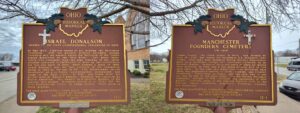
In May 1800, Congress passed an act dividing the Northwest Territory, with the western division becoming Indiana Territory and the eastern called the Territory of the United States northwest of the Ohio River. Two years later, thirty-five delegates from the nine counties of the latter division convened in Chillicothe to draw up the constitution for the new state of Ohio, which became a state in 1803. Israel Donalson was the last survivor of the convention dying in 1860 at the age of 93. This frontiersman served Manchester as a surveyor, schoolteacher, postmaster, and judge in the first court. In 1791, one month after his arrival here at Massie’s Station, Donalson was captured by Native Americans. His memoir is a colorful account of his capture and escape. Donalson served as an Elder for the first Presbyterian church in Adams County, which stood on these grounds.
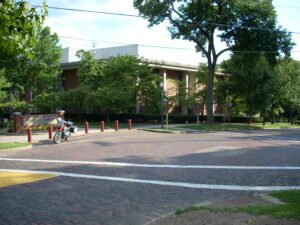
In April 1797, a committee of Marietta citizens, led by General Rufus Putnam, met to establish an academy suitable for preparatory instruction for their youth. Muskingum Academy, completed late that year, became the first institution of its kind in the Northwest Territory, providing “classical instruction… in the higher branches of an English education.” Its first instructor was David Putnam, a 1793 Yale graduate. The building also served as the home of the Congregationalist Church until 1808. Growing and expanding with Ohio’s first city, the academy served Marietta’s educational needs for more than thirty years as the forerunner of Marietta College.