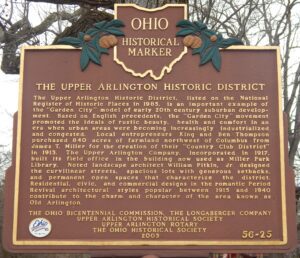
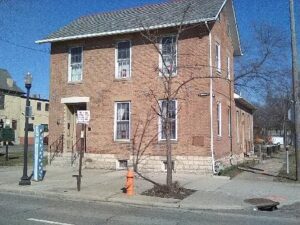
The Upper Arlington Historic District, listed on the National Register of Historic Places in 1985, is an important example of the “Garden City” model of early 20th century suburban development. Based on English precedents, the “Garden City” movement promoted the ideals of rustic beauty, health and comfort in an era when urban areas were becoming increasingly industrialized and congested. Local entrepreneurs King and Ben Thompson purchased 840 acres of farmland northwest of Columbus from James T. Miller for the creation of their “Country Club District” in 1913. The Upper Arlington Company, incorporated in 1917, built its field office in the building now used as Miller Park Library. Noted landscape architect William Pitkin, Jr. designed the curvilinear streets, spacious lots with generous setbacks, and permanent open spaces that characterize the district. Residential, civic, and commercial designs in the romantic Period Revival architectural styles popular between 1915 and 1940 contribute to the charm and character of the area known as Old Arlington.
Joseph F. Clunk, a blind Ohioan and an advocate for workforce development, inspired Toledo leaders in 1923 to serve their blind community. With cooperation from the Lions Club, Community Chest, Toledo Rotary Club, and Chamber of Commerce, the Toledo Society for the Blind was organized in November 1923. Its purpose, “to further the interest of the blind and to open to them all possible avenues to independence and self-support, through investigation, education, and recreation,” continues to guide The Sight Center. Generous donors, tireless volunteers, and dedicated staff helped the organization successfully navigate the Great Depression, war, societal change, and technological transformation. For more than a century of innovative training, classes, clubs, clinics, and assistive technology, The Sight Center continues to empower independence and enrich the lives of people who are blind or have low vision.
With five army camps in Columbus, Capitol Square was a military crossroads from 1861 to 1865. Ohio troops were mustered, paid, and on some occasions garrisoned at the Statehouse. Three of every five male Ohioans between the ages of 18 and 45 served in the Civil War. Ohio’s contribution to the war effort was enormous, supplying almost 320,000 soldiers to the Union Army, representing 230 regiments and 26 independent artillery batteries. More than 35,000 soldiers died during the war, and 30,000 more were disabled. One hundred forty-eight Ohio soldiers received the Congressional Medal of Honor for valor. Perhaps Ohio’s greatest contribution to the war was to the Union leadership that won it: Generals Ulysses S. Grant, William Tecumseh Sherman, Philip H. Sheridan, and James B. McPherson, as well as Secretary of War Edwin Stanton and Secretary of the Treasury Salmon Chase, were all Ohioans.
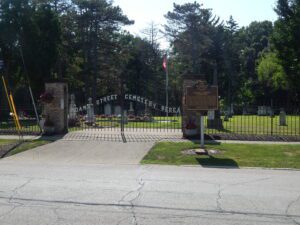
Known as the “Village Cemetery,” this was Berea’s main burial ground from 1834 to the 1880s. However, in 1886, the Cleveland Stone Co. purchased quarries adjacent to the cemetery, where Coe Lake is today. Quarrying had already caused flooding and landslides in the area. Local stories say that the company operated too near to the edge of cemetery, causing a landslide in the northwest corner that exposed some graves. Worried families moved their loved ones’ remains to other cemeteries, including those of five Civil War veterans. Pioneering families, 16 Civil War veterans, 3 mayors of Berea, several quarry owners, and many ordinary people still rest here. Of the original 589 burials, 40% were children. (Continued on other side)
In 1792, Captain Jacob White claimed land traditionally home to the Shawnee, Delaware (Lenni Lenape), Potawatomi, Miami, Wyandot, Seneca, Chippewa (Ojibwe or Anishinaabeg), Ottawa, and Wapakoneta indigenous nations. Located at the third crossing of Mill Creek, White’s Station, with a blockhouse and six cabins, served as a supply depot to nearby Cincinnati. On October 18, 1793, indigenous groups attacked the settlement in an effort to defend their ancestral lands. During the conflict, five people died: three members of David Flin’s family – Andrew Gobel and two of the Pryer children — as well as a tribal leader and his son whose names were not recorded. Andrew Pryer rushed to Fort Washington 10 miles away and returned with infantrymen who remained while a stockade was built to fortify the settlement.
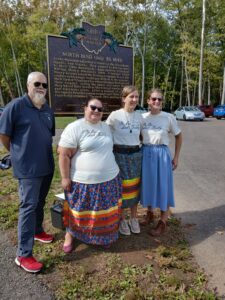
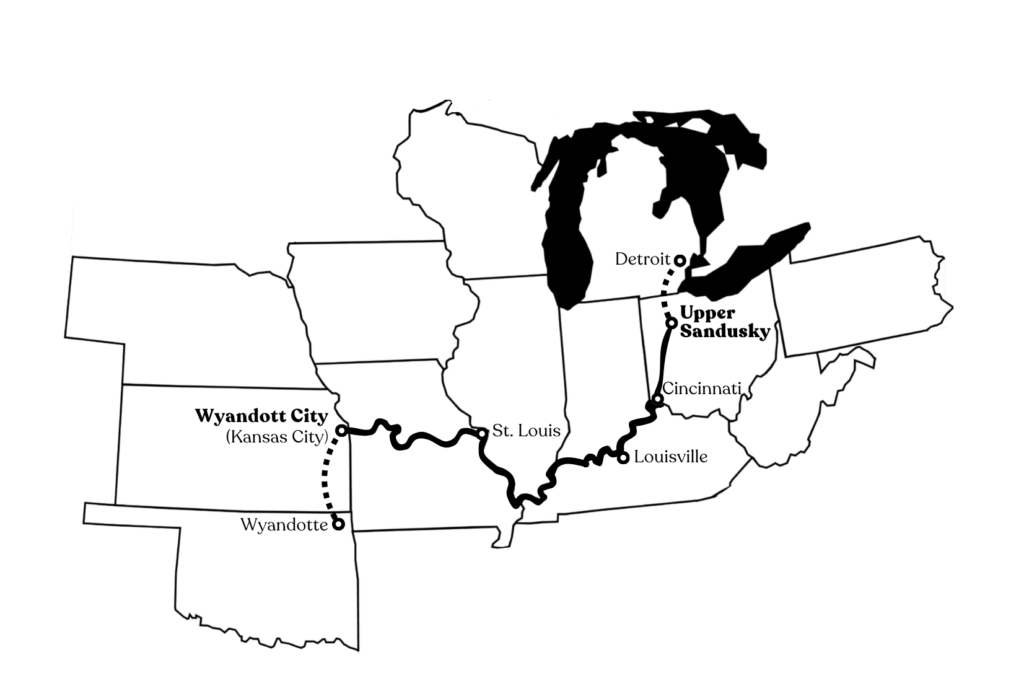
After decades of resistance and failed negotiations, the Wyandot were the last tribe removed from Ohio in 1843. Their removal route began on the Grand Reserve in Upper Sandusky and extended 150 miles to Cincinnati where nearly 700 Wyandots boarded steamboats bound for Kansas Territory. There, new settlers continued to place pressure on Wyandot lands. The Wyandotte Nation is now headquartered in Oklahoma.
“Uncle” George Lathrop Cooley (1861-1939) was known as the “Champion of the Farmer” for his advocacy on behalf of rural interests. He was born on a farm at the northwest corner of Dover and Hilliard Roads in Dover Township (Westlake). He attended area schools and Ohio Northern University and, in 1887, married Clara Hall. Cooley served as Dover Township trustee from 1901-1905 and as president of Dover’s village council in 1916. Cooley’s interest in better roads led him to supervise the hard-surfacing of Dover Center Road, which ran by his house. From about 1900 to 1913, he was involved in road construction and helped to organize state highway departments in Ohio, Louisiana and California. (Continued on other side)
Thomas Jefferson was president when the original two-story Federal-style brick building was built in 1807. The house is located on the east half of in-lot 123, a part of Franklinton since its beginning. Surveyed by Nathanial Massie on October 28, 1796, the lot was part of Virginia Military District entry #1393, comprising 1,000 acres on the west fork of the Scioto River. Captain Robert Vance, a veteran of Virginia Continental Line during the Revolution, claimed the land. Lucas Sullivant, the founder of Franklinton, acquired it from Vance. The acreage was a part of the 1797 plat of Franklinton, recorded by Sullivant in 1802 at the Ross County Courthouse in Chillicothe. Franklinton became Franklin County’s first seat in 1803 and preceded the founding of Columbus by 15 years. In its early years, Franklinton’s nearest neighbors were the Wyndat and Haudenosaunee people. (Continued on other side)