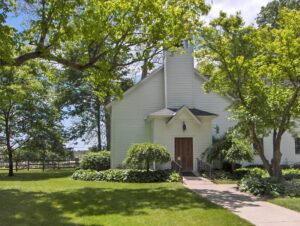
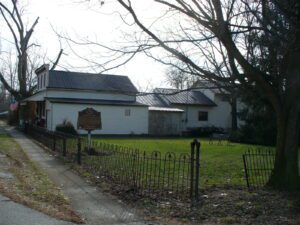
The first religious society organized in Liberty Township was formed in 1810 by Elders Thomas Cellar, Josiah McKinnie, and Leonard Monroe. Cellar and McKinnie came to Delaware in 1802. In 1820, The Elders and others built Liberty Church and laid out a cemetery on land provided by Thomas Cellar. Along with the Cellar and McKinnie families, early settlers, church and community leaders are buried here. In 1855, John F. Cellar deeded the three acres on which the church was located to Liberty for one dollar. The land was to be used only for the Church, burying ground, and schoolhouse. In the 1990s, the congregation outgrew the old meeting house. A Barn Church was constructed by builder John Redding, assisted by Amish men Josie and son, Junior Miller and their crew. It was constructed in 1996 near the old Liberty Church.
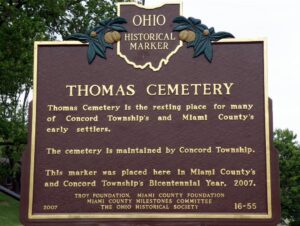
Thomas Cemetery is the resting place for many of Concord Township’s and Miami County’s early settlers. The cemetery is maintained by Concord Township. This marker was placed here in Miami County’s and Concord Township’s Bicentennial Year, 2007.
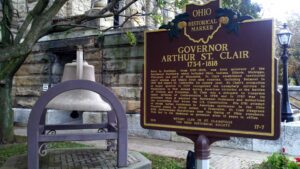
Born in Scotland. From 1787-1802, was first governor of the Northwest Territory, which included Ohio, Indiana, Illinois, Michigan, Wisconsin and part of Minnesota. St. Clair established territorial court system and Ohio’s first nine counties, including Belmont in 1801 and named St. Clairsville its county seat. St. Clair’s promotion to major general in 1777 recognized his exemplary service to Washington in New Jersey during American victories at the battles of Trenton and Princeton. St. Clair was a delegate to Congress under Articles of Confederation in 1786 and in 1787 was its president when it adopted the Northwest Ordinance and authorized the convention that wrote the U.S. Constitution. His 1791 attempt to break Indian resistance to American settlement in the Ohio Country ended in bitter defeat. A Federalist, St. Clair disagreed with Jeffersonian-Republicans over the timing of Ohio statehood. This led to his dismissal as governor after 15 years in office.
NE corner of S. Main Street and Zoar Road / Bayou Street
South Lebanon
, OH
Deerfield was laid out around 1795 and in 1802 Major Benjamin Stites, his son Benjamin, Jr., and John Gano officially recorded the village’s plat. A part of the great tide of Americans moving into the Northwest Territory (and Ohio after 1803), Deerfield’s early inhabitants included Revolutionary war veteran Ephraim Kibbey as well as Andrew Lytle, Nathan Kelly, William Snook, and War of 1812 veteran David Sutton. Deerfield was so called because it was a settlement in Deerfield Township, Hamilton County in the 1790s. (Continued on other side)
The 17th Infantry, created by Congress in 1812 and formed with personnel from western states, was the only Regular Army regiment in General James Winchester’s column of the Army of the Northwest’s campaign to regain Detroit. During the War of 1812, the 17th fought at Frenchtown, Fort Meigs, Fort Stephenson, and Thames River. In 1815, the 17th was consolidated with the 5th, 19th, and 28th Infantry to form the 3rd Infantry. In May 1861, the 17th Infantry was again organized as a Regular Army regiment and has since served continuously with distinction.
The foundation for the first Welsh settlement in Ohio was laid on June 29, 1801, when William and Morgan Gwilym purchased land in what is now Morgan Township at the Cincinnati Land Office. The Welsh, who settled in Pennsylvania beginning in the late eighteenth century, moved westward and settled here in 1802. This area was also the major terminus for the 1818 migration from Montgomeryshire and Cardiganshire in Wales. In 1803 a Congregational Church was organized and services were held in members’ homes or outdoors. A brick Meetinghouse, complete with a Welsh death door leading to the cemetery, was constructed in 1824. The building now serves as the Community House. The present brick church was built in 1854. For many years, the library, formed in 1852, was housed in the New London Special School District building that stood on this site. (Continued on other side)
In April 1784, the Continental Congress adopted the Report of Government for the Western Territory, a broad plan drafted primarily by Thomas Jefferson for organizing the United States’ new western lands that were ceded by the states and purchased from Native Americans. One of the most far-reaching legislative acts in American history, the resulting Land Ordinance of 1785, passed on May 20th, established the public land system by which all federal land was surveyed and distributed. The Ordinance established a rectilinear survey system that divided land into townships of six miles square aligned by north-south and east-west baselines, and set aside certain lands for Revolutionary War veterans and for public schools.
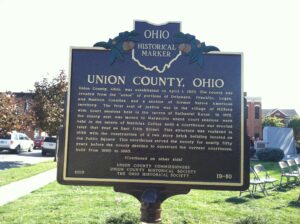
Union County, Ohio, was established on April 1, 1820. The county was created from the “union” of portions of Delaware, Franklin, Logan, and Madison Counties, and a section of former Native American territory. The first seat of justice was in the village of Milford with court sessions held in the tavern of Nathaniel Kazar. In 1822, the county seat was moved to Marysville where court sessions were held in the tavern of Matthias Collins until a courthouse was erected later that year on East Fifth Street. This structure was replaced in 1838 with the construction of a two story brick building located on the Public Square. This courthouse served the county for nearly fifty years before the county decided to construct the current courthouse, built from 1880 to 1883.