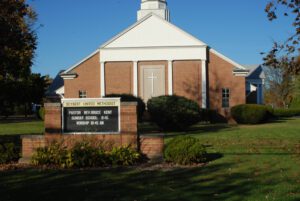
Born in Pennsylvania in 1791, Bishop John Seybert came to Ohio in 1822 and preached throughout the mid-west. Seybert served the faith for forty years as an itinerant preacher, a presiding elder, and the first bishop of the Evangelical Association, one of the original denominations that is now part of the United Methodist Church. As a circuit rider, he traveled on foot, horseback, and spring wagon a distance of 175,000 miles, preached 9,850 sermons, held 8,000 prayer and class meetings, and made about 46,000 pastoral calls and 10,000 calls on the sick. Seybert often paid his own expenses on the meager salary of $100 per year. He died in 1860 and is buried in the Bellevue – Flat Rock area.
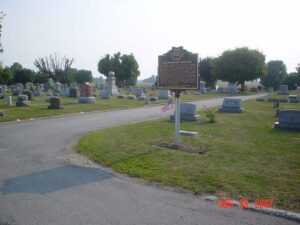
The Bloomingburg Presbyterian Church and cemetery were established in the northwest corner of the current cemetery grounds on March 7, 1818. Several years later it became a center for anti-slavery activity. The Reverend William Dickey, who presided over the church and other members, devoted their lives to the anti-slavery cause not only in voice but also in abolitionist activity. By the mid-1800s, their work, as well as the fact that Bloomingburg had become home to a vibrant African American community, led to the town becoming the area center for the Underground Railroad, which helped transport many fugitive slaves to freedom in the north. Six soldiers from the American Revolutionary War, nineteen from the War of 1812, and over 100 from the Civil War and Spanish-American War are buried in the Bloomingburg Cemetery, including Henry Casey, who was awarded the Congressional Medal of Honor for his valor at Vicksburg.
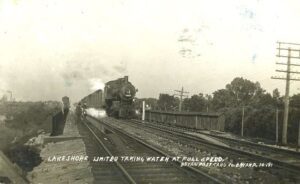
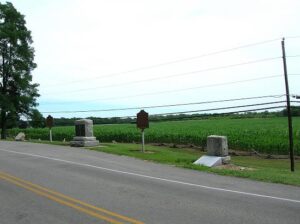
Like many nineteenth century communities in Ohio, Stryker owes its birth and early growth to the railroad industry. Stryker, named for Rome, New York, attorney and railroad executive John Stryker, was surveyed on September 19, 1853, beside the proposed Northern Indiana Railroad. For more than fifty years, “track pans” at Stryker allowed steam locomotives to take on 5,000 gallons of water while traveling at forty to fifty miles per hour, saving valuable time, “the principal enemy of railroad schedules.” On July 23, 1966, the U.S. rail speed record of 183.85 miles per hour was set through Williams County, including through Stryker. The Stryker depot was constructed in 1900 and placed on the National Register of Historic Places on August 7, 1989. (continued on other side)
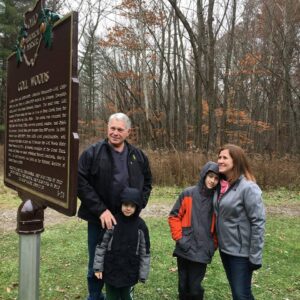
Two Deputy U.S. General Land Office Surveyors traversed Goll Woods: Benjamin Hough in 1815 and Captain James Riley in 1821. Hough (1772-1819) established the Michigan Meridian in 1815 and was county and state office holder in Ohio. Riley’s life was more tumultuous. Riley (1777-1840) captained the merchant ship Commerce, which wrecked off the Saharan coast in 1815. Riley and crew were enslaved for four months until ransomed by British diplomat William Willshire. In 1817, Riley published a famous account of his time in North Africa, and, in 1819, was appointed a surveyor by Surveyor General Edward Tiffin. Moving to Northwest Ohio, Riley named the village he founded in 1822, Willshire, for his deliverer. Riley returned to New York in 1826 and to the sea, where he died. Riley’s book went through more than twenty editions by 1860 and Abraham Lincoln credited the account as one that influenced him deeply.
Born on September 28, 1769 in New Bedford, Massachusetts, Bathsheba Rouse is recognized as the first woman to teach in the Northwest Territory. Rouse arrived in the region along with other pioneers in 1788. The following year, the Belpre community employed Rouse to teach young children in the Farmers’ Castle near the Ohio River. Instruction in reading, writing, and sewing was reserved for the girls, while boys received lessons in reading, writing, and arithmetic. Rouse taught in Belpre for several terms before marrying Richard Greene and settling at nearby Marietta. Their descendants attained civic prominence in Washington County for generations. Bathsheba Rouse Greene died on February 27, 1843 at the age of seventy-three and is buried alongside her husband in Marietta’s Mound Cemetery.
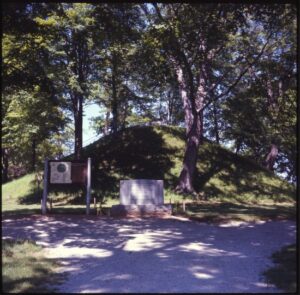
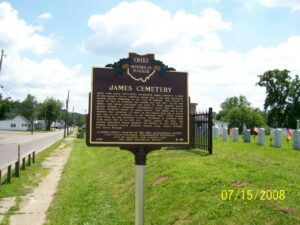
Major John James (1772-1854) established James Cemetery in 1828 on and around a Native American mound that is the only significant ancient mound remaining in the city of Jackson. The mound is about 70 feet in diameter and nearly six feet tall. In the late 1800s, this mound comprised one point of three ancient mound groups forming a triangular configuration along East Broadway Street, formerly known as James Street. One group was a few hundred feet northeast of here on the Watson farm and a second was just to the northwest on the Warnicke farm. These mounds were built by the Hopewell Culture, prominent in southern Ohio from about 100 BC to 400 AD. Major James, his wife, and several immediate family members are buried on the mound including Jackson County pioneers Andrew Long, Daniel Hoffman, and David Mitchell.
In the mid-1700s, France found its influence waning among midwestern tribes as it contested for Native American trade and military alliances with Great Britain. Shortly after Miami chief Memeskia (also known as Old Britain or La Demoiselle) moved his village to Pickawillany, British traders were given permission to establish a small post in the village, which was deep in the territory claimed by France. When French demands to evacuate the post failed, Charles Langlade led a party of 250 Ottawa and Ojibwe warriors and French Canadians in a surprise attack on the Miami village on June 21, 1752. The trading post was destroyed, British traders were taken to Detroit as prisoners, and Memeskia was executed. Pickawillany was completely abandoned soon after. As a prelude to the French and Indian War, the Battle of Pickawillany fueled land claim and trading right conflicts between France and Britain.
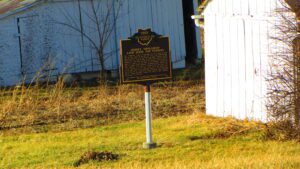
John “Appleseed” Chapman (b. September 26, 1774—d. March 18, 1845) was the first lessee of this 160 acre tract (NW 1/4, S 20, T 20, R 16), when he secured it for 99 years from the Virginia Military District School Lands on April 10, 1815. This $320 lease complied with the Ordinance of 1785 which stipulated that proceeds from the sale or lease of a 36th of all new land in the Northwest Territory be used to support public education. Perrysville author, Rosella Rice, knew Appleseed. In a history of Ashland County, she wrote, “One of his nurseries is near us and I often go to the secluded spot on the quiet banks of the creek [Blackfork]…with sod never broken since the old man did it.” Attributed as Green Township’s first permanent settler, Abram Baughman’s original 160 acres (c. 1807) adjoined this property to the west.