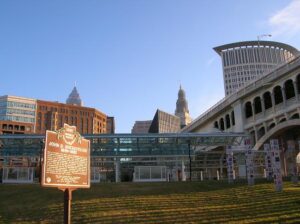
Born at Richford, New York, John D. Rockefeller moved to the Cleveland area with his family at age 14. He began his business career as a bookkeeper in 1855. From modest beginnings he became one of the richest men of his era by developing the world’s largest oil corporation, the Standard Oil Company, which was founded here in the Flats of Cleveland. Rockefeller moved to New York City in 1884 but maintained two homes in Cleveland, returning often with his wife Laura (1839-1915). Although he was a controversial businessman, Rockefeller donated millions of dollars to Cleveland charities and institutions, and land for Rockefeller and Forest Hills parks. John and Laura Rockefeller are interred in Lake View Cemetery.
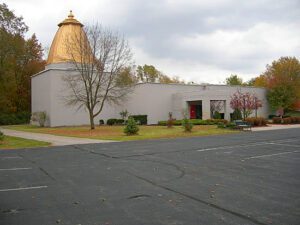
The Hindu Temple of Toledo was established in 1981 for the growing Hindu and Jain communities in northwest Ohio. Religious functions were initially held in a house located on a 15-acre property purchased in 1983. The Temple, designed in a Hindu-American style, was dedicated in August 1989. In 2000, the Temple underwent an expansion of 6000 square feet to the Heritage Hall area. Deities, Ganesh, Krishna, Radha, Vishnu, Laxmi, Rama, Sita, and Mahavir, are housed in the Temple. The holy structure is a living legacy of peaceful co-existence among religions and cultures.
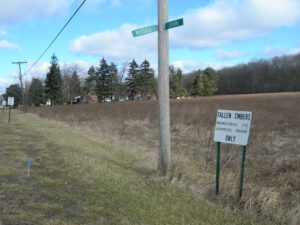
The Battle of Fallen Timbers, fought on August 20, 1794, is one of the most significant events relating to post-Revolutionary War America. Major General “Mad” Anthony Wayne led the Federal Army, known as The Legion of the United States against a confederacy of Native Americans led by Miami Chief Little Turtle and Shawnee war chief Blue Jacket. Defeat in battle and lack of help from their nearby British allies disheartened the tribes and lead to the 1795 Treaty of Greenville. The Treaty secured United States control of the Northwest Territory and ultimately resulted in the formation of five new states-Ohio, Indiana, Michigan, Illinois, and Wisconsin. (continued on other side)
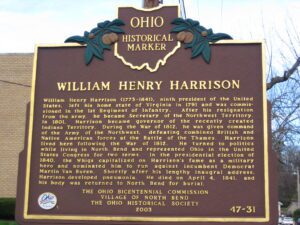
William Henry Harrison (1773-1841), ninth president of the United States, left his home state of Virginia in 1791 and was commissioned in the 1st Regiment of Infantry. After his resignation from the army, he became Secretary of the Northwest Territory. In 1801, Harrison became governor of the recently created Indiana Territory. During the War of 1812, he was given command of the Army of the Northwest, defeating combined British and Native American forces at the Battle of the Thames. Harrison lived here following the War of 1812. He turned to politics while living in North Bend and represented Ohio in the United States Congress for two terms. In the presidential election of 1840, the Whigs capitalized on Harrison’s fame as a military hero and nominated him to run against incumbent Democrat Martin Van Buren. Shortly after his lengthy inaugural address, Harrison developed pneumonia. He died on April 4, 1841, and his body was returned to North Bend for burial.
Considered the first citizen of the East Side, Peter Navarre, along with his brother Robert, first settled the land east of the Maumee River in 1807. A fur trader by profession, Navarre was experienced in wilderness survival and had a deep understanding of Native American life. He died on March 20, 1874, and was buried at Mt. Carmel Cemetery across the river from his beloved East Toledo. In 1922, the City of Toledo declared September 9th Peter Navarre Day, an official city holiday. This marker commemorates the 200th anniversary of the founding of East Toledo.
Here in the Oak Openings Region of northwest Ohio, some of the last Ottawa villages in Ohio lined the banks of Swan Creek during the 1830s. These Native Americans were led by Chief Ottokee (Autokee), a descendant of Pontiac, and half brother to another Ottawa Chief named Wauseon. Known for being honest and friendly, Ottokee was the last Ottawa chief in the Maumee Valley, for years refusing to go when the last of his people were removed to lands west of the Mississippi River.
In October of 1803, members of The Scioto Company, led by James Kilbourne, came from Connecticut and founded Worthington. On February 6, 1804, the Articles of Agreement establishing St. John’s Church of Worthington were executed. St. John’s, which had been planned in Connecticut prior to the Company’s departure, became the first Episcopal church established in the Northwest Territory and served as the founding church for several Episcopal churches in Ohio. James Kilbourne served as the church’s first Deacon. Reverend Philander Chase, the first Rector of St. John’s, became the first Episcopal Bishop of Ohio and founded Kenyon College. St. John’s Church and graveyard are listed on the National Register of Historic Places.
A network of Native American trails, usually following waterways, traversed Ohio and often determined the routes of military roads and improved highways. U.S. Route 33 follows the route of the Scioto Trail from the confluence of the Scioto and Olentangy rivers to State Route 161, where U.S. Route 33 becomes State Route 257. The Scioto Trail extended from the mouth of the Scioto River at Portsmouth (also known as Shawnee Town) to Sandusky Bay and connected the Shawnee’s hunting grounds in Kentucky with Lake Erie. The trail ran along the Scioto River, the Little Scioto River, and the Sandusky River with a portage between the Little Scioto and Sandusky rivers in Crawford County. The Scioto Trail, used for warfare, trade, and migration, was one of the most important trails in the Old Northwest.