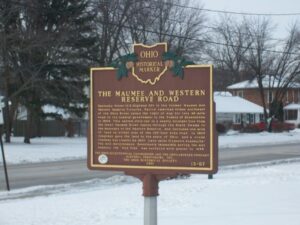
Sandusky Street (U.S. Highway 20) is the former Maumee and Western Reserve Turnpike. Native American tribes northwest of the Ohio River ceded the right of way for this 46-mile road to the federal government in the Treaty of Brownstown in 1808. This narrow strip ran in a nearly straight line from the lower Maumee River rapids through the Black Swamp to the boundary of the Western Reserve, and included one mile of land on either side of the 120-foot wide road. In 1823 Congress gave the land to the state of Ohio, and a crude roadway was cleared by 1827. Land sales financed roadbuilding and maintenance. Notoriously impassible during the wet seasons, the “Mud Pike” was surfaced with gravel in 1838.
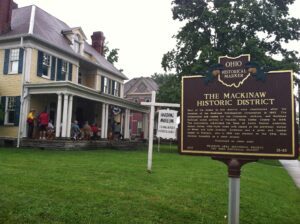
Most of the homes in this district were constructed after the creation of the Mackinaw Development Corporation in 1887. The corporation was named for the Cincinnati, Jackson, and Mackinaw Railroad which arrived in Franklin from Darke County in 1886. The corporation subdivided the farm of Lewis Gaston Anderson, whose Italian Villa-style home still stands at the northwest corner of Miami and Lake Avenues. Anderson was a grain and lumber dealer in Franklin, who in 1881 was elected to the 65th Ohio General Assembly as a state senator. (Continued on other side)
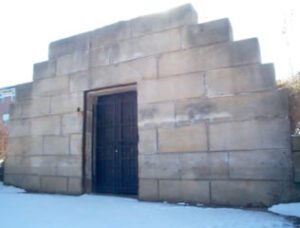
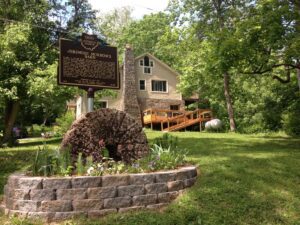
Cemetery vaults were used to store bodies in winter when the ground was too frozen to break manually. Locust Grove’s vault was constructed of locally quarried sandstone in 1872. The interior showcases the mason’s skills: the walls are smooth and the ceiling is arched. Tools, markers, and cemetery supplies replaced bodies after it became possible to break frozen ground with mechanical excavating equipment. In 1997, the 138-ton vault was moved approximately twenty-five feet northwest from its original location to make way for land development. Ethan Alling established Locust Grove Cemetery in 1846.
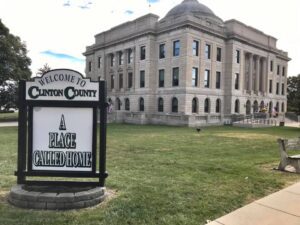
The Clinton County Courthouse was dedicated October 22, 1919. The Cincinnati firm of Weber, Werner and Adkins designed the edifice and it is a local masterpiece that fuses the Beaux-Arts and Neo-Classical architectural styles. A grand marble staircase rises from the basement to the second floor. At the center of the cruciform plan is a dome 32 feet in diameter with a stained-glass window. The murals of four women beneath the dome represent Agriculture, Education, Medicine, and Industry, and are known as the Guardians of the Courthouse. The county built courthouse and former jail for a combined cost of nearly $370,000.
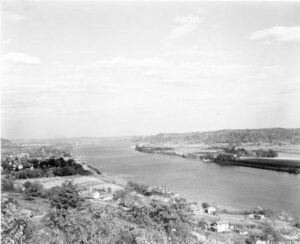
The Ohio River, the southeast border of Gallia County, played a significant role in the development of Gallipolis and Gallia County. One of the state’s first thoroughfares, this waterway enabled pioneers to settle in what was known as the Northwest Territory. On October 17, 1790, approximately 500 French immigrants arrived in Gallipolis, traveling by flatboats from Pittsburgh, and settled in log cabins in what is now City Park, in the heart of Gallipolis. This established the second oldest permanent settlement in the territory. The settlers relied on the River for communication, commerce, and transportation, and the River brought postal service to Gallipolis in 1794. As local business and river trade developed in the 1800s, Gallipolis became a thriving port. The scenic Ohio River is an important inland waterway, providing transportation for many commodities between major cities. The River also provides recreational opportunities for both visitors and residents, including water sports, fishing, and boating.
In 1795, at the age of 23, Jeremiah Morrow came to the Northwest Territory from Pennsylvania. He purchased land along the Little Miami River in Deerfield Township and in 1799 married Mary Parkhill of Pennsylvania. Around 1800 he built this barn which is one of Warren County’s oldest standing structures. In 1801, Morrow was sent to the Second Territorial Assembly and to the first Ohio Constitutional Convention in 1802. In 1803, he was elected the new state’s first U. S. Congressman and was Ohio’s only congressman for ten years. In 1813 the Ohio legislature elevated him to U.S. Senate. In 1822 he became Ohio’s ninth governor. He went on to serve in both the Ohio House and Senate and at age 69 returned to Congress. An extraordinary man, Jeremiah Morrow gave his country 43 years of public service.
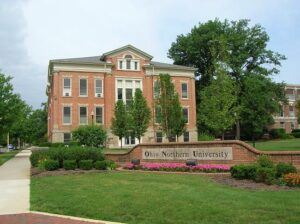
Henry Solomon Lehr founded Ohio Northern University in 1871 as the Northwestern Ohio Normal School. Its purpose was to train teachers and to provide higher education to the people in Northwest Ohio. In 1885, the school became Ohio Normal University. The new name recognized that the institution drew students from all over Ohio and the nation, and offered courses in many disciplines, including literature, music, business, telegraphy, and law, as well as teacher training. Beginning with 131 students, the institution’s enrollment grew rapidly during its first thirty years of existence. Buildings on the early campus included Dukes Memorial (left), built in 1905; the Normal School Building, built in 1871 and demolished in 1915 to make way for Lehr Memorial (center); and Hill building (right) finished in 1879. The Methodist Episcopal Church (predecessor to the United Methodist Church) assumed control in 1899. Ohio Normal University became Ohio Northern University in 1903. On June 3, 1910, President William Howard Taft delivered that year’s commencement address near this spot.
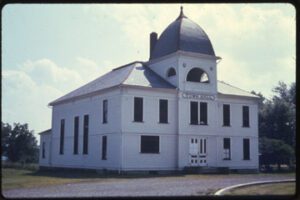
Major buildings dating from 1832 to 1898 surround the village green, the geographic center of Gustavus Township. Built in 1832 on the northwest quadrant, the George Hezlep House features Federal-Greek Revival architecture and has a closet reputedly used on the Underground Railroad. Built in 1840, the Farmers’ Exchange Store was originally a double entrance Greek Revival structure. The Storekeeper’s House, also a Greek Revival structure, was built next to the exchange store in 1840. South of this house is the Fraternal Hall, built in 1870. There were once four churches in Gustavus including the Methodist Church, built in 1856 with a temple front and a belfry, and the Congregational Church, built east of the center in 1854. The eclectic Town Hall was built in 1890 and fronts the southeast quadrant. The Gustavus Centralized School, reported as the first centralized school in the United States, was built in 1898 and was replaced by the current building in 1928.