The West Liberty area, in the Mad River Valley, was the location of at least seven Shawnee Indian villages. This elevated site was the location of one of those villages. Several septs or divisions of the Shawnee nation lived in this area after being forced from their homes in southern Ohio. In 1786, together with Simon Kenton, Colonel Benjamin Logan’s army destroyed all the Shawnee villages in retaliation for the Indian raids in southern Ohio and Kentucky. Consequently, the remaining Shawnees moved to northwest Ohio near the present-day site of Maumee.
Near intersection of Old Springfield Pike and US 68
Xenia
, OH
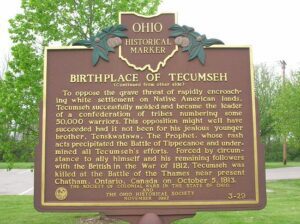
The great Native American Shawnee leader, Tecumseh, was born on the bank of a large spring at this site in 1768, at the very instant that a great meteor seared across the skies. The birth occurred while his parents, Shawnee war chief, Pucksinwah, and his wife, Methotasa, were en route from their village of Kispoko Town, on the Scioto River, to a major tribal council at the Shawnee tribal capital village of Chalahgawth (Chillicothe – now Oldtown), which was located “two arrow flights” northwest of this site. Though prohibited by tribal tradition from becoming chief of the Shawnees, Tecumseh rose to become one of the greatest warriors, orators, and military strategists of any tribe in America.
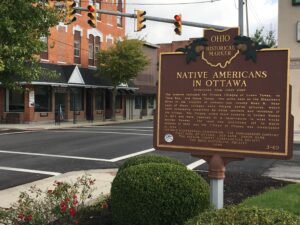
The Ottawa, or “Tawa” Indians had inhabited the Maumee Valley since the middle of the 1700s. By the 1790s, Ottawa settlements included villages along the Blanchard River at the present-day Village of Ottawa. During the War of 1812, Colonel James Findlay destroyed these villages because the Ottawa aided British forces. In 1817, the United States government established a reserve for the Ottawa in exchange for their lands in Northwest Ohio. The reserve encompassed a five-mile square area; its center was the intersection of the Blanchard River and an Indian trace near what is now Old State Route 65. (Continued on other side)
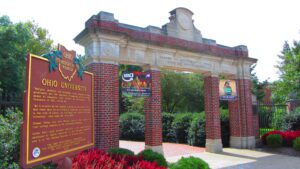
Manasseh Cutler, Rufus Putnam, Winthrop Sargeant, and Benjamin Tupper of the Ohio Company conceived Ohio University, which was encouraged by the Ordinance of 1787 and the Northwest Territorial Legislature in 1799, incorporated as the American Western University in 1802, and chartered by the Ohio State Legislature on February 18, 1804. The university is the first institution of higher learning in the Northwest Territory, second west of the Allegheny Mountains, and the first in the United States to be endowed with land by the government with proceeds used to pay for its operations-revenue from two townships was set aside to support the university. Opened on June 1, 1809, as an academy with three students, Ohio University awarded its first undergraduate degrees in 1815.
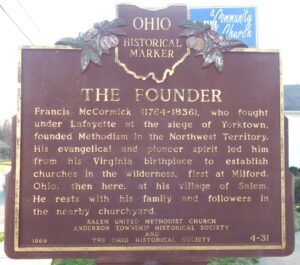
Francis McCormick (1764-1836), who fought under Lafayette at the siege of Yorktown, founded Methodism in the Northwest Territory. His evangelical and pioneer spirit led him from his Virginia birthplace to establish churches in the wilderness, first at Milford, Ohio, then here, at his village of Salem. He rests with his family and followers in the nearby churchyard.
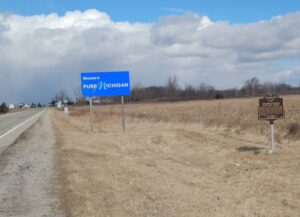
After the War of 1812, the United States Congress proposed two million acres of military bounty land for the Michigan Territory. To survey the land, the meridian had to first be established. U.S. Surveyor General Edward Tiffin created the meridian based on the western line of the Treaty of Detroit (1807). He contracted with Deputy Surveyor Benjamin Hough in April 1815 to begin the survey for $3 per mile. Taking a reading from Polaris (the North Star), Hough, Alexander Holmes, and 11 crew members surveyed the line due north from Fort Defiance. The difficult terrain they encountered temporarily halted all surveys in the territory and ultimately led to the bounty land being transferred to the Illinois and Missouri Territories.
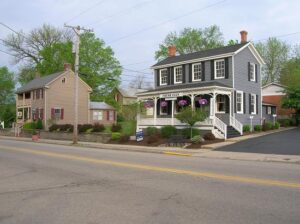
David and Rachel Burnet Evans built this Federal style house in 1836. Their son, Dr. John Evans (1814-1897), nationally known physician, statesman, and educator, lived here as a young man. After graduating from Lynn Medical College in Cincinnati, Dr. Evans became a prominent physician in Indiana and helped establish the Indiana Hospital for the Insane. He is recognized as one of the founders and first president of Northwestern University in Evanston, Illinois. He was appointed by President Abraham Lincoln as the first governor of the Colorado Territory and is credited for developing the railroad system in Colorado. His desire to institute a system of higher education in the territory led to the founding of Colorado Seminary, later known as Denver University. Evanston, Illinois and Mt. Evans near Denver were named in his honor.
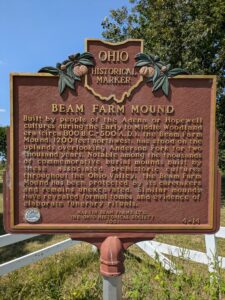
Built by people of the Adena or Hopewell cultures during the Early to Middle Woodland era (circa 800 B.C – 500 A.D), the Beam Farm Mound, 1200 feet northwest, has stood on the uplands overlooking Anderson Fork for two thousand years. Notable among the thousands of commemorative burial mounds built by these associated prehistoric cultures throughout the Ohio Valley, the Beam Farm Mound has been protected by its caretakers and remains unexcavated. Similar mounds have revealed formal tombs and evidence of elaborate funerary rituals.