

, OH
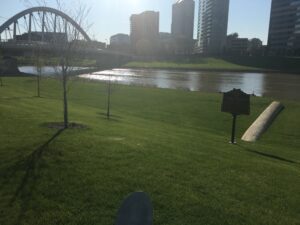
The historic district extends from the former Main Street Bridge to Long Street and encompasses the public buildings on either side of the Scioto River. The 580 foot long low-head concrete arch Main Street Dam was constructed in 1918 in response to the catastrophic 1913 flood. The dam helped reshape the Downtown Columbus Scioto River basin into a reflecting pool for the monumental riverfront buildings of teh Civic Center, which were influenced by the City Beautiful movement of the 1890s and early 1900s. Nearly a century after its construction, however, the dam had contributed to an unhealthy environment for aquatic life and was removed in late 2013 as part of teh Scioto Greenways river restoration project.
, OH
Puritas Mineral Spring Company bottled and sold mineral water from the natural springs in the area. In 1894, the Cleveland and Berea Street Railway bought Puritas Springs and expanded the area into a picnic grove with a dance hall and pavilion to increase passenger traffic on the inter-urban line. Puritas Springs Park opened June 10, 1900- the first day the railways operated all the way to the entrance gates. John E. Gooding bought Puritas Springs in June 1915 and added and indoor roller rink, amusement rides, and the mighty Cyclone roller coaster. Labor Day 1958 the park closed, and on May 9, 1059 a fire destroyed many parts of the abondoned park.
, OH
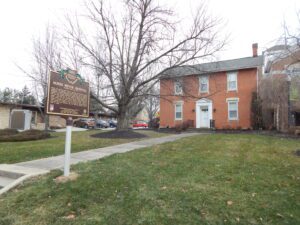
The house at this location, 110 South State Street, was the childhood home of Agnes Meyer Driscoll (1889-1971). Known as “the first lady of naval cryptology,” her career spanned from World War I to the Cold War. Driscoll attended Otterbein University before graduating from the Ohio State University, with majors in physics, math, music, and foreign languages. During World War I, she enlisted in the U.S. Navy as a chief yeoman, the highest rank possible for a woman at the time. After the war, Driscoll rose to become the chief civilian cryptanalyst for the U.S. Navy, breaking major Imperial Japanese Navy codes prior to World War II. (Continued on other side)
, OH
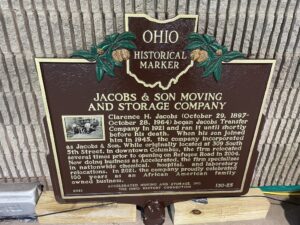
Clarence H. Jacobs (October 29, 1897?October 28, 1964) began Jacobs Transfer Company in 1921 and ran it until shortly before his death. When his son joined him in 1945, the company incorporated as Jacobs & Son. While originally located at 309 South 5th Street, in downtown Columbus, the firm relocated several times prior to opening on Refugee Road in 2004. Now doing business as Accelerated, the firm specializes in nationwide chemical, hospital, and laboratory relocations. In 2021, the company proudly celebrated 100 years as an African American family owned business.
, OH
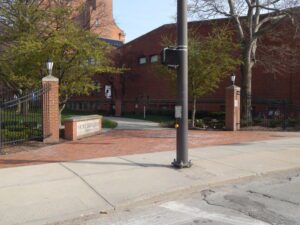
In 1886, Bishop Richard Gilmour (1824-1891) of the Roman Catholic diocese of Cleveland requested that the Jesuit superior of Buffalo establish a high school on Cleveland’s west side. The Jesuits, an order of the Roman Catholic Church founded by St. Ignatius Loyola in 1540, sought to establish schools that instilled a zeal for the Gospel and a love of learning. Under the leadership of Father Henry Behren, S.J. (1815-1895), the twentieth Jesuit secondary school in the United States opened in September 1886. Named Saint Ignatius College, the school grew from 76 students in 1886 to 490 in 1924. In 1924, the College split into two separate institutions: John Carroll University, which moved to University Heights in 1935, and Saint Ignatius High School, which remains on its original site. (Continued on other side)
, OH
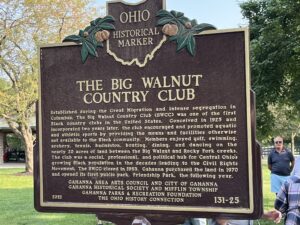
Established during the Great Migration and intense segregation in Columbus, The Big Walnut Country Club (BWCC) was one of the first Black country clubs in the United States. Conceived in 1925 and incorporated two years later, the club encouraged and promoted aquatic and athletic sports by providing the means and facilities otherwise not available to the Black community. Members enjoyed golf, swimming, archery, tennis, badminton, boating, dining, and dancing on the nearly 20 acres of land between the Big Walnut and Rocky Fork creeks. The club was a social, professional, and political hub for Central Ohio’s growing Black population in the decades leading to the Civil Rights Movement. The BWCC closed in 1963. Gahanna purchased the land in 1970 and opened its first public park, Friendship Park, the following year.
, OH
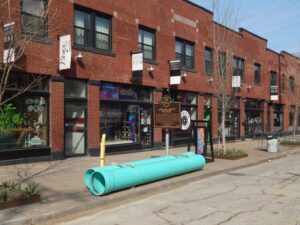
This block of W. 29th Street was home to Cleveland’s vibrant LGBT community and central to the development of the modern LGBT civil rights movement. In 1988, the Striebinger Building, at 1418 W. 29th, housed Cleveland’s Lesbian-Gay Community Services Center, which addressed the needs of the LGBT community. Cleveland’s first Pride Festival since the mid-1970s was held on the block in 1989, and in 1990 Cleveland’s first Pride Parade culminated here. During the HIV/AIDS crisis, The Living Room and ACT UP were located in the Striebinger Building and gave support to those with HIV/AIDs and provided a platform for political activism. It was on this block where many people could find their voices to “come-out” and advocate for their rights and their humanity. (Continued on other side)

, OH
Iuka Ravine, developed on land from the “Indianola Farm” that belonged to the Neil Family, is significant for its early 20th century architecture. The ravine’s natural beauty influenced architects to design homes for the upper middle class that incorporated “features of the old oak forest and glacial boulders.” Several ravine homes were designed by Frank Packard and Charles Inscho. Two classically-designed bridges built in 1912 insulated the area from traffic to create what became known during the 1920s-1950s as a “quiet professor enclave.” Iuka’s curvilinear street, one of the first in Columbus, as well as its stone walls, glacial erratics, and mature hardwoods created a “unique urban experience.” The Iuka Ravine Historic District was listed in The National Register of Historic Places in 1986 and added to the Columbus Register of Historic Properties in 1985.