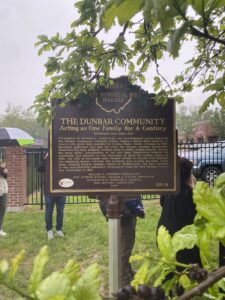
Dunbar, or Corsica Hollow, was an African American neighborhood on the western edge of Madisonville. Its streets and lots were laid out in 1886 after Mahlon and Anna Leonard subdivided their 10-acre tract near Duck Creek and sold lots to African Americans. Many early Dunbar residents were from the South; some born there prior to emancipation. Prominent early citizens included Harriet Deatherage, Elihu Parks, Gandison Embry, Thomas Duett, and James Murphy. Dunbar was home to the New Mission Missionary Baptist Church, founded in 1907. Originally meeting in a one-room building, the extant congregation relocated to Ravenna Street in 1963. By the late 1920s, Dunbar had about forty houses, a grocery run by Henry Lowman, and a hair salon run by Flora Hector. (Continued on other side)
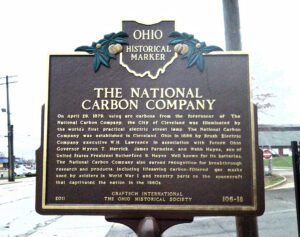
On April 29, 1879, using arc carbons from the forerunner of The National Carbon Company, the City of Cleveland was illuminated by the world’s first practical electric street lamp. The National Carbon Company was established in Cleveland, Ohio in 1886 by Brush Electric Company executive W.H. Lawrence in association with future Ohio Governor Myron T. Herrick, James Parmelee, and Webb Hayes, son of United States President Rutherford B. Hayes. Well known for its batteries, The National Carbon Company also earned recognition for breakthrough research and products, including lifesaving carbon-filtered gas masks used by soldiers in World War I and reentry parts on the spacecraft that captivated the nation in the 1960s.
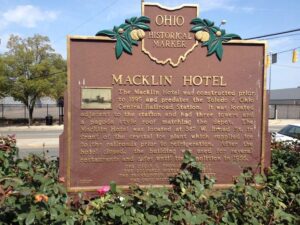
The only remaining Columbus railroad station, The Toledo & Ohio Central (T&OC) Railroad Station was constructed in 1895 and was the departure point for William McKinley when he left for Washington D.C to be sworn in as president. Designed by noted Columbus architects Joseph Warren Yost & Frank L. Packard, the pagoda style roof and tower have become Columbus icons. By 1900, the T&OC was purchased by the rival Hocking Valley Railroad and in 1911 the tracks were elevated above Broad Street. Later the New York Central Railroad gained control and used the station until 1930 when passenger service was transferred to Union Station in Columbus. Restored after the 1913 Flood and major fires in 1910 and 1975, the station was headquarters for the Central Ohio Volunteers of American from 1930 to 2003. The building was placed on the National Register of Historic Places in 1973.
Market Square, home to the Pearl Street Market, was located on the corner of Pearl and Lorain Streets (now West 25th St. and Lorain Ave.) in what was then known as the City of Ohio. The land that Market Square occupies was donated by local businessmen Josiah Barber and Richard Lord in 1840 for the public’s use. Farmers and food vendors gathered to sell their wares after a public market moved here in 1859. In 1868, an enclosed wood-framed Pearl Street Market building was erected.
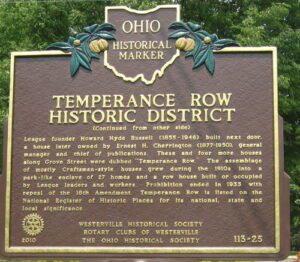
Here lived the reformers of the Anti-Saloon League of America who led the movement that turned the United States “dry” in 1920 with the 18th Amendment prohibiting the manufacture, sale or transportation of intoxicating liquor. Moving its headquarters to Westerville in 1909, the League built a publishing house that buried the liquor industry in a 10-year avalanche of books, pamphlets and periodicals that helped win Prohibition and made Westerville the “Dry Capital of the World.” Rev. Purley A. Baker (1858-1924), the League’s general superintendent, bought 11 acres and erected his rustic home at Park and Grove streets in 1910. (Continued other side)
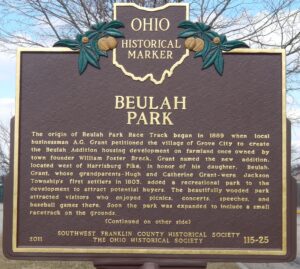
The origin of Beulah Park Race Track began in 1889 when local businessman A. G. Grant petitioned the village of Grove City to create the Beulah Addition housing development on farmland once owned by town founder William Foster Breck. Grant named the new addition, located west of Harrisburg Pike, in honor of his daughter, Beulah. Grant, whose grandparents, Hugh and Catherine Grant, were Jackson Township’s first settlers in 1803, added a recreational park to the development to attract potential buyers. The beautifully wooded park attracted visitors who enjoyed picnics, concerts, speeches, and baseball games there. Soon the park was expanded to include a small racetrack on the grounds.
7650 W. Cleveland Memorial Shoreway at W. 76th Street Tunnel
Cleveland
, OH
The W. 76th and W. 65th Street tunnels survive today and symbolize the power of community action. In 1911, Cleveland City Council approved construction of elevated tracks by Lake Shore & Michigan Southern Railway Company. The tracks separated Cleveland’s neighborhoods from Lake Erie. In protest, West Side residents petitioned the council and the mayor to demand that safe access to the lakefront be restored. Council passed Ordinance 23308 to issue $85,000 in bonds to extend W. 76th Street and build a “subway” for vehicles and pedestrians. Obligating the railway company to pay half, the council approved Ordinance 28043 in February 1913 to construct pedestrian subways at E. 79th, W. 65th and W. 76th for $126,000. The E. 79th and W. 65th subways were constructed the same year, and W. 76th completed in 1914.
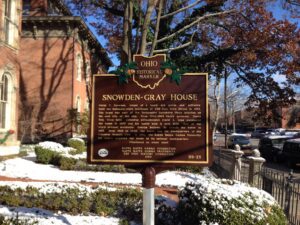
Philip T. Snowden, owner of a fancy dry goods and millinery, built the Italianate-style residence at 530 East Town Street in 1852. The house was part of the fashionable University Place addition on the east side of the city. From 1862-1864 Ohio’s governor, David Tod, lived here. Columbus philanthropist David S. Gray purchased the house in 1870 and his family held it until 1922. One of the city’s premier architects, George Bellows, Sr. rebuilt the house in 1872. From 1923 to 1940, the house was the headquarters of the Columbus Women’s Club. In 1951, the Kappa Kappa Gamma fraternity for women acquired the house as its national headquarters. (Continued on other side)