

, OH
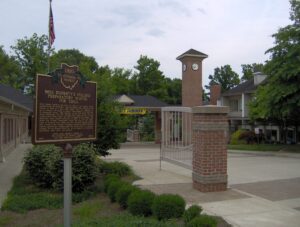
Mary Harlan Doherty was born in 1862 in the Dayton Street neighborhood of Cincinnati. She graduated from Woodward High School in 1880 at a time when women were not expected to go to college, but rather to marry, raise children, and take care of household duties. Miss Doherty, as she was known, saw the world differently. She felt strongly that women should not only possess solid social skills, but also be prepared for college. She graduated from Cornell University in 1899. In 1906 she established the College Preparatory School for Girls in the former home of Superior Court Judge and Ohio Governor George Hoadley, with a class of 125 students. Enrollment doubled by 1920, with Miss Doherty guiding her students under the school’s motto, Ad Summum, meaning “To the Highest Point,” or, as she viewed it, to strive for excellence, hard work, and service.
, OH
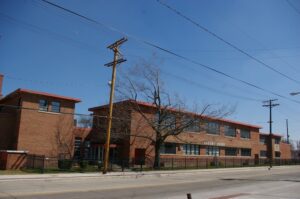
Karamu House, Incorporated was established in 1915 as the Playhouse Settlement, one of Cleveland’s many settlement houses for migrant and immigrant communities. Initiated by the Men’s Club of the Second Presbyterian Church, in 1915 Oberlin College and University of Chicago social work graduates, Russell and Rowena Woodham Jellliffe were hired as the founding directors. Originally located at 2239 East 38th Street, the Playhouse Settlement offered children’s theater and other social, recreational, and educational activities. It soon developed a partnership with the Dumas Dramatic Club, a local African American theater company that later became known as the Gilpin Players. (continued on other side)
, OH
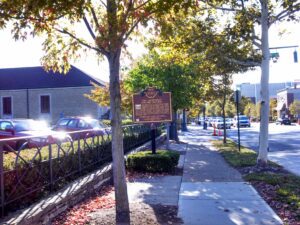
In the early 1900s, Ohio led the nation in interurban track mileage. The electrically powered interurban was favored over steam railroads for short distance passenger travel and the transport of local freight. Incorporated in 1899, the Columbus, Buckeye Lake, and Newark Traction Railway served Bexley from a terminal on Gay Street in downtown Columbus. Running south on High Street and then east on Mound Street, the line crossed Alum Creek into Bexley, went north up Pleasant Ridge Avenue past Capital University, and continued to the National Road (Main Street). Interurban cars stopped at the northeast corner of Main Street and Remington Road and thence sped on to Buckeye Lake, Newark, and later Zanesville. The popularity of the automobile spelled doom for the interurban. Service on the line ended in 1929.
, OH
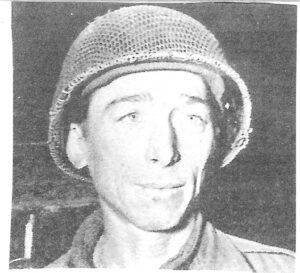
Alexander Albert Drabik was born here, in a log cabin, on December 28, 1910 to John Drabik and Frances Lewandowski, Polish immigrants from Szymborze, Germany, now Poland. Alex, youngest son of 14 children, attended Door Street School. A meat cutter, he enlisted in the United States Army in October 1942. Drabik fought in the Ardennes, Central Europe and Rhineland Campaigns of World War II. He received a Purple Heart during the Battle of the Bulge. On March 7, 1945, Sergeant Drabik led 10 Company A soldiers of the 27th Armored Infantry Battalion of the 9th Armored Division across the Ludendorff railroad bridge from Remagen, Germany to the Rhine River east bank. (Continued on other side)
, OH
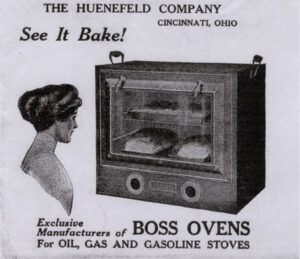
The first full-size glass door oven was invented and manufactured here by Ernst H. Huenefeld of The Huenefeld Company in 1909. Specially designed and patented sheet metal frames in the door allowed for expansion and contraction of the glass. The large window, guaranteed against steaming up or breaking from heat, allowed users to view their baking without opening the oven door. Huenefeld had acquired this property in 1903 for a new factory. The Huenefeld Company, established in 1872 on Pearl Street, moved its manufacturing here in 1904 from its downtown Cincinnati locations. The company, in operation until its sale in 1966, was widely known as a manufacturer of ranges, stoves, ovens, heaters, furnaces, refrigerators, washing machines, and other household products. A standard feature in homes today, the glass door oven was a technological breakthrough in 1909.
, OH
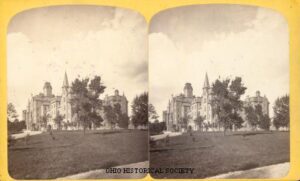
In 1835, Dr. William Awl of Columbus and Dr. Daniel Drake of Cincinnati presented recommendations to the Ohio General Assembly to establish a school for the blind. Legislation, signed by then governor of Ohio Duncan McArthur on April 3, 1837, provided funding to create the first state-supported residential school for the blind in the United States. The Institution for the Education of the Blind opened July 4, 1837, with five students. A year later, the first permanent structure, housing 60 students, was built on a nine-acre tract of land on the eastern edge of the city, and that was followed in 1874 with a larger facility near Fulton and Main streets. The school was honored and recognized in 1937 as being one of the finest schools for the blind in the country. In 1953, a new school for the blind was built at its present location at 5220 North High Street.
, OH
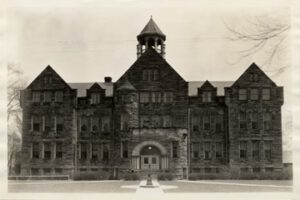
In 1845, Baldwin Institute, one of the first schools in the area open to all students regardless of gender, race, or creed, was chartered. The wealth generated by the sandstone and grindstone industries of Berea allowed John Baldwin to found the school. Ten years later, officials rechartered the school and renamed it Baldwin University. By the 1880s, the expanding quarries began to encroach on the original campus of the university, forcing it to relocate. In 1891, ground was broken for the new campus at the corner of Front Street and Bagley Road. Recitation Hall, renamed Wheeler Hall, was the first new building, followed by the Philura Gould Baldwin Memorial Library in 1894. In 1905, through the funding of the Carnegie Foundation, the Ladies Hall, renamed Carnegie Hall, was moved stone by stone to the new campus to serve as the science building. Baldwin University merged with German-Wallace College in 1913 to become Baldwin-Wallace College.
, OH
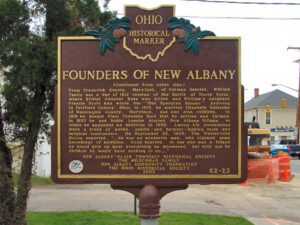
A tavern and inn, for which Noble Landon (1783-1866) obtained a liquor license in 1835, formerly occupied the southeast corner of High and Main streets. In 1837 Landon and William Yantis laid out the town of New Albany in 50-by-100-foot lots, with Landon’s lots lying on the east side and Yantis’ on the west side of High Street. Landon was born in Litchfield, Connecticut, lived as a young man in St. Albans, Vermont, and migrated to Licking County, Ohio, in 1810. He was the first clerk and first Justice of the Peace in St. Albans Township and first postmaster in Johnstown and later in New Albany. In addition to contributions as a builder-developer, Landon gave to the village lore the story of a remarkable conversion. Long known as a heavy drinker, he suddenly ordered kegs of whiskey he owned to be carried into the street and broken. He then attended church regularly. (continued on other side)