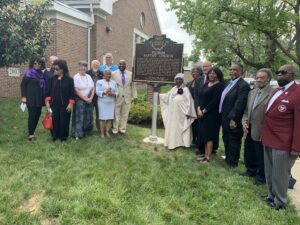
On January 9, 1919, a group of eight men and three women, being led by the Holy Spirit, met at a house on Wallace Street to form a new black Missionary Baptist Church in Hamilton, Ohio. The group quickly raised $150 to make the down payment on a two-story brick building at 333 Chestnut Street being sold for $1,850. The building was occupied on March 25, 1919, and the name Pilgrim Baptist Church was suggested and accepted. On May 11, 1919, a special council requested admittance into the Western Union Baptist Association, a district association now affiliated with the Ohio Baptist General Convention. Requirements for admission were met and Pilgrim Baptist Church was recognized as a Missionary Baptist Church. In 2019, Pilgrim Baptist Church celebrated a centennial of faithfulness in Hamilton.
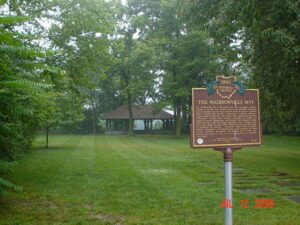
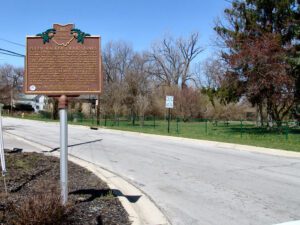
The Madisonville site is the largest and most thoroughly studied village of the late Fort Ancient culture (AD 1450 – 1670). Artifacts were so abundant here that local residents called this site the “pottery field.” Between 1879 and 1911, a generation of Harvard archaeologists trained at this site. Dr. Charles Metz, assisted by Harvard University’s Frederic Ward Putnam, excavated the remains of numerous houses, storage pits, and burials. The presence of glass beads and bits from iron kettles indicates these villagers may have been among the first native Ohioans to learn of the coming of Europeans to America. Mariemont street names Cachepit, Midden, Flintpoint, and Hammerstone, are reminders of these earlier residents. The pavilion was designed by the noted town planner John Nolen in 1921, but not constructed and dedicated until 2001.
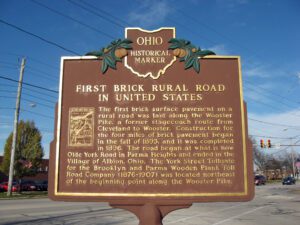
In the late nineteenth century, a movement to improve inadequate plank and dirt roads was brought on by the popularity of bicycling, the introduction of the automobile, and the need to improve travel to and from rural areas. Ohio, as a leader in the manufacture of brick paving blocks, was quick to upgrade roads. Toll roads were waning in popularity and the need for free roads was recognized. An act passed in 1892 authorized Cuyahoga County to levy a road tax. With funds levied, the Commissioners selected the Wooster Pike as one of three road improvement projects.
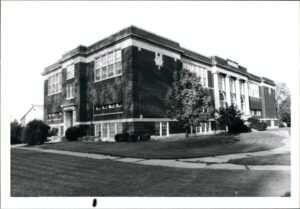
The Lincoln School building stood at 2402 Central Avenue for almost a century. In 1919, a twenty-year bond levy provided for the construction of five schools, including the “new east school” Lincoln Elementary. Construction began in 1921 on the eight-acre site while students attended classes in temporary structures. Lincoln School opened in 1923 with 500 students enrolled. Lincoln Field, football grounds for McKinley High School’s “Middies,” stood behind Lincoln from 1930 until 1950 when Barnitz Field Stadium was built on South Main Street. Additions to the original Lincoln building included a maintenance annex in 1935 and a gymnasium in 1959. Lincoln School closed in November 1980 during a 1980-1981 Middletown City School District reorganization. Students from Lincoln and Sherman schools moved to the refurbished Roosevelt School at 2701 Central Avenue.
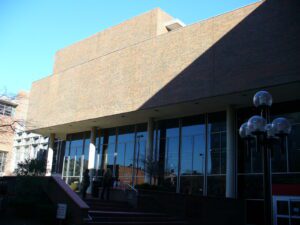
Among the first in America, Cincinnati’s public library dates from March 14, 1853. A public reading room opened in 1856, but funding remained a problem until 1867, when local school board president Rufus King II secured legislation for a renamed Cincinnati Public Library. In 1869, King lured leading librarian William Frederick Poole to organize Cincinnati as a national model for the growing public library movement. Poole designed 19th century America’s most advanced library at 629 Vine Street, which fully opened in 1874. Becoming a countywide system in 1898, the Public Library of Cincinnati and Hamilton County was a pioneer in the 20th century with special services for the blind and for children, bookmobile services, and circulation of audiovisual materials. (continued on other side)
In 1972, Urbancrest’s Ellen Walker Craig-Jones became the first African-American woman to be elected mayor, by popular vote, of a United States municipality. During her term as mayor (1972-1975), Craig-Jones oversaw the modernization of Urbancrest’s various programs and the village rebuilt three main streets, installed streetlights and street signs, and received approval to start a $3 million housing project. Craig-Jones had many years of experience in service to her community, serving twelve years on the Urbancrest Village Council. She was the recipient of dozens of awards and honors, including Who’s Who Among Black Americans.
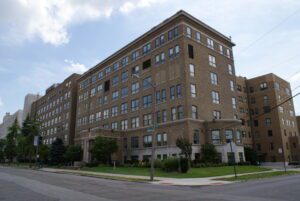
In late 1911, the Right Reverend Joseph Schrembs, Toledo’s first Bishop, corresponded with Sister Mary Bernardine McMullen and two companions, Sister Mary Anthony McMullen and Sister Mary DeChantel Lyons, and asked them to come to Toledo to establish the second of three Catholic hospitals in the new diocese. Land was purchased in 1916 on the corner of Madison Avenue and 23rd Street to build what would become a seven-story hospital. Noted Chicago architect, Meyer J. Sturm, was hired to design and construct the hospital using up-to-date methods of hospital construction. Costing approximately $300,000, Mercy Hospital of Toledo was completed in 1918. Bishop Schrembs dedicated and blessed the hospital on June 21 in a grand ceremony involving clergy of the diocese and the Mercy Hospital Guild as guests of honor.
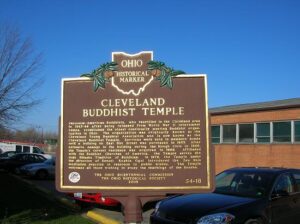
Japanese-American Buddhists, who resettled in the Cleveland area in 1943-44 after being released from World War II internment camps, established the oldest continually meeting Buddhist organization in Ohio. The organization was originally known as the Cleveland Young Buddhist Association and is now known as the Cleveland Buddhist Temple. Services were held in members’ homes until a building on East 81st Street was purchased in 1955. After extensive damage to the building during the Hough riots in 1966, the Temple’s current residence was acquired in 1968. Affiliated with the Buddhist Churches of America, the Temple serves the Jodo Shinshu Tradition of Buddhism. In 1979, the Temple under the direction of Sensei Koshin Ogui introduced the Zen Shin meditation practice in response to public wishes. The Temple welcomes all those wishing to study the teachings of the Buddha.