

, OH
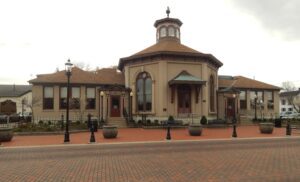
Clark Lane (1823-1907), industrialist and philanthropist, was a son of John Lane (1793-1880) and Rosanah Crum (1795-1877). John came with his family to the Ohio Country when it was still part of the Northwest Territory. As a young man, Clark worked in his family’s blacksmith shop, and eventually helped found Owens, Lane & Dyer Machine Company in 1854. It built agricultural machinery, sawmills, papermaking machines, and other products, initiating Hamilton’s prominence in metals manufacturing. Lane funded the Butler County Children’s Home, an orphanage for over a century, and constructed an octagon house as his residence on Third Street. He built this library in 1866, also as an octagon, and donated it to the people of Hamilton. A 19th century admirer wrote, “The name and generous deeds of Clark Lane will never fade from the memories of a grateful people who have been recipients of his favor.”
, OH
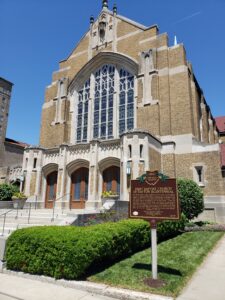
First Baptist Church of Dayton organized on May 29, 1824. A council met on the porch of William Huffman’s home at Third and Jefferson and approved 9 members as a congregation. The next day Lydia Huffman was baptized in the Great Miami River, the first recorded Baptist immersion in the city. Their first church building was erected in 1827 on Main Street. In 1829 the congregation suffered a Campbellite schism. Those resolved to remain Baptist incorporated on February 25, 1837, as The First Regular Baptist Church of Dayton, Ohio. The foundations for the Monument Avenue building were begun prior to the 1913 Dayton flood and the cornerstone was laid May 31, 1914. The building was completed, furnished, and ready for worship on June 26, 1915. (Continued on other side)
, OH
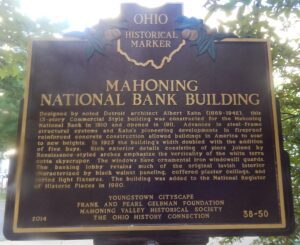
Designed by noted Detroit architect Albert Kahn (1869-1942), this 13-story Commercial Style building was contructed for the Mahoning National Bank in 1910 and opened in 1911. Advances in steel-frame structural systems and Kahn’s pioneering developments in fireproof reinforced concrete construction allowed buildings in America to soar to new heights. In 1925 the building’s width doubled with the addition of five bays. Rich exterior details consisting of piers joined by Renaissance-styled arches emphasize the verticality of the white terra cotta skyscraper. The windows have ornamental iron windowsill guards. The banking lobby retains much of the original lavish interior characterized by black walnut paneling, coffered plaster ceilings, and period light fixtures. The building was added to the National Register of Historic Places in 1980.
, OH
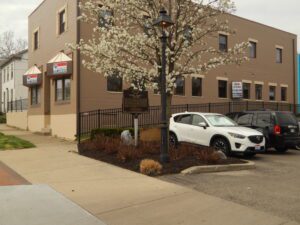
Raised and educated in St. Louis, author Fannie Hurst (1885-1968) was born in Hamilton at 918 Central Avenue, the home of her maternal grandparents. She was the daughter of Rose Koppel and Samuel Hurst. Already a writer as a student at Washington University (Class of 1909), Fannie moved to New York in 1910 to begin her career. Success came after repeated rejection. Stories for popular magazines brought her attention in the mid-1910s; by the mid-1920s she had become a best-selling, highly-regarded, and well-paid author. Between 1912 and 1964, Hurst wrote 18 novels, eight short story collections, and many other pieces. Hurst’s short story “Humoresque” (1919) and the novels Back Street (1931) and Imitation of Life (1933) were three of 32 films based on her writings. The film adaption of Imitation of Life received an Oscar nomination for Best Picture in 1934. (Continued on other side)
, OH
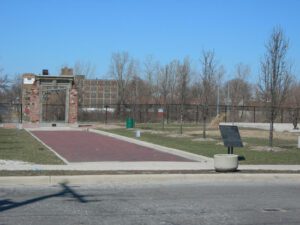
In 1934, workers at the Electric Auto-Lite Company and other automotive-related manufacturers secretly organized the Automobile Workers Federal Union Local 18384, American Federation of Labor (AFL), which became the United Auto Workers (UAW) Local 12. Anti-unionism, broken pledges by management, and abuse of workers had festered locally for generations. Workers bitterly resented the fact that management took advantage of the Depression’s high unemployment to decrease wages. In February, workers struck at Auto-Lite, Bingham Stamping, Logan Gear, and Spicer Manufacturing Company. When management refused to negotiate in good faith, the workers, including a large number of women, struck the Auto-Lite in mid-April. Auto-Lite management secured a court order limiting the number of strikers to twenty-five. The strike appeared to be lost until the Lucas County Unemployed League organized fierce resistance to the court injunction as the crowd around the plant grew to ten thousand. (continued on other side)
, OH
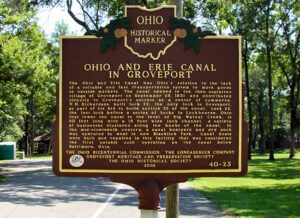
The Ohio and Erie Canal was Ohio’s solution to the lack of a reliable and fast transportation system to move goods to outside markets. The canal opened in the then unplatted village of Groveport on September 25, 1831 and contributed directly to Groveport’s success as a center of commerce. W.H. Richardson built lock 22, the only lock in Groveport, as part of his bid to build section 52 of the canal. Lock 22, the last lock before a series of locks in Lockbourne, Ohio that lower the canal to the level of Big Walnut Creek, is 90 feet long with a 15 foot wide lock channel. A variety of businesses clustered along the banks of the canal. In the mid-nineteenth century, a canal boatyard and dry dock was operated in what is now Blacklick Park. Canal boats were built and repaired in this facility that was considered the first notable such operation on the canal below Baltimore, Ohio.

, OH
The Erie Terminal Building, constructed 1921-1922, serviced both the Erie and Pittsburgh & Lake Erie Railways and area commerce. The design, by Swiss-born, Youngstown architect Paul Boucherle (1882-1966), is in the Commercial Style with simple classical details. The six-story building housed a passenger railroad station on the first floor and Erie Railway offices on the fifth and sixth floors. A one-story commercial bay faced Commerce Street and was the home of the International Bank and later the Morris Plan Bank. The widening of Commerce Street removed the bay in 1939. Once named the Hamory Building for its financial backer, Gustave Hamory, it was added to the National Register of Historic Places in 1986 and renovated in 2012, creating apartments in the upper floors and restoring the first-story railway spaces.
, OH
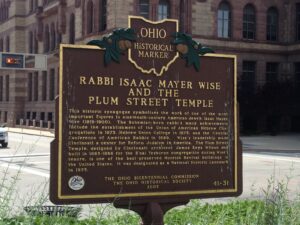
This historic synagogue symbolizes the work of one of the most important figures in nineteenth-century American Jewry, Isaac Mayer Wise (1819-1900). The Bohemian-born rabbi’s many achievements include the establishment of the Union of American Hebrew Congregations in 1873, Hebrew Union College in 1875, and the Central Conference of American Rabbis in 1889. Wise’s leadership made Cincinnati a center for Reform Judaism in America. The Plum Street Temple, designed by Cincinnati architect James Keys Wilson and built in 1865-1866 for the B’nai Yeshurun congregation during Wise’s tenure, is one of the best-preserved Moorish Revival buildings in the United States. It was designated as a National Historic Landmark in 1975.