

, OH
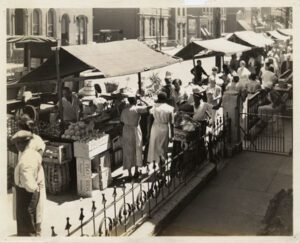
Public markets housing butchers, fish merchants, and produce vendors were once the primary source of perishable foods for residents of America’s cities. Cincinnati operated nine in 1859. Only Findlay Market, built here in 1852, survives. Cincinnati’s lost indoor markets include: Fifth Street Market: 1829 to 1870, Fifth between Vine and Walnut Wade Street Market: 1848 to 1898, corner of Wade and Bauer Avenue Canal Market: 1829 to 1864, Court between Vine and Walnut Court Street Market: 1864 to 1914, replaced Canal Market Jabez Elliott Flower Market: 1890 to 1950, Sixth between Elm and Plum Sixth Street Market: 1895 to 1960, Sixth between Plum and Western Row Pearl Street Market: 1901 to 1934, Market between Sycamore and Broadway
, OH
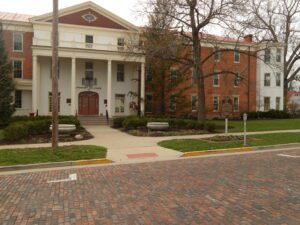
Chartered in 1849, the Institute was the first of three women’s colleges established in Oxford. The original brick building was completed in 1850, and forms the core structure. The Reverend John Witherspoon Scott, a member of Miami University’s early faculty, headed the Institute. In 1867, the Institute merged with Oxford Female College and later became the Oxford College for Women. Miami University acquired the building in 1928; in 1930 the Daughters of the American Revolution rededicated it as the “Caroline Scott Harrison Memorial.” From 1929-1998 it served as a Miami dormitory, nicknamed “Ox College.” Since 2003, the three-story building has housed the Oxford Community Arts Center. The structure is the oldest extant women’s college building in Ohio. It was placed on the National Register of Historic Places in 1976.
, OH
Harry B. Burt (1874-1926) came to Youngstown in 1893 and began making and selling penny candy. He expanded his business with high quality candies, chocolates, and ice cream. Around 1920 Burt invented a process for freezing a stick in an ice cream bar and coating it in chocolate so one could eat it without touching it. He called his new confection “Good Humor Ice Cream Suckers.” Burt purchased the building at 325 West Federal Street in 1921, remodeled it, and opened it on April 4, 1922 to make his products and serve his customers. Here he first mass produced ice cream bars and sold them in area neighborhoods from a fleet of freezer trucks with bells and uniformed drivers. After Burt’s death, investors purchased the brand, formed the Good Humor Corporation of America in Chicago, and it grew into a national phenomenon.
, OH
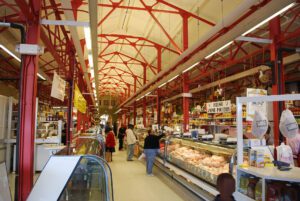
Ohio’s oldest surviving municipal market house, Findlay Market was designed under the direction of City Civil Engineer Alfred West Gilbert (1816-1900). It was listed on the National Register of Historic Places in 1972. The structure was among the first market houses in the United States to use iron frame construction technology. Originally an open pavilion, much of the market was erected in 1852, but disputes with contractors delayed its opening until 1855. The center masonry tower was built in 1902. Soon after, public health concerns prompted enclosure of the market stalls and the addition of plumbing and refrigeration. Until then, vendors found cool storage in deep cellars beneath nearby breweries. The tower bell was brought from Cincinnati’s Pearl Street Market in 1934. Findlay Market was renovated in 1973-74 and again in 2002-03.
, OH
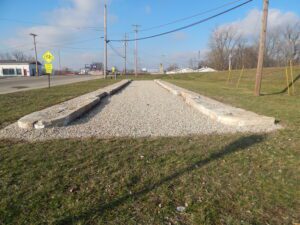
Construction of the Miami Extension of the Miami and Erie Canal, which included Troy, began around 1834. Lock 12 was built in 1836. General William Henry Harrison and other dignitaries officially opened the Troy section on July 4, 1837. The canal brought prosperity to the area, as its products were shipped to new markets and more people moved here. The last canal boat came through Lock 12 in 1912 and the disastrous flood of March 1913 finally ended Troy and Ohio’s canal era. Evidence suggests that in the late 1920s, the Hobart Brothers Company’s building on West Main Street covered part of the lock. The building and lock were razed in 2015. The footprint monument was dedicated June 7, 2017 and includes stones from Lock 12.
, OH
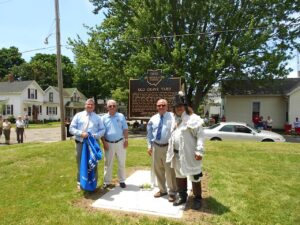
In 1805, a burial ground was dedicated to Champaign County at the intersection of Ward and Kenton Streets, which was then at Urbana’s town limits. It remained open until 1856. Among those interred there was Elizabeth Kenton, eight-year-old daughter of Simon Kenton. When she died in 1810, Kenton, the county jailer, was forbidden from crossing out of the town limits due to his unpaid debts. After following the funeral procession as far as he could, he watched Elizabeth’s burial from across the street. Also buried there were unknown soldiers from the War of 1812; Captain Arthur Thomas and son, who were killed by Native Americans in August 1813; four Bell children, who died in the tornado of March 22, 1830; and numerous early settlers of Champaign County. Many, but not all, were reinterred and rest in Oak Dale Cemetery.
, OH
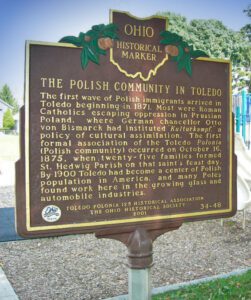
The first wave of Polish immigrants arrived in Toledo beginning in 1871. Most were Roman Catholics escaping oppression in Prussian Poland, where German chancellor Otto von Bismarck had instituted “Kulturkampf,” a policy of cultural assimilation. The first formal association of the Toledo Polonia (Polish community) occurred on October 16, 1875, when twenty-five families formed St. Hedwig Parish on that saint’s feast day. By 1900 Toledo had become a center of Polish population in America, and many Poles found work here in the growing glass and automobile industries.
, OH
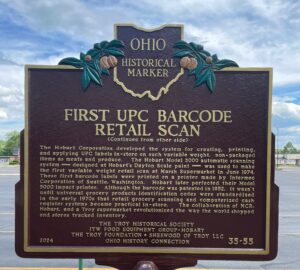
On June 26, 1974, the first retail scan of a product marked with a Universal Product Code (UPC or barcode) was made in the checkout line of Troy’s Marsh Supermarket located at 982 N. Market Street. A ten-pack of Wrigley’s Juicy Fruit chewing gum was scanned to simulate the purchase of a product. The barcode was scanned on the NCR 255 computerized check-out system developed by National Cash Register (NCR). The system featured a Spectra Physics Model A scanner and an NCR 726 in-store computerized cash register. The Troy grocery store, considered a “typical” American grocery, was conveniently located near NCR and Hobart facilities. Spectra Physics and NCR later donated one of the original scanners and cash registers used at Marsh’s to the National Museum of American History, Smithsonian. (Continued on other side)