In late March 1913, a series of three severe rainstorms inundated the already saturated and frozen ground of the Miami Valley, causing one of Ohio’s greatest natural disasters, the Flood of 1913. On March 25, the Great Miami River overflowed its banks at Miamisburg, fed by runoff from Bear and Sycamore creeks. Homes, businesses, and the bridges at Linden Avenue and Sycamore Street were swept away or wrecked by floodwaters reaching as high as eleven feet on Main and First streets. Early reports indicated that six people in the area died. Cleanup and recovery efforts took approximately a year. (Continued on other side)
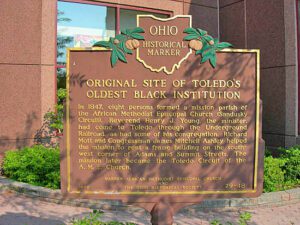
In 1847, eight persons formed a mission parish of the African Methodist Episcopal Church (Sandusky Circuit). Reverend Henry J. Young, the minister, had come to Toledo through the Underground Railroad, as had some of his congregation. Richard Mott and Congressman James Mitchell Ashley helped the mission to rent a frame building on the southwest corner of Adams and Summit streets. The mission later became the Toledo Circuit of the A.M.E. Church.
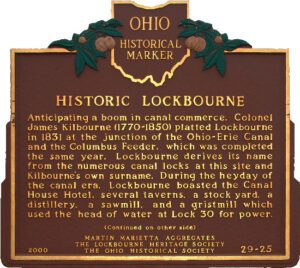
Anticipating a boom in canal commerce, Colonel James Kilbourne (1770-1850) platted Lockbourne in 1831 at the junction of the Ohio-Erie Canal and the Columbus Feeder, which was completed the same year. Lockbourne derives its name from the numerous canal locks at this site and Kilbourne’s own surname. During the heyday of the canal era, Lockbourne boasted the Canal House Hotel, several taverns, a stock yard, a distillery, a sawmill, and a gristmill which used the head of water at Lock 30 for power. (continued on other side)
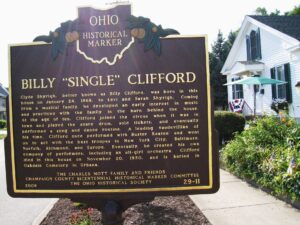
Clyde Shyrigh, better known as Billy Clifford, was born in this house on January 24, 1869, to Levi and Sarah Shyrigh. Coming from a musical family, he developed an early interest in music and practiced with the family in the barn behind the house. At the age of ten, Clifford joined the circus when it was in town and played the snare drum, sold tickets, and eventually performed a song and dance routine. A leading vaudevillian of his time, Clifford once performed with Buster Keaton and went on to act with the best troupes in New York City, Baltimore, Norfolk, Richmond, and Europe. Eventually, he created his own company of performers, including an all-girl orchestra. Clifford died in this house on November 20, 1930, and is buried in Oakdale Cemetery in Urbana.
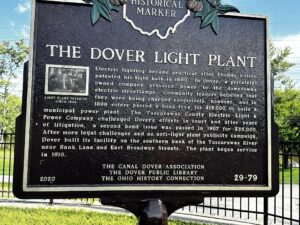
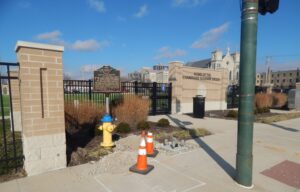
Electric lighting became practical after Thomas Edison patented his light bulb in 1880. In Dover, a privately-owned company provided power to the downtown’s electric streetlamps. Community leaders believed that they were being charged excessively, however, and in 1898 voters passed a bond levy for $15,000 to build a municipal power plant. The Tuscarawas County Electric Light & Power Company challenged Dover’s efforts in court and after years of litigation, a second bond issue was passed in 1907 for $35,000. After more legal challenges and an anti-light plant publicity campaign, Dover built its facility on the southern bank of the Tuscarawas River near Bank Lane and East Broadway Streets. The plant began service in 1910 and, with the Northern Ohio Traction & Light Company, supplied electricity to Dover.
Known by the trade name Henderson’s Printing, the business was a mainstay of Dayton’s African American community for almost 60 years and became a printer of choice for everything from advertising materials, office forms, and a community publications called “housewife savers.” John William Henderson Sr. (1913–1991) purchased his first printing press and founded the business in 1941, bringing to it experience as an instructor of journalism and printing at Wilberforce University. The business’s first location was the family home at 421 Kearney St. After several moves, the business settled at 301 Washington Street in 1958.
Corner of Division Street and East Lakeshore Drive
Kelleys Island
, OH
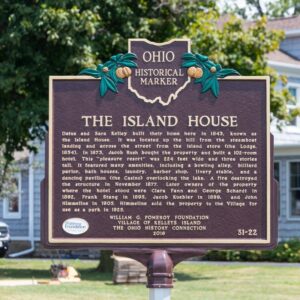
Datus and Sara Kelley built their home here in 1843, known as the Island House. It was located up the hill from the steamboat landing and across the street from the island store (the Lodge, 1854). In 1873, Jacob Rush bought the property and built a 102-room hotel. This “pleasure resort” was 224 feet wide and three stories tall. It featured many amenities, including a bowling alley, billiard parlor, bath houses, laundry, barber shop, livery stable, and a dancing pavilion (the Casino) overlooking the lake. A fire destroyed the structure in November 1877. Later owners of the property where the hotel stood were Clara Fann and George Schardt in 1892, Frank Stang in 1895, Jacob Kuebler in 1899, and John Himmeline in 1905. Himmeline sold the property to the Village for use as a park in 1925.
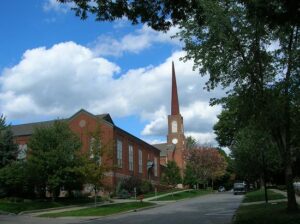
On this site, the first meetinghouse owned by the Hudson Congregational Church was dedicated March 1, 1820, twenty-one years after David Hudson first came to the Hudson area. Its members met here until they completed their sanctuary on Aurora Street in 1865. In August 1835, church members unanimously adopted a resolution declaring that slavery is”a direct violation of the law of Almighty God.” At a November 1837 prayer meeting, church member and anti-slavery leader John Brown made his first public vow to destroy slavery.