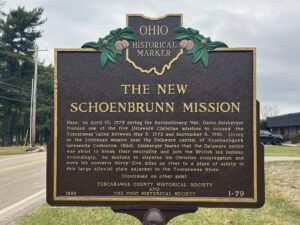
Here, on April 10, 1779 during the Revolutionary War, David Zeisberger founded one of the five Delaware Christian missions to occupy the Tuscarawas Valley between May 3, 1772 and September 8, 1781. Living at the Lichtenau mission near the Delaware capital of Goschachgunk (presently Coshocton, Ohio), Zeisberger feared that the Delaware nation was about to break their neutrality and join the British led Indians. Accordingly, he decided to disperse his Christian congregation and move his converts thirty-five miles up river to a place of safety in this large alluvial plain adjacent to the Tuscarawas River.
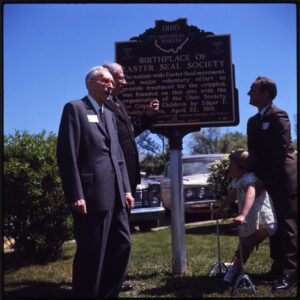
The nation-wide Easter Seal movement, first major voluntary effort to provide treatment for the crippled, was founded on this site with the organization of the Ohio Society for Crippled Children by Edgar F. (Daddy) Allen, April 22, 1919.
To furnish the needs of the early settlers, then to furnish ordnance for a nation at war, and finally to furnish merchant iron to the steel mills, 100 iron producing blast furnaces were built within these 1,800 square miles of the lower coal measures to become known as the Hanging Rock Region. Lawrence County, centrally located within the Region, had 23 blast furnaces constructed between 1826 and 1909.
I-77 SB just south of Exit 37 (Pleasant City) at Mile Marker 37.
Pleasant City
, OH
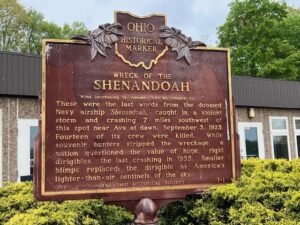
“Wind increasing in volume. Get no chance to . . . ” These were the last words from the doomed Navy airship Shenandoah, caught in a violent storm and crashing 7 miles southwest of this spot near Ava at dawn, September 3, 1925. Fourteen of its crew were killed. While souvenir hunters stripped the wreckage, a nation questioned the value of huge, rigid dirigibles, the last crashing in 1935. Smaller blimps replaced the dirigible as America’s lighter-than-air sentinels of the sky.
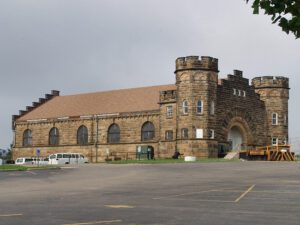
As the nation’s first and largest minimum security correctional facility, the Fairfield School for Boys served over 100,000 Ohio juvenile offenders. The school was converted to an adult facility in 1980. Presented by the Ridgeview Garden Club
“Wind increasing in volume. Get no chance to . . . ” These were the last words from the doomed Navy airship Shenandoah, caught in a violent storm and crashing 7 miles southwest of this spot near Ava at dawn, September 3, 1925. Fourteen of its crew were killed. While souvenir hunters stripped the wreckage, a nation questioned the value of huge, rigid dirigibles, the last crashing in 1935. Smaller blimps replaced the dirigible as America’s lighter-than-air sentinels of the sky.
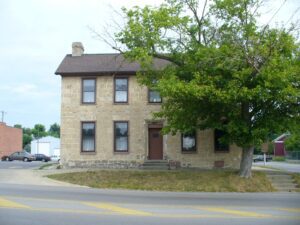
The Smith Tannery is the oldest original structure remaining in Greenfield. Built in 1821 by Revolutionary War veteran William Smith and his son Samuel, the tannery became a noted station on the fabled “Underground Railroad.” The structure, which also served as the family residence, was the birthplace of Dr. Samuel M. Smith, Surgeon General of Ohio during the Civil War, and Dr. William R. Smith, who personally notified Abraham Lincoln of his nomination to the presidency in 1864. The Smiths were active members of the Abolition Society of Paint Valley, which was established in 1833 in Greenfield and reorganized in 1836 as the Greenfield Anti-Slavery Society. In 1844, the Society assisted the efforts of Frederick Douglass, one of the nation’s leading abolitionists. The Society provided an important junction on the Underground Railroad, assisting many fugitive slaves to gain freedom, including, it is said, Eliza Jane Harris of Uncle Tom’s Cabin fame. The Smith Tannery was named to the National Register of Historic Places in 1978.
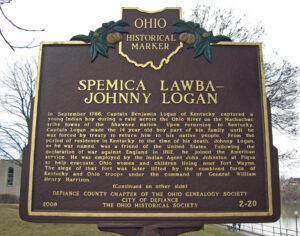
In September 1786, Captain Benjamin Logan of Kentucky captured a young Indian boy during a raid across the Ohio River on the Machachac tribe towns of the Shawnee nation. Upon returning to Kentucky, Captain Logan made the 14 year old boy part of his family until he was forced by treaty to return him to his native people. From the period of residence in Kentucky to the time of his death, Johnny Logan, as he was named, was a friend of the United States. Following the declaration of war against England in 1812, he joined the American service. He was employed by the Indian Agent John Johnston at Piqua to help evacuate Ohio women and children living near Fort Wayne. The siege of that fort was later lifted by the combined force of Kentucky and Ohio troops under the command of General William Henry Harrison. [continued on other side]