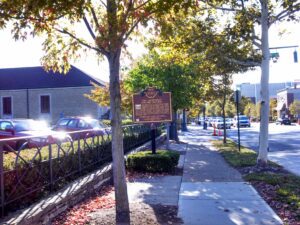
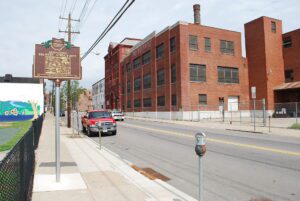
In the early 1900s, Ohio led the nation in interurban track mileage. The electrically powered interurban was favored over steam railroads for short distance passenger travel and the transport of local freight. Incorporated in 1899, the Columbus, Buckeye Lake, and Newark Traction Railway served Bexley from a terminal on Gay Street in downtown Columbus. Running south on High Street and then east on Mound Street, the line crossed Alum Creek into Bexley, went north up Pleasant Ridge Avenue past Capital University, and continued to the National Road (Main Street). Interurban cars stopped at the northeast corner of Main Street and Remington Road and thence sped on to Buckeye Lake, Newark, and later Zanesville. The popularity of the automobile spelled doom for the interurban. Service on the line ended in 1929.
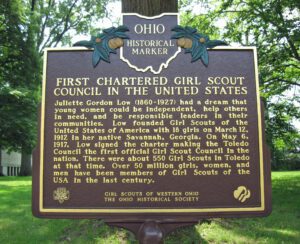
Juliette Gordon Low (1860-1927) had a dream that young women could be independent, help others in need, and be responsible leaders in their communities. Low founded Girl Scouts of the United States of America with 18 girls on March 12, 1912 in her native Savannah, Georgia. On May 6, 1917, Low signed the charter making the Toledo Council the first official Girl Scout Council in the nation. There were about 550 Girl Scouts in Toledo at that time. Over 50 million girls, women, and men have been members of Girl Scouts of the USA in the last century.
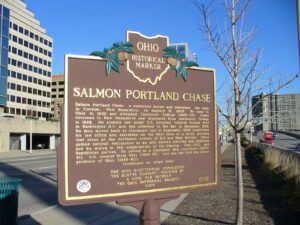
Salmon Portland Chase, a renowned lawyer and statesman, was born in Cornish, New Hampshire, on January 13, 1808. He came to Ohio in 1820 and attended Cincinnati College (1822-23). Chase returned to New Hampshire and graduated from Dartmouth College in 1826. He studied law under U.S. Attorney General William Wirt in Washington D.C. and was admitted to the bar in December 1829. He then moved back to Cincinnati and in September 1830 established his law office and residence on the first floor of a brick building that stood at the northeast corner of 3rd and Main Streets. Chase gained national recognition as an anti-slavery attorney and politician and by aiding in the organization of the Liberty, Free-Soil, and Republican parties. He served as a Cincinnati city councilman (1840-41), U.S. senator from Ohio (1849-55), and was the first Republican governor of Ohio (1856-60). (continued on other side)
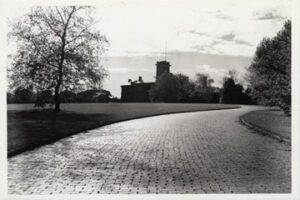
The Ohio General Assembly established the Ohio Agricultural Experiment Station in 1882. From its inception until 1892, the Station occupied 17 acres on the Columbus campus of The Ohio State University before relocating to 470 acres in Wayne County. In 1965, the Station changed its name to the Ohio Agricultural Research and Development Center (OARDC) to more accurately reflect its mission and programs. In 1982, the Center formally merged with The Ohio State University. Today, the Center encompasses nearly 2,100 acres in Wayne County with 10 branches located across the state for a total of approximately 7,100 acres dedicated to agricultural research.
The Brewery District contains the majority of Cincinnati’s remaining breweries and associated structures such as icehouses, bottling buildings, offices, and stables. With the first brewery north of Liberty Street founded in1829, German immigrants fueled the growth of the brewing industry; by 1891, Cincinnati breweries produced over four barrels of beer per resident annually, almost twice as much as any other city in the nation. The brick breweries were typically designed in the Romanesque Revival style, and larger complexes often covered multiple city blocks. To produce the lager style beer common by 1860, typically very deep basements were dug or tunnels were cut into hillsides for the lagering process. At the height of production, 18 of the 36 breweries in greater Cincinnati were operating in Over-the-Rhine and the West End. Prohibition in 1919 closed most of the breweries permanently.
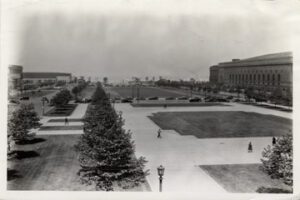
In August 1903, architects Daniel H. Burnham, John M. Carrere, and Arnold W. Brunner presented Mayor Tom L. Johnson and the City of Cleveland a plan that epitomized the City Beautiful Movement in America. The Group Plan envisioned a grand landscaped mall surrounded by public buildings in the Beaux-Arts style. The plan would create a monumental civic center, influence the design of buildings throughout the city, and lay the foundation for a city planning commission. The first of its kind in the nation, the Group Plan, as built, was the most completely realized of Burnham’s city planning efforts. In its green space and architecture, the Mall remains an enduring and vital element of Cleveland’s civic culture. (continued on other side)
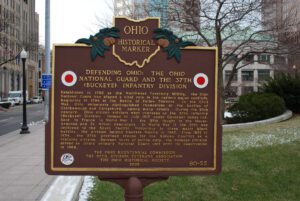
With five army camps in Columbus, Capitol Square was a military crossroads from 1861 to 1865. Ohio troops were mustered, paid, and on some occasions garrisoned at the Statehouse. Three of every five male Ohioans between the ages of 18 and 45 served in the Civil War. Ohio’s contribution to the war effort was enormous, supplying almost 320,000 soldiers to the Union Army, representing 230 regiments and 26 independent artillery batteries. More than 35,000 soldiers died during the war, and 30,000 more were disabled. One hundred forty-eight Ohio soldiers received the Congressional Medal of Honor for valor. Perhaps Ohio’s greatest contribution to the war was to the Union leadership that won it: Generals Ulysses S. Grant, William Tecumseh Sherman, Philip H. Sheridan, and James B. McPherson, as well as Secretary of War Edwin Stanton and Secretary of the Treasury Salmon Chase, were all Ohioans.
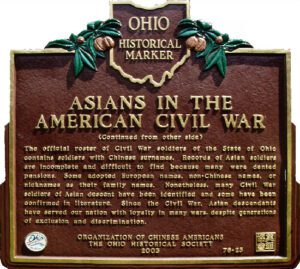
Despite exclusionary laws preventing U.S. citizenship, Asians served in the Union and Confederate armies and navies during the American Civil War (1861-1865). Many of these soldiers were denied citizenship following their services due to the anti-Asian sentiment, which culminated in the Naturalization Act of 1870 and the Chinese Exclusion Act of 1882. The exclusionary laws continued until 1943, and all restrictions on national origin or race were abolished in 1965. In April 2003, House Joint Resolution 45 was introduced to Congress to posthumously proclaim Civil War soldiers of Asian descent to be honorary citizens of the United States as recognition of their honorable services. (continued on other side)