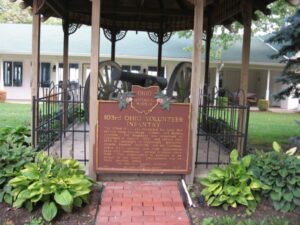
The 103rd O.V.I. was recruited for Civil War service from Cuyahoga, Lorain, and Medina counties. The Regiment was organized at Cleveland in August, 1862, and served until 1865 in campaigns at Cincinnati, Knoxville, Atlanta, Franklin, Nashville, and the Carolinas.103rd O.V.I. veterans and their descendants have held continuous, annual reunions since 1867. The organization is believed to be unique in the nation. Descendants live on these grounds today.
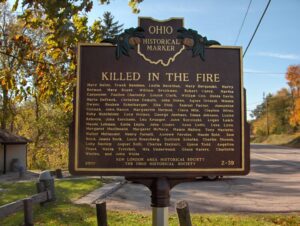
Located one mile north of Fitchville, the Golden Age Nursing Home caught fire and burned to the ground at 4:45 a.m., November 23, 1963, killing 63 of 84 patients. Fire departments from New London, Greenwich, North Fairfield, and Plymouth responded. Ignited by the arcing of overloaded wiring, the incident called for action to require sprinklers, automatic fire detection systems, and electrical wiring compliance to building codes in all nursing homes. The worst tragedy of its kind in the nation, the incident was overshadowed by the assassination of President John F. Kennedy and was not widely reported. Twenty-one unclaimed bodies were interred in a 60-foot grave in Woodlawn Cemetery in Norwalk. Those killed in the fire are listed on the reverse.
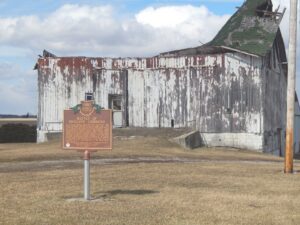
The Northwest Ordinance of 1787 defined the boundary of the northern and southern tier of states to be carved out of the Northwest Territory, as a line drawn east from the southernmost tip of Lake Michigan until it intersects Lake Erie. Controversy over the exact location of that line led to the 1834-1837 boundary dispute between the State of Ohio and Michigan Territory. Passions ran high as everyone on both sides of the boundary knew that a great port city (Toledo) would emerge in the disputed territory. President Andrew Jackson settled the dispute in 1836 when he signed an act that recognized the current border between Ohio and Michigan, giving Michigan 9,000 square miles of Upper Peninsula land and awarding the disputed strip of approximately 470 square miles to Ohio. Michigan then joined the nation as a state the following year.
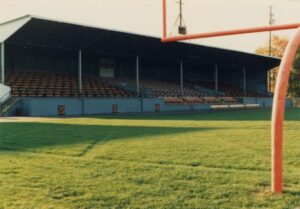
Opened in 1926, Tanks Memorial Stadium became the home of the Ironton Tanks semi-professional football team. The Tanks were formed in 1919 and through the years played other semi-professional teams as well as teams from the American Professional Football Association that became the National Football League in 1930. In twelve seasons the Tanks had a record of 85 wins, 19 losses, and 14 ties, including wins against the Chicago Bears and New York Giants. The Tanks disbanded in 1931, but five players moved on to the Portsmouth Spartans, which became the Detroit Lions, and other NFL teams picked up four other players. Tanks Memorial Stadium is one of the few remaining roofed high school football stadiums in the country.
A. B. Graham, superintendent of Springfield Township Rural schools in Clark County, established the Boys and Girls Agricultural Experiment Club, which revolutionized agricultural education and non-formal youth development methods. The first meeting of the club, said to be the nation’s first farm club for young people, was held at this site on January 15, 1902 in the basement of the Clark County Courthouse. This was the start of what would be called a 4-H Club a few years later. Through the years, the overall objective of A.B. Graham and 4-H has remained the same: the development of youth as individuals and as responsible and productive citizens.
The West Liberty area, in the Mad River Valley, was the location of at least seven Shawnee Indian villages. This elevated site was the location of one of those villages. Several septs or divisions of the Shawnee nation lived in this area after being forced from their homes in southern Ohio. In 1786, together with Simon Kenton, Colonel Benjamin Logan’s army destroyed all the Shawnee villages in retaliation for the Indian raids in southern Ohio and Kentucky. Consequently, the remaining Shawnees moved to northwest Ohio near the present-day site of Maumee.
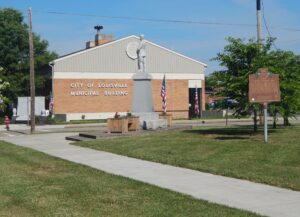
At this site on September 17, 1952, an assembly of Louisville citizens led by Olga T. Weber joined U.S. Congressman Frank T. Bow in commemorating the completion of U.S. Constitution on September 17, 1787. With the goal of promoting a wider understanding of citizens’ rights and responsibilities, the Committee for the Preservation of the Constitution lobbied for both state and national observances. In 1953, Governor Frank Lausche proclaimed September 17 as Constitution Day in Ohio; subsequently President Dwight D. Eisenhower proclaimed the week of September 17, 1955 as Constitution Week. The committee, incorporated in 1962, has marked the anniversary each year since–making this Louisville tradition the nation’s longest continuing observance of Constitution Day.
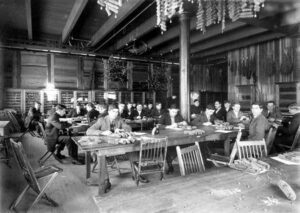
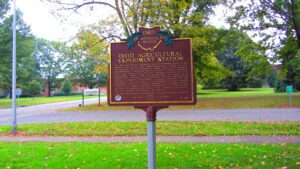
The Ohio General Assembly established the Ohio Agricultural Experiment Station in 1882. From its inception until 1892, the Station occupied 17 acres on the Columbus campus of The Ohio State University before relocating to 470 acres in Wayne County. In 1965, the Station changed its name to the Ohio Agricultural Research and Development Center (OARDC) to more accurately reflect its mission and programs. In 1982, the Center formally merged with The Ohio State University. Today, the Center encompasses nearly 2,100 acres in Wayne County with 10 branches located across the state for a total of approximately 7,100 acres dedicated to agricultural research.