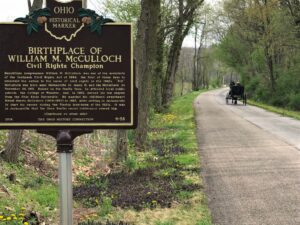
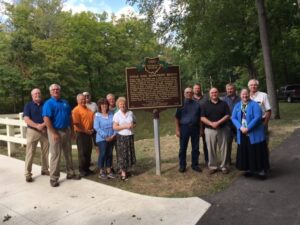
Republican congressman William M. McCulloch was one of the architects of the landmark Civil Rights Act of 1964, the first of three laws to recommit the nation to the cause of civil rights in the 1960s. “Bill” McCulloch was born near Holmesville to James H. and Ida McCulloch on November 24, 1901. Raised on the family farm, he attended local public schools, the College of Wooster, and, in 1925, earned his law degree from the Ohio State University. He married his childhood sweetheart Mabel Harris McCulloch (1904-1990) in 1927, after settling in Jacksonville to start his career during the Florida land-boom of the 1920s. It was in Jacksonville that the Deep South’s racial intolerance seared him. (Continued on other side)
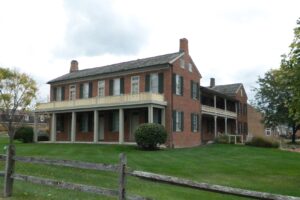
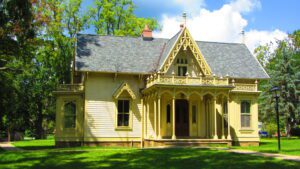
David Snively built the Federal-style Pennsylvania House in 1839 along the newly constructed National Road. This tavern and inn was an important stopover for livestock drovers and pioneers traveling by foot, on horseback, or in Conestoga wagons during the westward expansion of the United States in the nineteenth century. Dr. Isaac K. Funk, of Funk & Wagnalls fame, lived in the house in the 1840s while his father served as its tavern keeper. Closed as an inn after the Civil War, it then served as a doctor’s clinic, boarding house, and secondhand shop before falling into total disrepair. The Lagonda Chapter of the Daughters of the American Revolution saved it from demolition and has owned and operated it as a museum since 1941. The Pennsylvania House was put on the National Register of Historic Places in 1972.
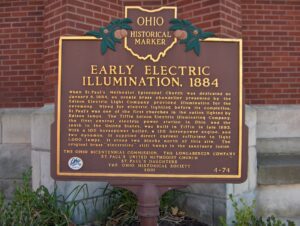
When St. Paul’s Methodist Episcopal Church was dedicated on January 6, 1884, an ornate brass chandelier presented by the Edison Electric Light Company provided illumination for the ceremony. Wired for electric lighting before its completion, St. Paul’s was one of the first churches in the nation lighted by Edison lamps. The Tiffin Edison Electric Illuminating Company, the first central electric power station in Ohio and the tenth in the United States, was built in Tiffin in late 1883. With a 100 horsepower boiler, a 120 horsepower engine, and two dynamos, it supplied direct current sufficient to light 1,000 lamps. It stood two blocks north of this site. The original brass “electrolier” still hangs in the sanctuary inside.
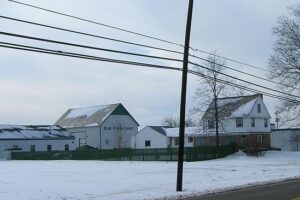
In 1927, Henry Abell, a master plumber, purchased a 100-acre dairy farm. When the Great Depression struck the nation two years later, Abell could find little work as a plumber and decided to develop his dairy farm. In 1934, he and his family began the Dairy, growing the farm to 500 acres and producing enough milk, ice cream, and other dairy products to supply five counties. The dairy closed in 1979, but today houses America’s Ice Cream and Dairy Museum, dedicated to the cultural history of the ice cream and dairy industry in Ohio and the United States.
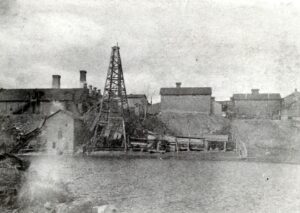
In 1885, 800 feet north of this marker, Benjamin Faurot struck oil after drilling into the Trenton Rock Limestone formation at a depth of 1,251 feet. This event marked the beginning of the great Oil Boom of northwest Ohio. The ensuing rush brought speculators who drilled hundreds of wells in the Trenton Rock (Lima) Oil Field that stretched from Mercer County north through Wood County in Ohio and west to Indiana. By 1886, the Lima field was the nation’s leading producer of oil, and by the following year it was considered to be the largest in the world. Production from the Ohio portion of the Lima-Indiana field reached its peak in 1896, when more than 20 million barrels were brought out of the ground. Though short-lived, the oil rush brought an influx of people, pipelines, refineries, and businesses, giving a powerful impetus to the growth of northwest Ohio.
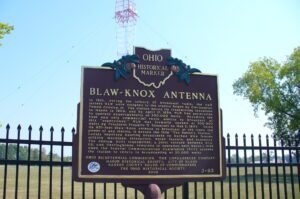
In 1922, during the infancy of broadcast radio, the call letters WLW were assigned to the station begun by Cincinnatian Powell Crosley Jr. The station moved its transmitting operations to Mason in 1928, and by April 17, 1934, WLW had permission to operate experimentally at 500,000 watts. Becoming the first and only commercial radio station to broadcast at this “superpower,” WLW was formally opened at 500,000 watts by President Franklin D. Roosevelt on May 2, 1934. Using its 831-foot Blaw-Knox antenna to broadcast at ten times the power of any station, it earned the title “The Nation’s Station.” Locals reported hearing broadcasts on barbed wire fences, milking machines, rainspouts, water faucets, and radiators. The custom built transmitter, a joint venture between RCA, GE, and Westinghouse, remained in operation until March 1, 1939 when the Federal Communications Commission (FCC) ordered the station to return to broadcasting at 50,000 watts.
Zenas King (1818-1892) was a 19th century bridge builder whose iron bridges received wide acceptance throughout the country. He developed his tubular bowstring bridge in 1859, patented the design in 1861, renewed the patent in 1867, and founded King Iron Bridge & Manufacturing Company in 1871. Based on an arch’s inherent strength, King’s design used less raw materials than wooden bridges and the square tubes were simple to fabricate and ship for on-site assembly. His Cleveland-based company soon built so many patent bowstrings across Ohio that it set a design standard. (Continued on other side)
In 1938 the president of Kenyon College, Gordon Keith Chalmers, brought one of the nation’s most distinguished poets and critics, John Crowe Ransom, to the Gambier Hill. Chalmers brought Ransom to Kenyon College to create a distinguished literary review. With its first appearance late in 1938, The Kenyon Review would become one of the most influential and honored literary magazines in America. Among the authors Ransom published during his two decades as editor were Robert Penn Warren, William Empson, Flannery O’Connor, Doris Lessing, Robert Lowell, and Randall Jarrell. The Kenyon Review also became closely identified with the “New Criticism,” a method of interpreting literature that influenced succeeding generations of readers and teachers around the world. (Continued other side.)