

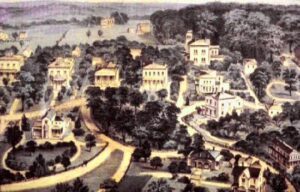
, OH
Established in 1851 after the addition of the Cincinnati, Hamilton, and Dayton Railway, Glendale incorporated in 1855 as Ohio’s first planned community and one of the nation’s first planned villages. The original planning included forested greenbelts and parks, curvilinear streets meandering around established trees, large lots, and superior building standards. Glendale is designated as a National Historic Landmark community from the Department of Interior and a Certified Local Government through the Ohio Historic Preservation Office, all owed to Glendale’s persistent adherence to the plan and faithful preservation of original infrastructure. Much of today’s preserved infrastructure includes the original 59 pivotal buildings, curvilinear streets, tree canopy, stone gutters, gas streetlights, and railroad depot.
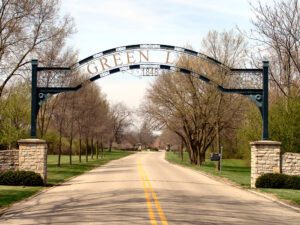
, OH
Landscape architect Howard Daniels designed the original portion of Green Lawn Cemetery in 1848. Noted Columbus architect Frank Packard designed Green Lawn’s Chapel mausoleum, the Hayden family mausoleum, and the Packard mausoleum. Spanning over 360 acres, the cemetery’s wooded setting provides a habitat for a variety of birds and other wildlife. The Chapel contains stunning stained glass windows and mosaic artwork by Tiffany & Company of New York. The monuments, obelisks, and memorials throughout the cemetery represent a wealth of artwork and a history of Columbus. As one of the oldest and largest cemeteries in Ohio, Green Lawn is the resting-place of many noted individuals who have made significant contributions to Columbus, Franklin County and the nation.
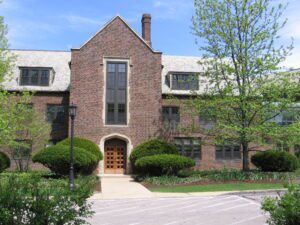
, OH
Florence E. Allen (1884-1966) was nicknamed “first lady of the law” for her many firsts as a woman in the legal profession. After graduating from Western Reserve College for Women, she taught at Laurel School from 1906 to 1909. She then became a crusader for women’s rights, and in 1913 received a law degree from New York University. Allen was appointed as an assistant Cuyahoga County prosecutor in 1919, the first woman in the country to hold such a position. In 1920, she was elected to Cleveland’s Court of Common Pleas, advancing, in 1922, to the Ohio Supreme Court, where she served two terms. In 1934, President Franklin D. Roosevelt appointed Allen to the nation’s second highest tribunal, the United States Sixth Circuit Court of Appeals, where she became its first female member. In 1958, she was elevated to Chief Justice of that body and retired in 1965.
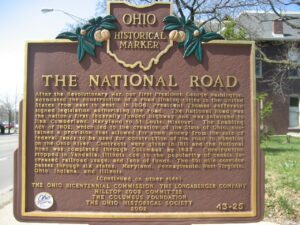
, OH
After the Revolutionary War, our first President, George Washington, advocated the construction of a road linking cities in the United States from east to west. In 1806, President Thomas Jefferson signed legislation authorizing the road. The National Road was the nation’s first federally funded highway and was intended to link Cumberland, Maryland to St. Louis, Missouri. The Enabling Act of 1802, which led to the creation of the state of Ohio, contained a provision that allowed for some money from the sale of federal lands to be used for construction of the road to Wheeling on the Ohio River. Contracts were given in 1811 and the National Road was completed through Columbus by 1833. Construction stopped in Vandalia, Illinois due to the popularity of canals, increased railroad usage, and lack of funds. The 591-mile corridor passes through six states: Maryland, Pennsylvania, West Virginia, Ohio, Indiana, and Illinois.
, OH
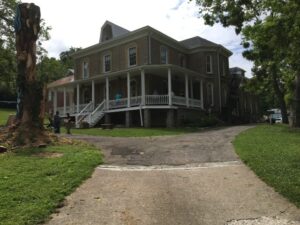
The Civil War created orphaned and impoverished children across the nation. To establish a home for area children, a group of Hamilton women met with Reverends Thane Miller and Benjamin W. Chidlaw in January 1869. By May, the women had rented a house on North C Street. Five years later, a new house was needed. Local businessmen Clark Lane and Elbridge G. Dyer pledged a combined $10,000 to purchase the property at 425 South D Street. One condition of the gift was that home’s operators had to raise an additional $2,000 to cover expenses. The newer, larger home opened in September 1875. In 1902, Robert and Eleanor Beckett McKinney donated funds to build a hospital on the property, named Ruth Hospital, to honor their deceased infant daughter. Mrs. McKinney and her mother, Martha Beckett, had long supported the home’s work. (Continued on other side)
, OH
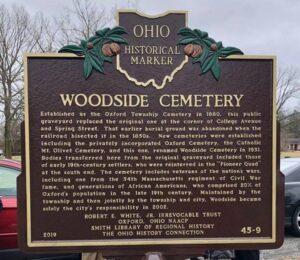
Established as the Oxford Township Cemetery in 1880, this public graveyard replaced the original one at the corner of College Avenue and Spring Street. That earlier burial ground was abandoned when the railroad bisected it in the 1850s. New cemeteries were established including the privately incorporated Oxford Cemetery, the Catholic Mt. Olivet Cemetery, and this one, renamed Woodside Cemetery in 1931. Bodies transferred here from the original graveyard included those of early 19th-century settlers, who were reinterred in the “Pioneer Quad” at the south end. The cemetery includes veterans of the nation’s wars, including one from the 54th Massachusetts regiment of Civil War fame, and generations of African Americans, who comprised 20% of Oxford’s population in the late 19th century. Maintained by the township and then jointly by the township and city, Woodside became solely the city’s responsibility in 2002.
, OH
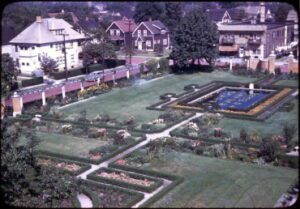
The Village of Collinwood was originally a part of Euclid Township of the Western Reserve and named after the death of railroad chief engineer Charles Collins in 1876. Originally known as “Frogsville,” the population of Collinwood dramatically increased in the 1870s, due partly to repair roundhouses of the Lake Shore & Michigan Southern Railroad. By 1901, the Village has grown to 7,500, and as a result, the schoolhouse, which once housed 200 students and four classrooms, had been enlarged twice to house 350 students in eight classrooms. Constructed in 1901, the Lakeview School was the site of a tragedy that reverberated across the nation and around the world. (Continued on other side)
, OH
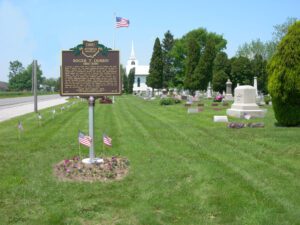
According to fellow World War II veteran and U.S. Senator Bob Dole, Roger T. Durbin was “the public persona—the beacon—of the drive to build a National World War II Memorial in our nation’s capital.” It started with a conversation between Mr. Durbin and Congresswoman Marcy Kaptur at a local fish fry in February 1987. Enlisting Kaptur’s support, the work to create the memorial began. Described as a “gentleman with a square jaw, twinkling eyes, and churlish grin,” Mr. Durbin committed himself to serving others. He was a rural letter carrier, Richfield Township trustee, and coached Little League baseball. He was a veteran of the Tenth Armored (Tiger) Division and saw action at the Battle of the Bulge. The National WWII Memorial was dedicated May 29, 2004. Although Mr. Durbin did not live to see that day, his determination is the reason it stands.