

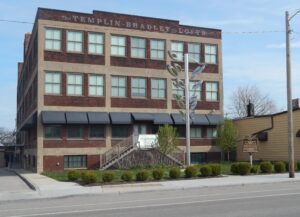
, OH
In 1907, the Templin-Bradley Company’s Children’s Flower Mission was developed in response to the Cleveland Public Schools Horticulture Program, supplying seed packets for 1 cent each–commonly referred to as Penny Packet Seeds. This earned the company a reputation for being the nation’s largest distributor of seeds for school garden programs. Although only nine varieties of plants were offered, interest was so great that nearly 50,000 packages were sold during the first year with no expense to the public-school teachers. With great success realized in the local school gardening program, interest grew exponentially across the nation and programs began in other cities. For fifty years, the Templin-Bradley Company sold flower and vegetable seeds at low costs to student members of garden groups throughout the country, cultivating many generations of gardeners.
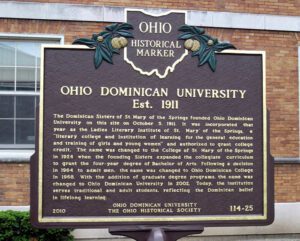
, OH
The Dominican Sisters of St. Mary of the Springs founded Ohio Dominican University on this site on October 5, 1911. It was incorporated that year as the Ladies Literary Institute of St. Mary of the Springs, a “literary college and institution of learning for the general education and training of girls and young women” and authorized to grant college credit. The name was changed to the College of St. Mary of the Springs in 1924 when the founding Sisters expanded the collegiate curriculum to grant the four-year degree of Bachelor of Arts. Following a decision in 1964 to admit men, the name was changed to Ohio Dominican College in 1968. With the addition of graduate degree programs, the name was changed to Ohio Dominican University in 2002. Today, the institution serves traditional and adult students, reflecting the Dominican belief in lifelong learning.
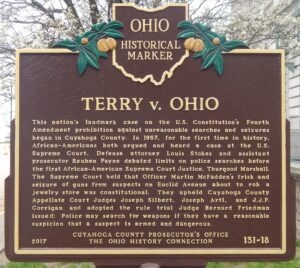
, OH
This nation’s landmark case on the U.S. Constitution’s Fourth Amendment prohibition against unreasonable searches and seizures began in Cuyahoga County. In 1967, for the first time in history, African-Americans both argued and heard a case at the U.S. Supreme Court. Defense attorney Louis Stokes and assistant prosecutor Reuben Payne debated limits on police searches before the first African-American Supreme Court Justice, Thurgood Marshall. The Supreme Court held that Officer Martin McFadden’s frisk and seizure of guns from suspects on Euclid Avenue about to rob a jewelry store was constitutional. They upheld Cuyahoga County Appellate Court Judges Joseph Silbert, Joseph Artl, and J.J.P. Corrigan and adopted the rule trial Judge Bernard Friedman issued: Police may search for weapons if they have a reasonable suspicion that a suspect is armed and dangerous.
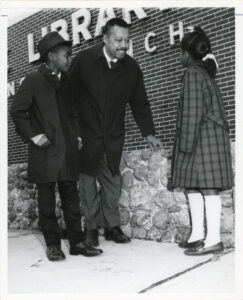
, OH
On November 19, 1968, the Columbus Metropolitan Library dedicated the first public library in the nation named after Dr. Martin Luther King Jr. After King’s assassination on April 4, 1968, the East Side Community Council requested that the new library being planned for the King-Lincoln Bronzeville community bear his name. The King family had both family and civic ties to Columbus and were honored by the tribute. More than 1,000 people gathered outside 1600 E. Long Street to hear Martin Luther King Sr. deliver the November dedication speech. Continuing the King family tradition, Martin Luther King III cut the ribbon to open a new branch building at 1487 E. Long Street on October 18, 2018. The Martin Luther King Branch was the first Columbus public library to bear an individual’s name.
, OH
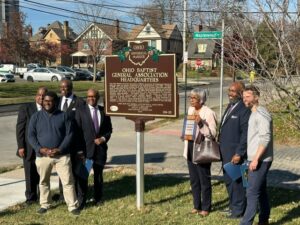
The Ohio Baptist General Association (OBGA) acquired 48 Parkwood Avenue in 1954 and used the former residence as its headquarters until 1996. Formed in 1896, the Association includes more than forty African American churches, many formed prior to the Civil War. Baptist general associations nationwide became an important voice during the 1960s Civil Rights Movement as they addressed the wrongs of racial violence and discrimination in business, housing, and education. The OGBA fought for the ideals of justice and freedom with its strongly-held Baptist beliefs. “America with her wealth as a great nation,“ OGBA President Wilber A. Page declared in 1957, “is well able to face integration and give a democracy to all her citizens.” The former Association Headquarters was listed in the National Register of Historic Places on December 3, 2020.

, OH
Carl Stokes was born in Cleveland on June 21, 1927. Recognized for his trailblazing service as a public official, Stokes is one of the few American politicians whose career spanned all three branches of state government. Over 30 years, he served 3 terms as an Ohio legislator (1963-1967), 2 terms as Cleveland’s mayor (1967-1971), and 8 years as a municipal court judge (1983-1994). In 1972, he became the first Black anchorman for a television station in New York City. After a decade working in television, Stokes returned to Cleveland to work as an attorney for the United Auto Workers. In 1994, President Bill Clinton appointed him U.S. Ambassador to the Republic of Seychelles. While serving as Ambassador, he was diagnosed with cancer. Carl Stokes died, in Cleveland, on April 3, 1996.
, OH
The Greater Abyssinia Baptist Church (GABC) organized with 250 members on December 16, 1945, at a Phillis Wheatley Association meeting. Led by its first pastor, Rev. John Rollins Plummer, the congregation raised $47,000 to purchase the Jewish Synagogue at East 105th Street and Tacoma Avenue from the Beth Hamedrosh Hagodel Beth Israel Congregation in 1946. It later purchased a parsonage, land for parking, and created a Federal Credit Union. Tragically, Rev. Plummer was killed in a car accident on October 22, 1951. The church’s lower auditorium was remodeled and dedicated as J.R. Plummer Memorial Hall. Honoring its missionary and pastoral care foundations, the church built a $3M senior citizens complex nearby. An endowment fund, instituted by its pastor’s savings in 1995, ensures that this commitment to civic leadership endures.
, OH
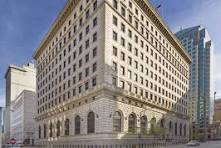
Cleveland was chosen as one of the country’s twelve Federal Reserve cities after a competitive selection process and opened its bank on November 16, 1914. The Federal Reserve Banks promote maximum employment and stable prices as part of the central banking system authorized by the 1913 Federal Reserve Act. Cleveland’s Bank serves the communities of the Fourth Federal Reserve District through supervision and regulation of financial institutions, analyzing and reporting on regional economic trends, and producing research on economic issues of importance to the nation and world. The first woman officer in any of the twelve banks was promoted to her role in 1956 by the Cleveland Fed. In 1982, the first woman in any of the nation’s Federal Reserve Banks served as the sixth President of the Federal Reserve Bank of Cleveland.