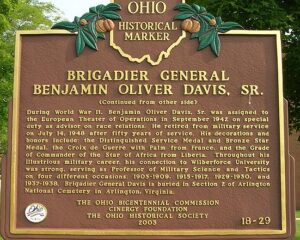
Benjamin Oliver Davis, Sr. (July 1, 1877 – November 26, 1970), the nation’s first African American general in the Regular Army, was born in Washington, D.C. Davis first served as a temporary first lieutenant of the 8th U.S. Volunteer Infantry during the Spanish-American War. Following that conflict, he enlisted as a private in the 9th U.S. Cavalry, serving in the Philippine Insurrection where he began to rise in rank. Davis was promoted to first lieutenant in 1905, captain in 1915, lieutenant colonel in 1920, colonel in 1930, and brigadier general in 1941. His military career took him around the world. In 1909, he was detailed as Military Attache to Monrovia, Liberia. During World War I, Davis was stationed in the Philippines. In 1938, he took command of the New York’s African American 396th National Guard Infantry, later known as the 369th Coast Artillery (Antiaircraft) Regiment. (Continued on other side)
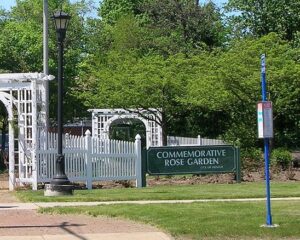
From the 1920s through the 1970s, Mentor was recognized as the Rose Capital of the Nation. Lake effect climate, a variety of soils, and abundant water made Mentor ideal for growing roses. Over a dozen growers produced about five million plants a year from their fields in Mentor. The Civic Center Complex was once a massive field of roses, and streets such as Tea Rose, Wyant, and Rosebud were named in honor of the blossoms that grew so abundantly here. Notable growers include Gerard K. Klyn, the largest rose grower in the Midwest; Joseph Kallay, who in 1932 received U.S. patent No. 10 for “Blaze;” Melvin E. Wyant, accredited rose grower, judge, and lecturer; Joseph J. Kern, nationally recognized expert on old fashioned roses; and Paul R. Bosley, who specialized in hybrid tea roses. By the 1970s, increased land values and development led to depletion of much of Mentor’s nursery lands.
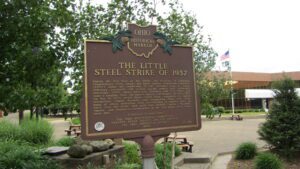
During the New Deal of the 1930s, the Congress of Industrial Organizations (CIO) formed the Steel Workers Organizing Committee (SWOC) under the leadership of CIO president John L. Lewis. Following successful CIO strikes in the rubber and automobile industries, SWOC signed hard-won contracts with U.S. Steel and Jones & Laughlin Steel, the nation’s largest steelmakers, in early 1937. On May 26 SWOC struck three “Little Steel” companies for similar recognition: Inland, Republic, and Youngstown Sheet and Tube, many of whose operations were concentrated in eastern Ohio. By early June the strike idled more than 28,000 Canton, Massillon, Warren, and Youngstown steelworkers in the first major steel strike since 1919. (continued on other side)
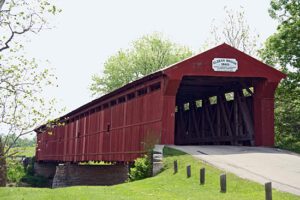
Originally known as Allen’s Mill Bridge, the Eldean Covered Bridge was built over the Great Miami River in 1860 for Miami County by the Hamilton Brothers of nearby Piqua. Its 224 feet place it among Ohio’s longest covered bridges and the longest in the nation that follows an 1830 Stephen H. Long patent, considered America’s first science-based bridge design. The Long system added strength through a series of hand-driven wedges. Placed on the National Register of Historic Places in 1975, the bridge was restored in 2005/2006.
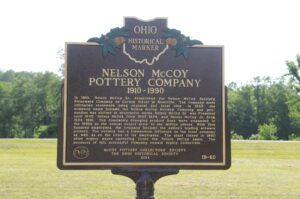
In 1910, Nelson McCoy Sr. established the Neleson McCoy Sanitary Stoneware Company on Gordon Street in Roseville. The company made utilitarian stoneware using regional and local clay. In 1933, the company name became the Nelson McCoy Pottery Company and production was shifted to decorative wares. Nelson McCoy Sr. was President until 1945, Nelson Melick from 1945-1954, and Nelson McCoy Jr. from 1954-1981. The constantly changing product lines were expanded in the 1950s as the annual output grew to ten million pieces. WIth five hundred employees, the company became the nation’s leading artware pottery. The pottery had a tremendous influence on the local economy as well as on the lives of its employees. The plant closed in 1990 after eighty years operating under the Nelson McCoy name. The products of this successful company remain highly collectible.
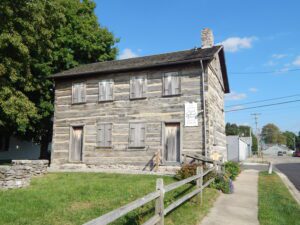
On this site Daniel Gebhart established a tavern in 1811. Taverns were where people gathered to eat, rest, and share news. During spring freshets, boatmen from the Great Miami River stayed at the tavern. Joining them were pioneers coming by the river and overland to settle at Hole’s Station, now Miamisburg. The tavern closed in 1840, became a boarding house, and then sold to become a private residence in 1853. To commemorate the nation’s Bicentennial in 1976, Miamisburg’s bicentennial committee purchased the tavern and gave it to the city. It was restored and opened as a museum in 1982. (Continued on other side)
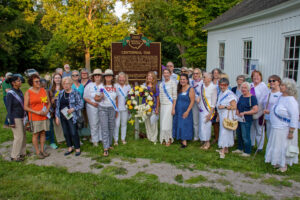
The Newbury Woman Suffrage Political Club, headquartered at Union Chapel, planted the Centennial Oak on July 4, 1876. The White Oak (Quercus alba) was chosen for its endurance, longevity, and beauty. The picnic and planting celebration included speeches, songs, fireworks, and a poem dedicated to the Oak written by local suffragist Anna Green. As the club gained national recognition, it attracted such notable suffragists as Susan B. Anthony and Harriet Taylor Upton as visitors and speakers. A Newbury gathering on August 23, 1919, held to celebrate Ohio’s recent ratification of the 19th Amendment, included suffragists Upton and Frances Jennings Casement. The last living founding member of Newbury’s Woman Suffrage Club, Dr. Julia Porter Green, led a parade from the chapel to Centennial Oak. There she placed a wreath of evergreen and goldenglow upon the tree.
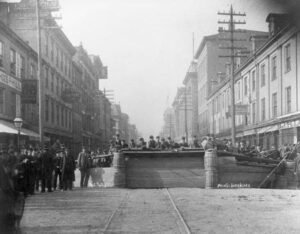
In March 1884, public confidence of Cincinnati law enforcement was extremely low. The public believed that murderers and other serious offenders were not brought to justice promptly or received little punishment. Civil unrest was brought to a boil when a seventeen-year-old was sentenced to only twenty years for manslaughter after brutally murdering his employer. On March 28, thousands of citizens stormed the county jail and courthouse. The riots lasted three days requiring forces from the Sheriff’s Office, city police, and local and state militia to restore order. Fifty-four people were killed and more than 200 wounded. The courthouse and jail suffered enormous damage, and valuable records were destroyed from the assault and fire. The riot gained international notoriety and helped pave the way for removal of political favoritism and a larger police force.