
, OH
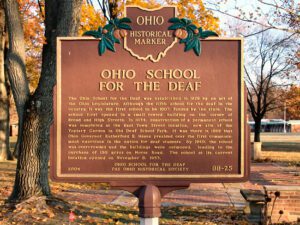
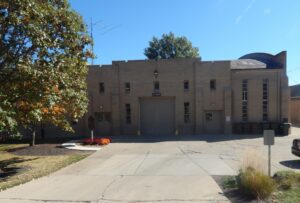
The Ohio School for the Deaf was established in 1829 by an act of the Ohio Legislature. Although the fifth school for the deaf in the country, it was the first school to be 100% funded by the state. The school first opened in a small rented building on the corner of Broad and High Streets. In 1834, construction of a permanent school was completed at the East Town Street location, now site of the Topiary Garden in Old Deaf School Park. It was there in 1869 that Ohio Governor Rutherford B. Hayes presided over the first commencement exercises in the nation for deaf students. By 1940, the school was overcrowded and the buildings were outmoded, leading to the purchase of 130 acres on Morse Road. The school at its current location opened on November 8, 1953.
, OH
Xavier University Armory. The Xavier University Armory was dedicated in 1948 by the first Secretary of the Army, Kenneth C. Royall. In the following decades, U.S. Army Reserve Officer Training Corps (ROTC) cadets used it as a place to refine their tactical and technical skillsets in preparation to serve as officers in the U.S. Army. Since 1948, Xavier University ROTC commissionees have become General Officers and recipients of the Silver Star Medal, Bronze Star Medal, Purple Heart, and other prestigious awards. (Continued on other side)
, OH
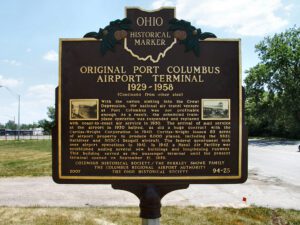
The original Port Columbus Airport terminal was founded by the people of Columbus and was one of the first airport facilities in the United States. Dedicated on July 8, 1929, Port Columbus was the first transfer point in the westbound transcontinental passenger service, which was operated by the Pennsylvania Railroad, Transcontinental Air Transport (TAT), and the Santa Fe Railway. Its first passengers departed by rail from New York City on July 7, 1929, and boarded TAT Ford Tri-Motor aircraft at Port Columbus to fly to Waynoka, Oklahoma, the following day. They then traveled by rail to Clovis, New Mexico, and completed their journey with a TAT flight to Los Angeles. The scheduled 48-hour trip was celebrated in Columbus, marking the beginning milestone of national airport travel. (continued on other side)
, OH
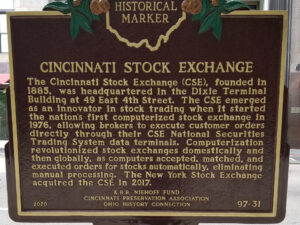
The Cincinnati Stock Exchange (CSE), founded in 1885, was headquartered in the Dixie Terminal Building at 49 East 4th Street. The CSE emerged as an innovator in stock trading when it started the nation’s first computerized stock exchange in 1976, allowing brokers to execute customer orders directly through their CSE National Securities Trading System data terminals. Computerization revolutionized stock exchanges domestically and then globally, as computers accepted, matched, and executed orders for stocks automatically, eliminating manual processing. The New York Stock Exchange acquired the CSE in 2017.
, OH
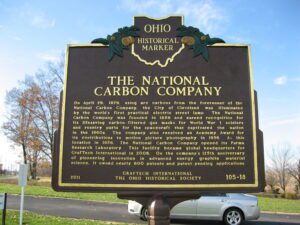
On April 29, 1879, using arc carbons from the forerunner of the National Carbon Company, the City of Cleveland was illuminated by the world’s first practical electric street lamp. The National Carbon Company was founded in 1886 and earned recognition for its lifesaving carbon-filtered gas masks for World War I soldiers and reentry parts for the spacecraft that captivated the nation in the 1960s. The company also received an Academy Award for its contributions to motion picture photography in 1956. At this location in 1956, The National Carbon Company opened its Parma Research Laboratory. This facility became global headquarters for GrafTech International in 2006. On the company’s 125th anniversary of pioneering innovation in advanced energy graphite material science, it owned nearly 800 patents and patent-pending applications.
, OH
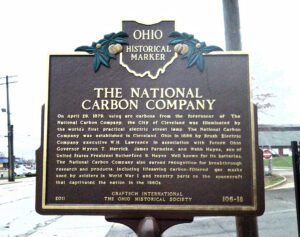
On April 29, 1879, using arc carbons from the forerunner of The National Carbon Company, the City of Cleveland was illuminated by the world’s first practical electric street lamp. The National Carbon Company was established in Cleveland, Ohio in 1886 by Brush Electric Company executive W.H. Lawrence in association with future Ohio Governor Myron T. Herrick, James Parmelee, and Webb Hayes, son of United States President Rutherford B. Hayes. Well known for its batteries, The National Carbon Company also earned recognition for breakthrough research and products, including lifesaving carbon-filtered gas masks used by soldiers in World War I and reentry parts on the spacecraft that captivated the nation in the 1960s.
, OH
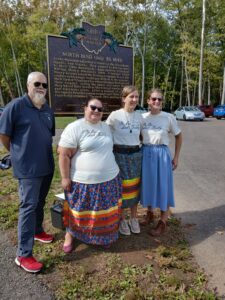
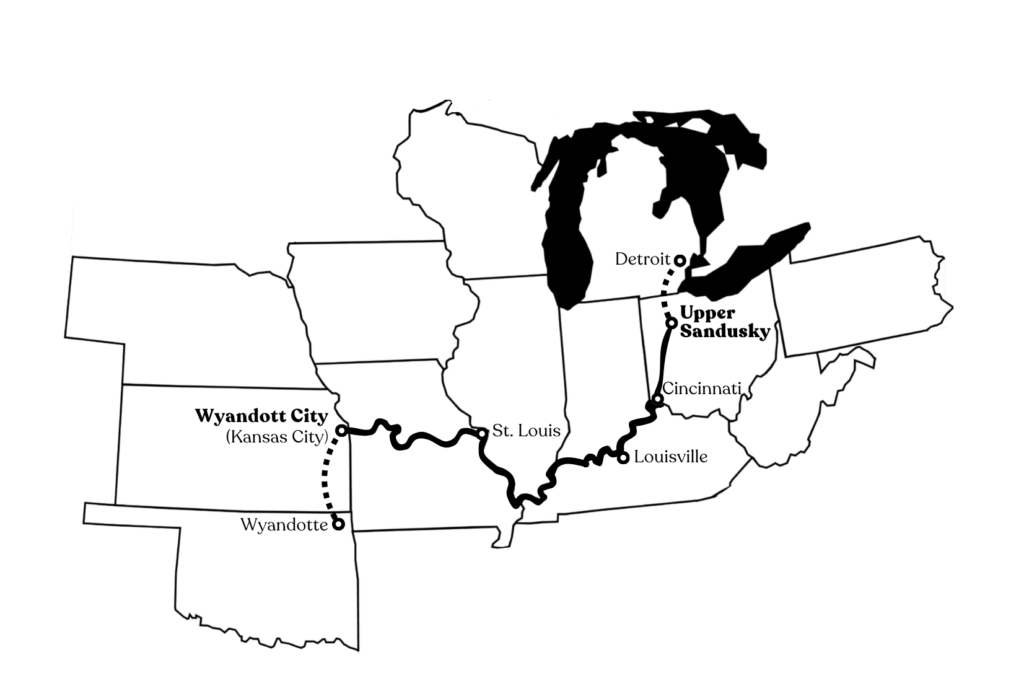
After decades of resistance and failed negotiations, the Wyandot were the last tribe removed from Ohio in 1843. Their removal route began on the Grand Reserve in Upper Sandusky and extended 150 miles to Cincinnati where nearly 700 Wyandots boarded steamboats bound for Kansas Territory. There, new settlers continued to place pressure on Wyandot lands. The Wyandotte Nation is now headquartered in Oklahoma.
, OH
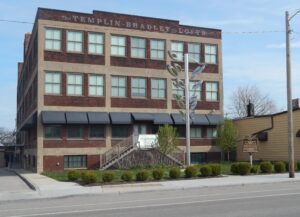
In 1907, the Templin-Bradley Company’s Children’s Flower Mission was developed in response to the Cleveland Public Schools Horticulture Program, supplying seed packets for 1 cent each–commonly referred to as Penny Packet Seeds. This earned the company a reputation for being the nation’s largest distributor of seeds for school garden programs. Although only nine varieties of plants were offered, interest was so great that nearly 50,000 packages were sold during the first year with no expense to the public-school teachers. With great success realized in the local school gardening program, interest grew exponentially across the nation and programs began in other cities. For fifty years, the Templin-Bradley Company sold flower and vegetable seeds at low costs to student members of garden groups throughout the country, cultivating many generations of gardeners.