The Black community of Gallipolis pooled their resources and expertise to open Gallipolis Union Colored School in 1868. Located on the northwest corner of Third Avenue and Olive Street, the public school offered primary education until, around 1877, a high school curriculum was added. In 1882, the first four students to graduate high school were W.H. Haskins, Minnie Battles, Idella Black, and Mary Nease. By 1890, the school had been renamed for President Abraham Lincoln. Valuing their public education, many Lincoln School graduates became teachers; of 33 high school graduates in the first 8 classes, 11 would become schoolteachers. Dr. Edward Alexander Bouchet (Principal 1908-1913) added an intellectual rigor to Lincoln’s curriculum. The nation’s first Black Ph.D., Bouchet earned a doctorate in physics from Yale University in 1876. (Continued on other side)
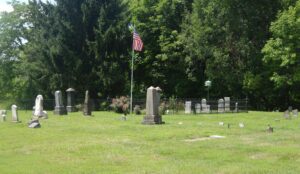
Originally part of the Casterline farm, this cemetery was once the site of the 1824 Bazetta Presbyterian Church, the first church in Bazetta Township. Ziba Casterline deeded .75 acres for the cemetery to the church in 1829 for five dollars. When the small log structured church was relocated to Lot 55 in the township, the cemetery remained. Buried in the cemetery are several early settlers, including Moses Hampton, Joseph Headley, Joseph Pruden, and John Hulse, the first white child born in the township. [continued on other side]
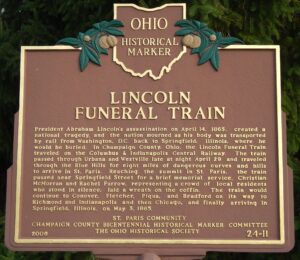
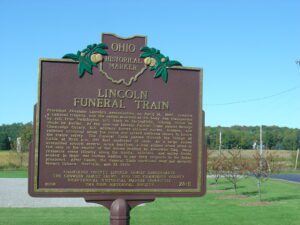
President Abraham Lincoln’s assassination on April 14, 1865, created a national tragedy, and the nation mourned as his body was transported by rail from Washington D.C. back to Springfield, Illinois, where he would be buried. In Champaign County, Ohio, the train passed through Urbana and Westville late at night April 29 and traveled through the Blue Hills for eight miles of dangerous curves and hills to arrive in St. Paris. Reaching the summit in St. Paris, the train paused near Springfield Street for a brief memorial service. Christian McMorran and Rachel Furrow, representing a crowd of local residents who stood in silence, laid a wreath on the coffin. The train would continue to Conover, Fletcher, Piqua, and Bradford on its way to Richmond and Indianapolis and then Chicago, finally arriving in Springfield, Illinois, on May 3, 1865.
Woodland Cemetery and Arboretum, 118 Woodland Avenue
Dayton
, OH
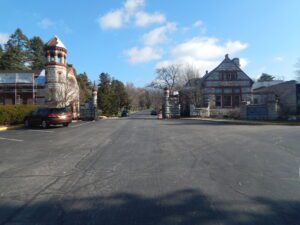
Founded in 1841, Woodland is one of the nation’s oldest rural garden cemeteries, the style of which was a dramatic departure from traditional church burial grounds at the time. Woodland’s oldest portion, including Victorian Era burial sections, a Romanesque gateway, and a Tiffany chapel, forms a district listed on the National Register of Historic Places. The Arboretum, with over 3,000 trees on more than 200 acres, completes this outdoor museum of Dayton history. Among those buried here are cemetery founder John Van Cleve, the Wright Brothers, inventors John Patterson and Charles Kettering, poet Paul Laurence Dunbar, Col. Edward Deeds, Governor James M. Cox, and humorist Erma Bombeck.
Cincinnati Museum Center at Union Terminal, 1301 Western Avenue
Cincinnati
, OH
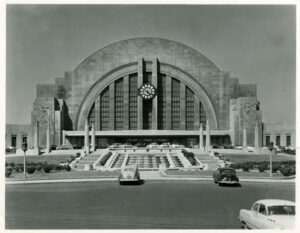
The Cincinnati Union Terminal opened in March 1933 and integrated rail travel in the city, which previously operated from five separate passenger terminals. Built when rail travel was already in decline, Union Terminal stopped operating as a passenger railroad station in 1972. Only during WWII was the terminal used to capacity with as many as 34,000 people travelling through the building daily in 1944. As part of preservation efforts, 14 mosaics depicting Cincinnati industry of the 1930s by Winold Reiss were saved from the concourse and moved to the Greater Cincinnati Airport. The restored Union Terminal became a Museum Center in November 1990 with the opening of the renovated Cincinnati Museum of Natural History and new Cincinnati History Museum. Cincinnati Union Terminal has been described as one of the most outstanding examples of Art Deco train stations in the nation and was listed on National Register of Historic Places in 1972.
President Abraham Lincoln’s assassination on April 14, 1865, created a national tragedy, and the nation mourned as his body was transported by rail from Washington, D.C. back to Springfield, Illinois, where he would be buried. As the nine-car Lincoln Funeral Train passed through Champaign County, U.S. military forces secured curves, bridges, and railroad crossings along the route and spiked switches closed to insure the train’s safety. The Funeral Train passed through the Village of Cable at 10:13 p.m. 150 feet southeast of here. As a large crowd assembled around several large bonfires, a lone soldier stood alone in the rain in the center of the crowd holding an American flag. Many residents stood silently along the tracks, hillsides, and valley fields, soaked in their wet clothes waiting to pay their respects to the fallen president. After Cable, the Funeral Train continued west and downhill toward Urbana, Westville, and St. Paris.
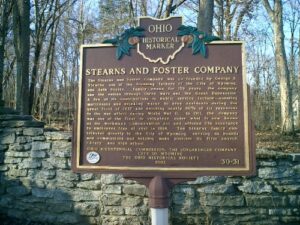
The Stearns and Foster Company was co-founded by George S. Stearns, one of the founding fathers of the City of Wyoming, and Seth Foster. Family-owned for 139 years, the company saw the nation through three wars and the Great Depression. A few of its contributions to public service include-donating mattresses and drinking water to area residents during the great flood of 1937 and devoting nearly 80% of its resources to the war effort during World War II. In 1911, the company was one of the first to volunteer under what is now known as the Workman’s Compensation Act and offered life insurance to employees free of cost in 1914. The Stearns family contributed greatly to the City of Wyoming, serving on boards and commissions and helping make possible its first church, library, and high school.
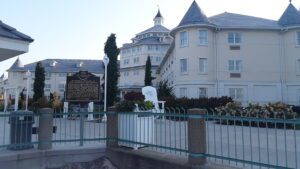
About 60 leaders of Ohio hospitals gathered at the Hotel Breakers on August 25, 1915 to form the Ohio Hospital Association (OHA), the nation’s first state hospital association. Established 15 years after the American Hospital Association, the OHA formed, in part, to address state legislation regarding hospitals and public health. Issues addressed in OHA’s first years included Ohio’s 1915 Nurse Practice Act, workers’ compensation rates, and the federal Harrison Narcotics Tax Act. A century later, OHA represents 220 hospitals and 13 health systems guided by a mission “to collaborate with member hospitals and health systems to ensure a healthy Ohio.”