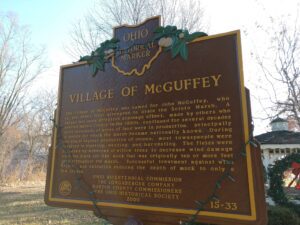
The Village of McGuffey was named for John McGuffey, who in the 1860s first attempted to drain the Scioto Marsh. A larger and more effective drainage effort, made by others who entered Hardin County in the 1880s, continued for several decades until thousands of acres of land were in production, principally of onions for which the marsh became nationally known. During the era of highest production of onions, most townspeople were involved in planting, weeding, and harvesting. The fields were bordered by windrows of willow trees to decrease wind damage over the black silt-like muck that was originally ten or more feet deep throughout the marsh. Successful treatment against wind erosion and oxidation reduced the depth of muck to only a few inches.
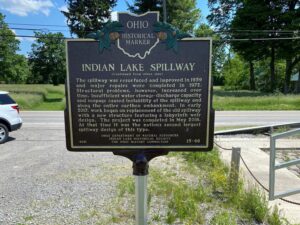
Indian Lake Dam was built 1851-1860 to create a feeder lake, known as the Lewistown Reservoir, for the Miami and Erie Canal. The dam included a 700-foot long concrete ogee weir spillway that discharged water from the lake into the Great Miami River. In 1898, the Ohio General Assembly designated the lake as a public recreation area and renamed it Indian Lake. The lake and dam structure have been owned and operated by the Ohio Department of Natural Resources since the creation of ODNR in 1949. (Continued on other side)
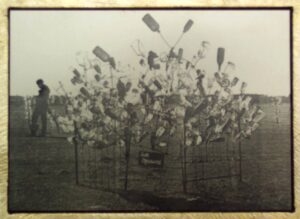
A direct descendent of original settlers in Jackson Township, Winter Zellar (Zero) Swartsel was born in 1876. Throughout his life he was a natural born showman, teacher, eccentric, anarchist, and “possibly the grandfather of American Pop Culture.” At a young age and tired of the routines of Farmersville, he declared that, “He would live by his wits while his brothers lived by the sweat of their brows.” He and a friend bicycled first to New York City and then turned around to head west and eventually the world. Later his home would overflow with items collected while traveling the world. Outside was a similar story. While chiding the American people for their wastefulness and abusing their environment, his 22 acres of farmland became his artist’s canvas filled with the thousands of items he collected from the “wasteful.” [continued on other side]
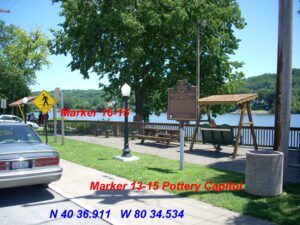
Fawcettstown, later to become East Liverpool, marked the first Ohio community to be encountered by early river travelers as they headed toward new challenges and new lives in the expanding nation. Indian canoes, flatboats, and steamboats carried increasing traffic, both passenger and freight, along these Ohio “Gateway” shores. Many of these early craft were built locally and local residents served as crewmen. Products from farms and ceramics from this city’s pioneer potteries were shipped from this site. The wharf area also served as a landing place for many of the early English potters who came here to ply their trades and, in the process, create a defining industry. The river continues to play an important role in industrial and recreational capacities.
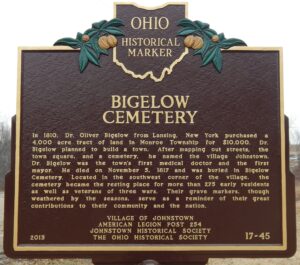
In 1810, Dr. Oliver Bigelow from Lansing, New York purchased a 4,000 acre tract of land in Monroe Township for $10,000. Dr. Bigelow planned to build a town. After mapping out streets, the town square, and a cemetery, he named the village Johnstown. Dr. Bigelow was the town’s first medical doctor and the first mayor. He died on November 5, 1817 and was buried in Bigelow Cemetery. Located in the southwest corner of the village, the cemetery became the resting place for more than 275 early residents as well as veterans of three wars. Their grave markers, though weathered by the seasons, serve as a reminder of their great contributions to their community and the nation.
Believed to have been constructed in 1866, this facility is one of the largest of its kind in the nation. The complex of 200 ovens was erected by the Leetonia Iron and Coal Company, later known as the Cherry Valley Iron Works, to supply fuel for pig-iron producing blast furnaces that stood south of this site. The man-made “beehive” ovens were used to transform hard coal into coke. The “coking” process burnt impurities out of the coal. The end product — coke — was the best fuel source for the furnaces that were used to manufacture iron and steel. The facility discontinued operations in the early 1930s at the height of the Great Depression.
The freight depot east of this marker stands on the western terminus of Hancock County’s first rail link to the outside world. In 1849 the Mad River and Lake Erie Railroad Company opened a branch line from Findlay to its main line at Carey. A freight warehouse was built here ca. 1848 and passenger station in 1863. The Cleveland, Cincinnati, Chicago, and St. Louis Railroad replaced these earlier buildings with the present depot in the 1890s.
One of seven native Ohioans to serve as president of the United States, William McKinley (1843-1901) was born at this site. The original house was moved from this site and ultimately destroyed by fire. The McKinleys lived here until 1852 when they moved to Poland, Ohio, where William attended the Poland Seminary. He briefly attended Allegheny College in Pennsylvania, but poor health and family financial strain forced him to return to Ohio. As an enlistee in the 23rd Ohio Volunteer Infantry during the Civil War, McKinley rose to the rank of major. After the war, he settled in Canton and practiced law. Elected to Congress in 1876, McKinley favored high protective tariffs, a policy he continued to support as President.(Continued on other side)