

, OH
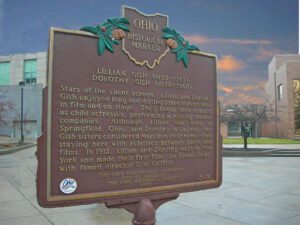
Stars of the silent screen, Lillian and Dorothy Gish enjoyed long and distinguished careers both in film and on stage. They began their careers as child actresses, performing in touring theater companies. Although Lillian was born in Springfield, Ohio, and Dorothy in Dayton, the Gish sisters considered Massillon their home, often staying here with relatives between plays and films. In 1912, Lillian and Dorothy went to New York and made their first film, An Unseen Enemy, with famed director D.W. Griffith.
, OH
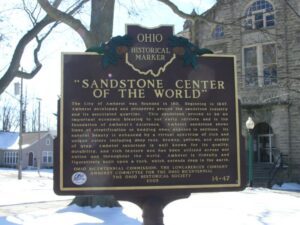
The City of Amherst was founded in 1811. Beginning in 1847, Amherst developed and prospered around the sandstone industry and its associated quarries. This sandstone proved to be an important economic blessing to our early settlers and is the foundation of Amherst’s existence. Amherst sandstone shows lines of stratification or bedding when exposed in sections. Its natural beauty is enhanced by a virtual spectrum of rich and unique colors including deep reds, browns, yellows, and shades of gray. Amherst sandstone is well known for its quality, durability, and rich texture and has been utilized across our nation and throughout the world. Amherst is literally and figuratively built upon a rock, which extends deep in the earth.
, OH
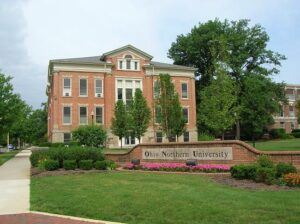
Henry Solomon Lehr founded Ohio Northern University in 1871 as the Northwestern Ohio Normal School. Its purpose was to train teachers and to provide higher education to the people in Northwest Ohio. In 1885, the school became Ohio Normal University. The new name recognized that the institution drew students from all over Ohio and the nation, and offered courses in many disciplines, including literature, music, business, telegraphy, and law, as well as teacher training. Beginning with 131 students, the institution’s enrollment grew rapidly during its first thirty years of existence. Buildings on the early campus included Dukes Memorial (left), built in 1905; the Normal School Building, built in 1871 and demolished in 1915 to make way for Lehr Memorial (center); and Hill building (right) finished in 1879. The Methodist Episcopal Church (predecessor to the United Methodist Church) assumed control in 1899. Ohio Normal University became Ohio Northern University in 1903. On June 3, 1910, President William Howard Taft delivered that year’s commencement address near this spot.
, OH
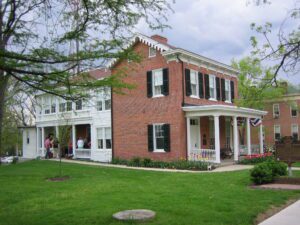
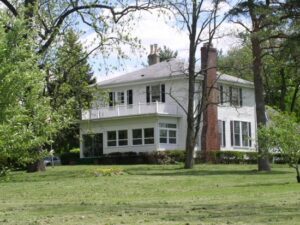
William Holmes McGuffey (1800-1873) was a Miami University faculty member in 1836 when he compiled the first edition of the McGuffey Eclectic Reader in this house. His Reader taught lessons in reading, spelling, and civic education by using memorable stories of honesty, hard work, thrift, personal respect, and moral and ethical standards alongside illustrative selections from literary works. The six-edition series increased in difficulty and was developed with the help of his brother Alexander Hamilton McGuffey. After the Civil War the Readers were the basic schoolbooks in thirty-seven states and by 1920 sold an estimated 122 million copies, reshaping American public school curriculum and becoming one of the nation’s most influential publications. (Continued on other side)
, OH
Robert L. Eichelberger was born in Urbana on March 9, 1886, the youngest of the five children of George Maley Eichelberger, an Urbana lawyer, and Emma (Ring) Eichelberger. After graduating from Urbana High School in 1903, he attended Ohio State University and then was appointed to the United States Military Academy at West Point. Graduating in 1909, he was appointed a second lieutenant of infantry. Four years later he married Emma Gudger, daughter of Judge H. A. Gudger of Asheville, North Carolina. For several years, he saw service in Panama and the Mexican border before joining the American Expeditionary Forces in Siberia. From 1918 to 1920 Major Eichelberger observed the Japanese incursion into Siberia and became aware of Japanese methods. In 1940 he was appointed Superintendent of the Military Academy at West Point where he established regular courses to include flight training for Flying Army Officers. [continued on other side]
, OH
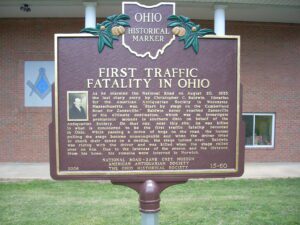
As he traveled the National Road on August 20, 1835, the last diary entry by Christopher C. Baldwin, librarian for the American Antiquarian Society in Worcester, Massachusetts, was, “Start by stage on the Cumberland Road for Zanesville.” Baldwin never reached Zanesville or his ultimate destination, which was to investigate prehistoric mounds in southern Ohio on behalf of the Antiquarian Society. On that day, near this site, he was killed in what is considered to be the first traffic fatality recorded in Ohio. While passing a drove of hogs on the road, the horses pulling the stage became unmanageable and when the driver tried to check their speed on a decline, the stage turned over. Baldwin was riding with the driver and was killed when the stage rolled over on him. Due to the lateness of the season and the distance from his home, his remains were interred in Norwich.
, OH
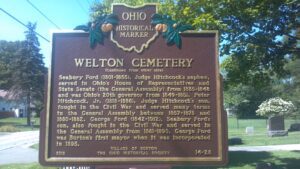
Welton Cemetery was known as Roselawn Cemetery until the early 1900s. Early settlers to the Burton area donated the land. Welton Cemetery is the burial place for veterans of the nation’s wars and for several state officials. Judge Peter Hitchcock (1781-1853) served in the War of 1812. From 1810-1852, he was elected to both houses of Ohio’s General Assembly and one term in the U.S. House of Representatives and served on the state’s Supreme Court. He was Chief Justice from 1831-1833 and 1849-1851. In 1850, he was a member of Ohio’s constitutional convention. (Continued on other side)
, OH
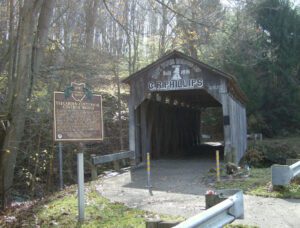
The Teegarden-Centennial Covered Bridge, constructed primarily of white oak is of Multiple King Post design spanning 67 feet. It was built nearly 100 years after the birth of the nation. Located on Eagleton Road, just off Teegarden Road, it is still at its original location, spanning the Middle Fork of the Little Beaver Creek in Eagleton’s Glen Park. It remained in use until 1992 when it was bypassed by a new concrete structure. The official contract for the construction of the bridge was awarded to Jeremiah C. Mountz in June of 1875. The stonework for the abutments was awarded to David Reese and painting of the original structure to George W. Akin in 1876. Members of Highland Christian Church came here to be baptized by immersion. There were over 250 covered bridges in Columbiana County, including at least 16 railroad covered bridges. The Teegarden-Centennial Covered Bridge is one of only five still remaining.