

, OH
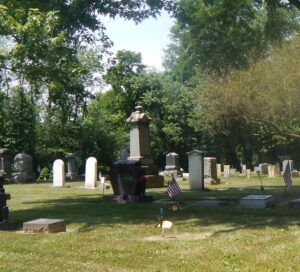
In 1827, noted evangelist Walter Scott came to Canfield and visited with a number of area Baptist families living on Palmyra Road and in the vicinity of Dean Hill. A follower of Alexander Campbell, Scott delivered powerful sermons that persuaded some to establish a new church congregation in the Disciple faith. After meeting in congregation members’ homes, a framed meeting house was erected circa 1830 on land purchased from William and Orsemus Dean. This church stood across from William Dean’s brick residence. A burial ground was provided at the site with existing grave markers dating to 1837. Veterans from all the wars of this nation are buried here, including Benjamin Dean of the 105th Ohio Infantry Regiment who died from wounds suffered in the 1863 Battle of Murfreesboro in Tennessee. (continued on other side)
, OH
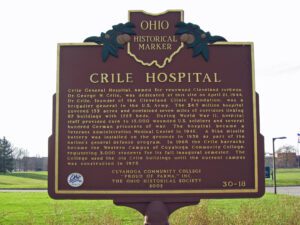
Crile General Hospital, named for renowned Cleveland surgeon, Dr. George W. Crile, was dedicated at this site on April 21, 1944. Dr. Crile, founder of the Cleveland Clinic Foundation, was a brigadier general in the U.S. Army. The $4.5 million hospital covered 153 acres and contained seven miles of corridors linking 87 buildings with 1725 beds. During World War II, hospital staff provided care to 15,000 wounded U.S. soldiers and several hundred German prisoners of war. The hospital became a Veterans Administration Medical Center in 1945. A Nike missile battery was installed on the grounds in 1956 as part of the nation’s general defense program. In 1966 the Crile barracks became the Western Campus of Cuyahoga Community College, registering 3,000 students for its fall inaugural semester. The College used the old Crile buildings until the current campus was constructed in 1975.
, OH
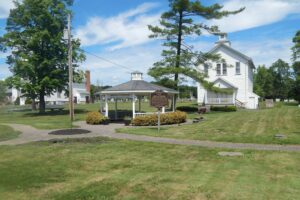
The Connecticut Land Company surveyed Vienna Township as Township 4, Range 2, in 1798. The Township’s proprietors were Ephraim Root, Uriel Holmes, Jr., and Timothy Burr. Survey members Dennis Clark Palmer, Isaac Flower, and Samuel Hutchins and their families were the first to settle here in 1799. Between 1810 and 1840, Vienna was a center for the wooden works clock industry in Trumbull County and the Connecticut Western Reserve, with six factories located amid farms, sawmills, and quarries. After coal was discovered in 1866, over twenty mines were opened, bringing boom times for two decades. Vienna’s miners helped to bring about Ohio’s first mining safety law in 1874. Vienna was the birthplace of abolitionist and attorney John Hutchins (1812-1891), who represented Trumbull and Ashtabula counties in the United States Congress (1859-1863) and raised troops during the Civil War.
, OH
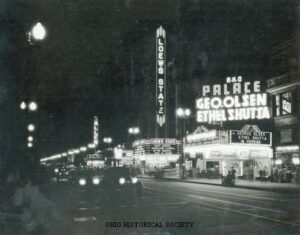
The Theater District, bound by Chester Avenue, Prospect Avenue, East 18th, East 9th and East 12th Streets, came into being at the turn of the 20th century, when Cleveland emerged as a thriving metropolis. Built between 1890-1928, the area hosted a variety of fine retail stores, theaters, prestigious clubs, restaurants, and distinct office buildings. The rise of television and flight to the suburbs sent downtown entertainment into a death spiral, until a 1970 grass roots effort saved from demolition the surviving post-World War I theaters (the State, Ohio, Hanna, Allen, and Palace), making it the “world’s largest theater restoration project.” It became a catalyst for reinvestment in downtown properties, restoring civic pride and giving testimonial to the creative vision of the city’s civic leaders and citizenry. By the year 2000, Cleveland’s Theater District boasted the nation’s 2nd largest performing arts center.
, OH
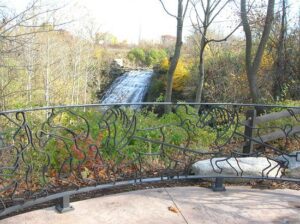
Formed by erosion of Cleveland shale and cascading 48 feet, making it the tallest waterfall in the county, the Cataract Falls of Mill Creek powered the gristmill and sawmill built by William Wheeler Williams and Major Wyatt in 1799. The mills, commissioned by the Connecticut Land Company to encourage settlement of the Western Reserve, attracted people to Newburgh. Cleveland finally outgrew bustling Newburgh by 1830 and eventually annexed most of it. The founding of the Cleveland Rolling Mill in Newburgh, beginning with the firm of Chisholm, Jones, & Company in 1857, precipitated the growth of the steel industry in Cleveland. By 1868, under the management of Henry Chisholm, it became one of the first in the nation to produce steel using the Bessemer process. The Rolling Mill, later the American Steel and Wire Company (a subsidiary of U.S. Steel), purchased the millworks at the falls in 1872.
, OH
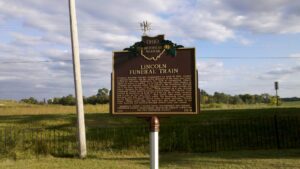
President Abraham Lincoln’s assassination on April 14, 1865, created a national tragedy, and the nation mourned as his body was transported by rail from Washington, D.C. back to Springfield, Illinois, where he would be buried. On its way the Funeral Train stopped in Columbus and Lincoln’s coffin was moved to the Statehouse Rotunda for a day-long viewing. From Columbus Governor John Brough and others changed the train’s route, which resulted in a trip through Champaign County where it stopped several times. The Funeral Train arrived in Woodstock on April 29 at 9:46 p.m. for a brief ceremony and to take on fuel and water. With nearly 500 people present, bouquets were laid on Lincoln’s coffin. The Woodstock Cornet Band, led by Warren U. Cushman, played hymns of grief, including “Pleyel’s Hymn.” Village bells rung and silent men and women stood as the train departed and traveled downhill toward Cable and Urbana.
, OH
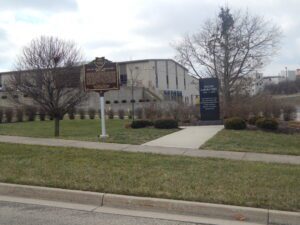
The facilities once here propelled the United States through the Nuclear and Space Ages and were named for the nearby pre-historic Miamisburg Mound. The Manhattan Engineer District of the War Department began construction of Mound Laboratory in 1946. The facility consolidated production of the nuclear-reaction initiators, developed for the United States’ first atomic bombs during World War II. Previously (1943-1946), the work to separate, purify, and process the element polonium used in these initiators occurred at facilities throughout the Dayton area. Mound Laboratory was the nation’s first permanent post-WWII Atomic Energy Commission site. Mound Laboratory had 116 buildings and at its peak employed approximately 2,500 scientists, engineers, and skilled workers. Contractors operating at the site were Monsanto (1947-1988), Edgerton, Germeshausen, and Grier (1988-1997), and Babcock and Wilcox (1997-2002). (Continued on other side)
, OH
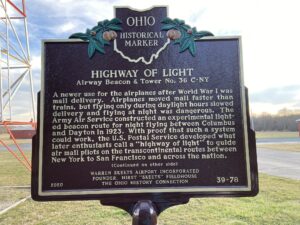
A newer use for the airplanes after World War I was mail delivery. Airplanes moved mail faster than trains, but flying only during daylight hours slowed delivery and flying at night was dangerous. The Army Air Service constructed an experimental lighted beacon route for night flying between Columbus and Dayton in 1923. With proof that such a system could work, the U.S. Postal Service developed what later enthusiasts call a “highway of light” to guide air mail pilots on the transcontinental routes between New York to San Francisco and across the nation. (Continued on other side)