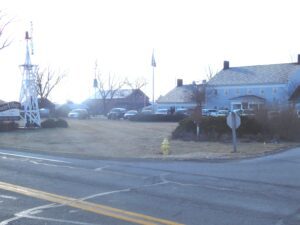
A pioneer furniture manufacturer and philanthropist, Erie J. Sauder (1904-1997) was born and reared on a farm in Archbold. With the help of his wife Leona, he began woodworking in their town barn in 1934. Crafting tables and church pews, the Sauder Woodworking Company grew quickly. Sauder’s 1951 invention of an easily shipped table kit heralded the modern ready-to-assemble furniture industry and firmly established the company as one of Fulton County’s primary employers. In 1976 Sauder founded the Sauder Village to interpret nineteenth century rural lifestyles in the Black Swamp region.
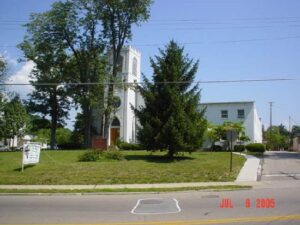
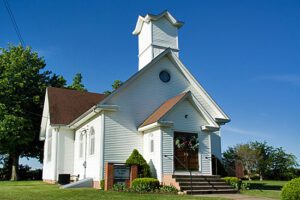
Founded in 1797 in the log cabin of the Reverend Francis McCormick, the Milford Methodist Church is the oldest of the denomination in the Northwest Territory and Ohio. Pioneer worshipers walked many miles through the wilderness to attend its circuit rider services. The present sanctuary was consecrated on Christmas Day, 1835. The bell tower and Sunday School rooms were 1870 additions.
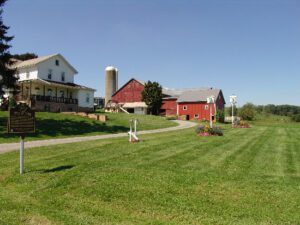
Jonas Stutzman, from Somerset County, Pennsylvania, came to this site in 1809 to clear land for farming and to build a log home for his family. He was the first permanent settler in the eastern portion of what would in 1825 become Holmes County. Jonas and his wife Magdalena Gerber Stutzman were of the Amish faith–descendants from a group of strict Protestant Anabaptists with origins in Switzerland and Holland and dating from the 16th -century Protestant Reformation. Some of their beliefs, including separation of church and state, refusal to take oaths, pacifism, and believer’s baptism, were perceived as threats to the state church and government. Persecuted by both Catholics and Protestants, Anabaptists migrated and some came to the New World, many at the invitation of Pennsylvania’s William Penn. The Stutzmans and other early Amish pioneer setters-Millers, Hershbergers, Hochstetlers, Weavers, Troyers, Masts, and Schrocks-founded here what has become the largest Amish settlement in North America.
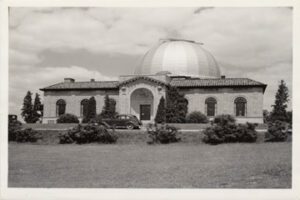
One-half mile east is the site of the former BIG EAR radio telescope. Designed by Dr. John D. Kraus, pioneering radio astronomer at Ohio State University, it had a collecting area of 340 by 70 feet (104 by 21 meters). The observatory was completed in 1963. The Ohio Sky Survey recorded here between 1965 and 1972 was the most accurate, reliable, and complete mapping of cosmic radio signals (the “radio sky”) for many years. BIG EAR gained fame for its ability to detect quasi-stellar radio sources, or “quasars,” and for its discovery of some of the most distant objects known. This observatory conducted a 24-year continuous search for evidence of extraterrestrial intelligence, during which the famous “Wow!” signal was received in 1977. BIG EAR was demolished in 1998. [“Wow!” signal graphic]
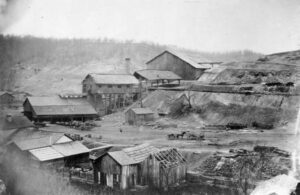
To furnish the needs of the early settlers, then to furnish ordnance for a nation at war, and finally to furnish merchant iron to the steel mills, 100 iron producing blast furnaces were built within these 1,800 square miles of the lower coal measures to become known as the Hanging Rock Region. Lawrence County, centrally located within the Region, had 23 blast furnaces constructed between 1826 and 1909.
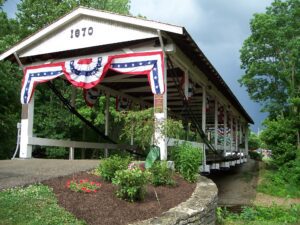
Restored in 1963, the Germantown Covered Bridge on East Center Street, spanning Little Twin Creek, was 93 years old and is reputed to be the only existing covered bridge of its kind in the world. For 41 years this unique inverted bow string truss covered bridge spanned Little Twin Creek on the Dayton Pike in Germantown, Ohio. In 1911 it was removed to its present location where it has been restored and beautified as a link with Ohio’s early history. It is a symbol of individual initiative in America’s early history.
The Israel Evangelical Lutheran Church was organized August 23, 1812. According to available records, in 1813 the first meeting in Ohio of the “Special Conferences” called by the Lutheran Ministerium of Pennsylvania was held at the church. Pioneer Lutheran pastors, the Reverends Heineke, Henkle, Huet, and Jacob Leist, met to further organize the Christian Witness on the Ohio frontier.
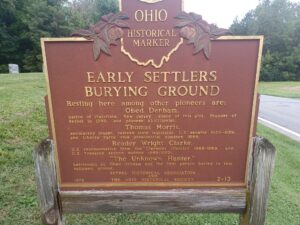
Early Settlers Burying Ground Cemetery, N. Main Street
Bethel
, OH
Resting here among other pioneers are: Obed Denham, native of Plainfield, New Jersey, donor of this plot, founder of Bethel in 1798, and pioneer abolitionist; Thomas Morris, antislavery leader, veteran state legislator, U.S. senator 1833-1839, and Liberty Party vice presidential nominee 1844; Reader Wright Clarke, U.S. representative from the Clermont District 1865-1869, and U.S. Treasury second auditor 1869-1870; “The Unknown Hunter”; befriended by Obed Denham and the first person buried in this hallowed ground.