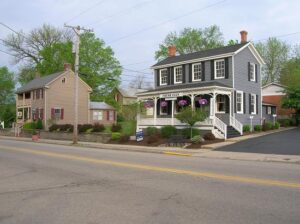
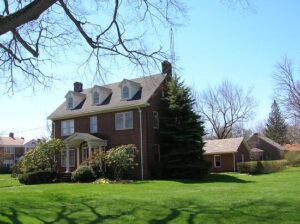
David and Rachel Burnet Evans built this Federal style house in 1836. Their son, Dr. John Evans (1814-1897), nationally known physician, statesman, and educator, lived here as a young man. After graduating from Lynn Medical College in Cincinnati, Dr. Evans became a prominent physician in Indiana and helped establish the Indiana Hospital for the Insane. He is recognized as one of the founders and first president of Northwestern University in Evanston, Illinois. He was appointed by President Abraham Lincoln as the first governor of the Colorado Territory and is credited for developing the railroad system in Colorado. His desire to institute a system of higher education in the territory led to the founding of Colorado Seminary, later known as Denver University. Evanston, Illinois and Mt. Evans near Denver were named in his honor.
With the signing of the Treaty of Paris in 1783, England lost the American Revolution and ceded to its former colonies land from the Atlantic Ocean to the Mississippi River. By this time, pioneer settlers had reached the eastern bank of the Ohio River, but the Ohio Country, located west and north of the river, was still considered Indian Territory. The Indian tribes desperately defended their hold on this land. On August 20, 1794, United States forces led by Major General Anthony Wayne defeated an Indian alliance at the Battle of Fallen Timbers fought near modern-day Toledo. One year later, on August 3, 1795, the largest assemblage of northwestern Indian representatives at a peace settlement signed the Treaty of Greene Ville, which effectively ceded all land south of the Greene Ville Treaty line to the Americans. The Fort Laurens site was a reference point in the Treaty line. The Ohio Country was then rapidly settled, and in 1808, Tuscarawas County was organized.
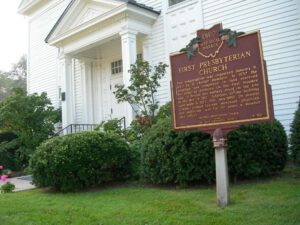
This congregation was organized January 9, 1820 by 11 charter members. In 1837 the structure was completed on land reserved for religious purposes on the first Maumee plat. A British gun battery stood on the site in the War of 1812. Additions to the building were made in 1922, 1951, and 1968. Dr. Horatio Conant, pioneer teacher, merchant, physician, and politician, was for 59 years a member and officer.
Ohio’s first female county sheriff, Maude Charles Collins (1893-1972) of Vinton County was appointed to finish her husband Fletcher’s term after he was killed in the line of duty in October 1925. In 1926, she ran for the office in her own right on the Democratic ticket and handily beat males in both the primary and general elections. “Sheriff Maude” investigated crimes, answered calls, patrolled roads, and performed the duties of her office, all while raising five children. She gained national attention for solving an intriguing double murder case in 1926, later featured in Master Detective and Startling Detective magazines. In 1927 she was the first woman to deliver inmates to the Ohio State Penitentiary in Columbus. Collins, a pioneering woman in law enforcement, was inducted into the Ohio Women’s Hall of Fame in 2000. She is buried in Hamden Cemetery.
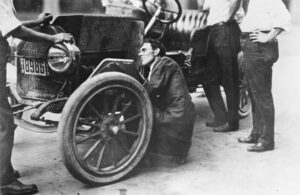
Charles F. “Boss” Kettering was a prolific inventor. While at National Cash Register, he invented the first electric cash register. Kettering founded the Dayton Engineering Laboratories Company (Delco) in 1909 and developed the electric self-starter for automobiles, first used in 1912 Cadillacs. He also developed no-knock Ethyl gasoline, lacquer car finishes, four-wheel brakes, safety glass, and high-compression engines; made significant improvements to diesel engines that led to their use in locomotives, trucks, and buses; and collaborated with Thomas Midgley, Jr. in the development of the refrigerant Freon. Kettering served as President of the Society of Automotive Engineers in 1918, co-founded the Engineers’ Club of Dayton (1914), and was director of research at General Motors Corporation from 1920 to 1947. His interest in medical and scientific research led to the founding of the Kettering Foundation and the Sloan-Kettering Institute for Cancer Research.
Administration Building built in 1931. Chapter House built in 1962. Commemorating American Red Cross Centennial, 1881-1981.
Early Western Reserve burial grounds, 1804-1848. Grave sites of 12 Revolutionary War veterans and Mary Chesney, member of pioneer Warren family and for whom local D.A.R. chapter was named.
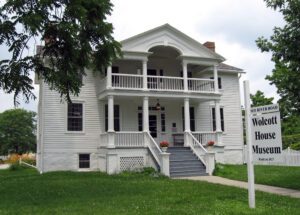
This federal style house was built in 1827 by James A. Wolcott who migrated to Ohio in 1818 from Connecticut. Of distinguished parentage, Wolcott was a leading merchant, shipbuilder, judge and politician. Here he and his wife, Mary Wells, daughter of scout William Wells and Sweet Breeze, Indian Chief Little Turtle’s daughter, made their home a center of frontier activity. This house stands as a tangible symbol of this Maumee pioneer, a Registered National Historic Place.
The Scioto Salts Licks, located in and around Jackson, is an area where naturally occurring salt water, known as brine, flowed to the surface as a salt-water spring. It is known that the spring existed since the Pleistocene Ice Age because numerous bones, probably including those of mammoth and ground sloth, were excavated there. Native Americans obtained salt here for at least 8,000 years and did so until 1795 when the Treaty of Greenville separated the Native American and European populations. Early pioneer settlers utilized the licks in the second half of the eighteenth and first half of the nineteenth centuries, constructing salt furnaces that extended for four miles up and down Salt Lick Creek. Salt was a precious and necessary commodity, and the early settlers in the area profited from its trade.