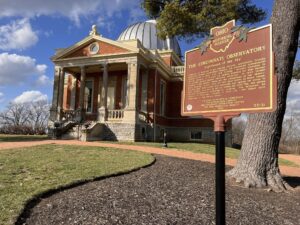
Prompted by response to his popular lectures, astronomer Ormsby MacKnight Mitchel (1809-1862) founded the Cincinnati Astronomical Society (CAS) in 1842. With CAS funding, Mitchel traveled to Munich, Bavaria, to acquire the optical elements for what became the world’s second largest refractor telescope. In 1843 former president John Quincy Adams laid the cornerstone of the observatory building, located upon the hill since known as Mount Adams. The Cincinnati Observatory was completed and opened for study in 1845. Mitchel, who died in service during the Civil War, was among the first to popularize astronomy in America. The telescope he brought to Cincinnati remains in daily use, the oldest such instrument in the United States.
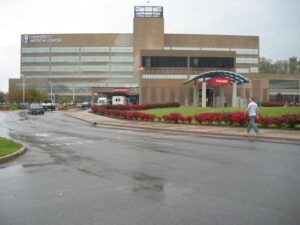
State interest in medical education for northwest Ohio became a reality when the Medical College of Ohio at Toledo was established in December, 1964. Located initially at South Detroit and Arlington on Lucas County property, MCO moved to the present 350-acre campus starting in 1972. It is the area’s first medical school since the closing of the Toledo Medical College (1882-1914).
Indian Ridge Golf Club, 2600 Oxford Millville Road
Oxford
, OH
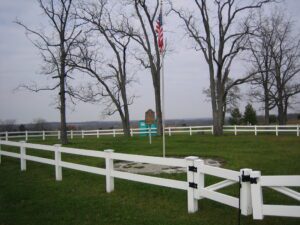
A cemetery was established on the site in 1811 and became the final resting place for many of the area’s early pioneer families. The Hanover Township Trustees obtained title to the land in 1823 from John and Anna Farnsworth, and it was expanded for additional plots in 1879. Unfortunately many burials remain unmarked or can be located only by primitive limestone markers above them. The oldest readable headstone is dated 1816. (continued on the other side)
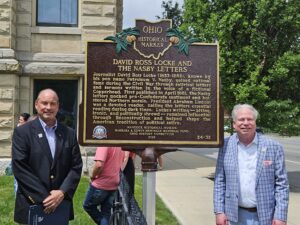
Journalist David Ross Locke (1833–1888), known by his pen name Petroleum V. Nasby, gained national fame during the Civil War through satirical letters and sermons written in the voice of a fictional Copperhead. First published in April 1861, the Nasby letters mocked pro-Confederate sentiment and bolstered Northern morale. President Abraham Lincoln was a devoted reader, calling the letters essential reading during dark times. Locke’s writing—biting, ironic, and politically shrewd—remained influential through Reconstruction and helped shape the American tradition of political satire.
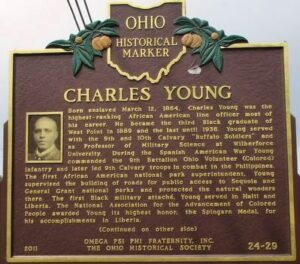
Born enslaved March 12, 1864, Charles Young was the highest-ranking African American line officer most of his career. He became the third Black graduate of West Point in 1889 and the last until 1936. Young served with the 9th and 10th Calvary “Buffalo Soldiers” and as Professor of Military Science at Wilberforce University. During the Spanish American War Young commanded the 9th Battalion Ohio Volunteer (Colored) Infantry and later led 9th Calvary troops in combat in the Philippines. The first African American national park superintendent, Young supervised the building of roads for public access to Sequoia and General Grant national parks and protected the natural wonders there. The first Black military attache, Young served in Haiti and Liberia. The National Association for the Advancement of Colored People awarded Young its highest honor, the Spingarn Medal, for his accomplishments in Liberia. (continued on other side)
North side of 300 block of West Broadway between Cherry and S Plum streets.
Granville
, OH
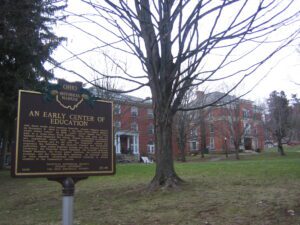
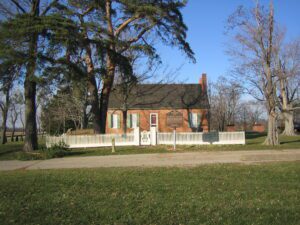
Just three weeks after reaching Granville, pioneer villagers decided on December 9, 1805 to build a log cabin where eighty children would attend school. By 1820, public school classes were being held in a three-story brick building. When rail lines and the National Road bypassed the village, dreams of becoming an industrial and commercial center were dashed. Educational institutions, however, thrived and by the Civil War Granville’s citizens had organized the following: the Granville Literary and Theological Institution, later called Granville College and then renamed Denison University; the Granville Female Seminary, the Granville Episcopal Female Seminary, the Young Ladies’ Institute, the Granville Female Academy, and the Granville Male Academy. As Granville enters its third century, educational excellence continues to attract students to the community’s schools.
As Oxford Township was developing in the mid-1800s, a cluster of farmsteads near its northern border developed and was designated the “Doty Settlement.” As was the custom, the community took its name from a prominent family in the area. In or near the settlement were a church and cemetery, a school, a blacksmith shop, a sawmill, a distillery, a furniture shop, and a fulling mill for cleansing, shrinking, and thickening cloth. With the frontier spirit of self-reliance, it was seldom necessary to travel several miles into Oxford village for additional goods or services. Working together, the community farmed local fields and bartered for other items. Men, women, and children worked long, hard hours in the fields harvesting corn and wheat. It is evident that these families, living in an agricultural society, possessed many useful skills for surviving in the Ohio country.
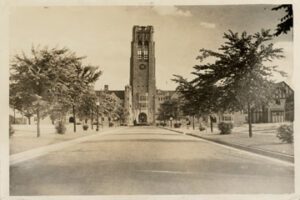
The Toledo University of Arts and Trades was established in 1872 with an endowment of 160 acres of land from Jesup W. Scott, local pioneer, publisher, and real estate broker. Scott envisioned Toledo as the “Future Great City of the World” and wanted an institution to train young people to fulfill their roles in the city’s bright future.