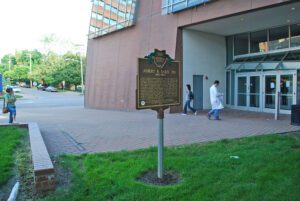
Albert B. Sabin developed the oral, live-virus polio vaccine at the University of Cincinnati College of Medicine and Children’s Hospital Research Foundation, where between 1939 and 1969, he conducted his most significant research. His vaccine has nearly eradicated the dreaded “infantile paralysis” that killed or maimed millions of children. Dr. Sabin, who considered Cincinnati his home, made many other significant medical discoveries here, particularly in the area of tropical diseases. Presidents and royalty worldwide honored him, including President Bill Clinton who said he was “one of the great heroes of American medicine.” His numerous awards include the U.S. National Medal of Medicine (1970), Presidential Medal of Freedom (1986), Medal of Liberty (1986), and Order of Friendship among Peoples awarded by the President of the Supreme Soviet of the U.S.S.R.
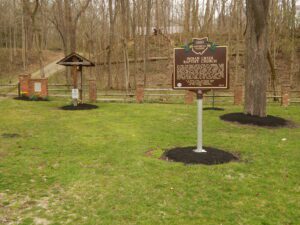
The Indian Creek Regular Baptist Church was established in 1810 as an arm of the Little Cedar Creek Church of Brookville, Indiana. The congregation purchased three acres of land for a burial ground and church and built a log structure here in 1811. Members voted in 1812 that they would receive no person who believed in the principles of slavery. By 1829, membership had reached 150 and the present brick meeting house was built. In the 1840s, membership declined due to conflict over mission activity The congregation dissolved in 1879 and the land was deeded to the Indian Creek Cemetery Association in 1880. The county park system received the property in 1960 through and with the cooperation of the Butler County Historical Society and the Cemetery Association.
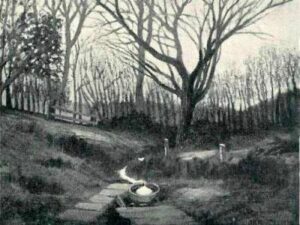
A salt spring, located about a mile west of this site, was the primary attraction for immigrants to the Western Reserve territory in the mid-1700s. Prior to European-American settlement, Indians used the springs, boiling the water to extract the salt and using it for preserving meat among other uses. In 1755, surveyor Lewis Evans underscored the importance of the springs by noting it on his “General Map of the Middle British Colonies in America.” This enticed immigrants from western Pennsylvania to the region. In addition to the salt itself, the abundance of wildlife near the spring ensured good hunting in the area. (Continued on other side)
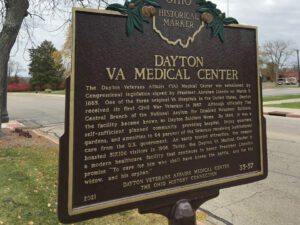
The Dayton Veterans Affairs (VA) Medical Center was established by Congressional legislation signed by President Abraham Lincoln on March 3, 1865. One of the three original VA Hospitals in the United States, Dayton received its first Civil War Veterans in 1867. Although officially The Central Branch of the National Asylum for Disabled Volunteer Soldiers, the facility became known as Dayton Soldiers Home. By 1884, it was a self-sufficient planned community, providing hospital, living quarters, gardens, and amenities to 64 percent of the Veterans receiving institutional care from the U.S. government. An early tourist attraction, the campus boasted 517,106 visitors in 1906. Today, the Dayton VA Medical Center is a modern healthcare facility that continues to honor President Lincoln’s promise “To care for him who shall have borne the battle, and for his widow, and his orphan.”
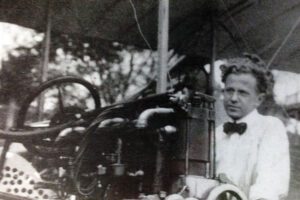
Ernest “Ernie” C. Hall, a pioneer of early flight who is widely recognized for his long career in aviation, was born near Warren, Ohio in 1890. A friend of the Wright brothers, Hall built his first powered airplane in 1909 and flew in 1911. He began his career as a civilian flight instructor in 1913, opening a flying school in Pennsylvania in 1915. During World War I, he transferred to Call Field in Wichita Falls, Texas, where he trained over 500 military pilots for combat. In 1922, Hall relocated his flight school to Warren, Ohio, where he taught until his death in 1972. His 1911 monoplanes have been displayed at the Smithsonian’s National Air & Space Museum in Washington D.C. and the National Museum of U.S. Air Force in Dayton, Ohio.
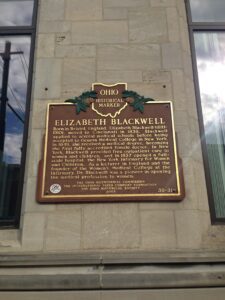
Born in Bristol, England, Elizabeth Blackwell (1821-1910), moved to Cincinnati in 1838. Blackwell applied to several medical schools before being accepted to Geneva Medical College in New York. In 1849, she received a medical degree, becoming the first fully accredited female doctor. In New York, Blackwell provided free outpatient care to women and children, and in 1857 opened a full-scale hospital, the New York Infirmary for Women and Children. As a lecturer in England and the founder of the Women’s Medical College at the Infirmary, Dr. Blackwell was a pioneer in opening the medical profession to women.
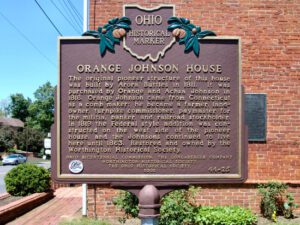
The original pioneer structure of this house was built by Arora Buttles in 1811. It was purchased by Orange and Achsa Johnson in 1816. Orange Johnson came from Connecticut as a comb maker; he became a farmer, landowner, turnpike commissioner, paymaster for the militia, banker, and railroad stockholder. In 1819 the Federal style addition was constructed on the west side of the pioneer house, and the Johnsons continued to live here until 1863. Restored and owned by the Worthington Historical Society.
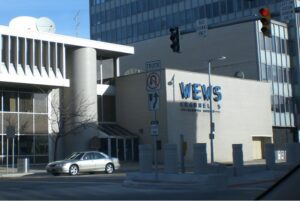
One of America’s most admired women, pioneer television newscaster Dorothy Snell Fuldheim (1893-1989) began her career as a lecturer in the 1920s and entered broadcasting with a biographical series on WTAM radio in Cleveland. In 1947, Fuldheim joined Ohio’s first commercial television station, WEWS, becoming the first woman in the United States to anchor a news show. Her later work included the long-running “One O’clock Club” live interview show and regular news commentary. During her six-decade career in an often youth-dominated profession, Fuldheim conducted over 15,000 interviews-including Adolf Hitler, Benito Mussolini, the Duke of Windsor, Albert Einstein, and Helen Keller-in a unique and erudite style. She retired in 1984 at the age of 91.