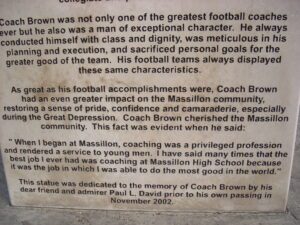
Paul E. Brown, born September 7, 1908 in Norwalk, Ohio, and raised in Massillon, is a member of the Professional Football Hall of Fame and was one of the greatest coaches in the history of football at all levels. From 1932 until 1940, he led Massillon High School to a record of 80-8-2. He coached Ohio State to the 1942 national collegiate championship, and joined the professional football ranks in 1946 as coach of the new franchise in Cleveland. He coached his namesake Cleveland Browns to seven league championships in 17 seasons.
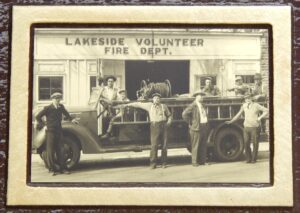
The Lakeside Volunteer Fire Protective Association responded to both fire and medical emergencies on the Marblehead Peninsula for more than 100 years. It was founded in 1905, after a devastating fire destroyed Lakeside’s business district. In 1946, the Association began providing emergency medical aid. During their service, the Lakeside Volunteer Fire Protective Association progressed from hand-drawn chemical carts to the area’s first heavy-duty fire and rescue truck. In 2013, the Association donated its assets to the newly-formed Danbury Township Volunteer Fire Department and passed into history.
Near this location stood the settlement of African American families known as “The Lett Settlement.” The Lett Settlement was a self-sustaining community of mixed race families, including the Caliman, Guy, and Lett families. The families had formed ties through marriage and common background during the mid-1700s in Virginia and Maryland. These early African American pioneer families came to Ohio as “free people of color,” and began acquiring land in Meigs Township, Muskingum County, and surrounding townships in adjacent counties during the 1820s. They were soon joined by the Brown, Clifford, Earley, Simpson, Tate, and Pointer families. The families of the Lett Settlement were land owners and tax payers in Ohio before the Civil War and challenged the State of Ohio for the right to vote and for access to education during the 1840s, 1850s, and 1860s. (Continued on other side)
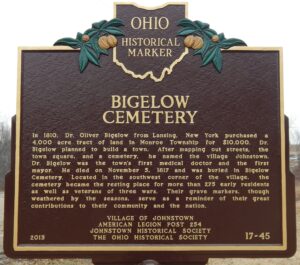
In 1810, Dr. Oliver Bigelow from Lansing, New York purchased a 4,000 acre tract of land in Monroe Township for $10,000. Dr. Bigelow planned to build a town. After mapping out streets, the town square, and a cemetery, he named the village Johnstown. Dr. Bigelow was the town’s first medical doctor and the first mayor. He died on November 5, 1817 and was buried in Bigelow Cemetery. Located in the southwest corner of the village, the cemetery became the resting place for more than 275 early residents as well as veterans of three wars. Their grave markers, though weathered by the seasons, serve as a reminder of their great contributions to their community and the nation.
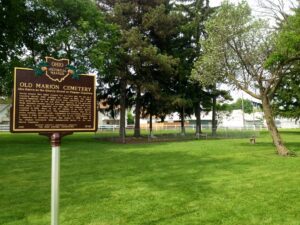
Marion founder Eber Baker donated this two-acre plot for use as a cemetery shortly after platting the village in 1822. The oldest legible headstone bears an 1812 burial date, indicating that it may have been moved to the site after the opening of the cemetery. While complete records are not available, approximately 200 burials took place in the cemetery with the final one believed to have occurred in 1872. Many of the 65 victims of an 1854 cholera outbreak were buried here. The cemetery’s location next to an active railroad, combined with unfavorable soil conditions, eventually created a need for relocation. This led to the establishment of a cememtery on Delaware Avenue that opened in 1858. Many of the original internments were subsequently moved to the new Marion Cemetery.
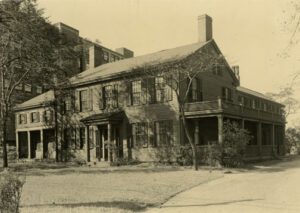
Dunham Tavern is the oldest building still standing on its original site in the City of Cleveland. Once a stagecoach stop on the old Buffalo-Cleveland-Detroit road (modern Euclid Avenue), the tavern dates from 1824. The structure was built by Rufus and Jane Pratt Dunham, who journeyed to the Western Reserve from Mansfield, Massachusetts. The Dunhams sold the tavern in 1853. However, it continued to serve the public until 1857, when it was converted to a private residence. It remained a home until the nineteen thirties, when commercial development threatened the former tavern’s existence. The historic structure was dedicated in 1936 as a museum depicting the life of an early Cleveland pioneer family. Dunham Tavern is listed in the National Register of Historic Places and is a designated Cleveland Landmark building.
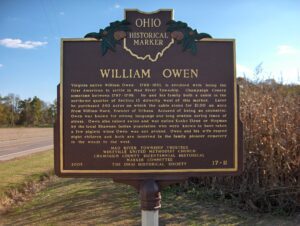
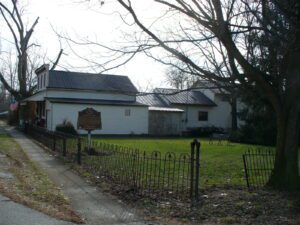
Virginia native William Owen, 1769-1821, is credited with being the first American to settle in Mad River Township, Champaign County sometime between 1797-1799. He and his family built a cabin in the northeast quarter of Section 15 directly west of this marker. Later he purchased 240 acres on which the cabin stood for $1.00 an acre from William Ward, founder of Urbana. Accused of being an eccentric, Owen was known for strong language and long oration during times of stress. Owen also raised swine and was called Kosko Elene or Hogman by the local Shawnee Indian population who were known to have taken a few piglets when Owen was not around. Owen and his wife reared eight children and both are interred in the family pioneer cemetery in the woods to the west.
The foundation for the first Welsh settlement in Ohio was laid on June 29, 1801, when William and Morgan Gwilym purchased land in what is now Morgan Township at the Cincinnati Land Office. The Welsh, who settled in Pennsylvania beginning in the late eighteenth century, moved westward and settled here in 1802. This area was also the major terminus for the 1818 migration from Montgomeryshire and Cardiganshire in Wales. In 1803 a Congregational Church was organized and services were held in members’ homes or outdoors. A brick Meetinghouse, complete with a Welsh death door leading to the cemetery, was constructed in 1824. The building now serves as the Community House. The present brick church was built in 1854. For many years, the library, formed in 1852, was housed in the New London Special School District building that stood on this site. (Continued on other side)