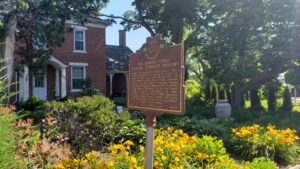
In 1809-1811, Magdalene Strader Borror, widow of Revolutionary War veteran Jacob Borror Jr., moved to this area from Virginia with her seven children (Martin, Jacob, Myomi, Solomon, Christine, Issac, and Absalom). Originally clearing and settling 400 acres of land given to Magdalene by her father, Christopher Strader, the family eventually prospered throughout the entire township. After her death in 1838, Magdalene was buried in nearby Scioto Cemetery, the resting place of more than seventy of her descendants.
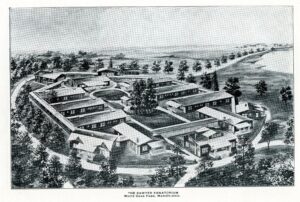
Doctors Charles Elmer Sawyer and his son, Carl Walker Sawyer, opened Sawyer Sanatorium on White Oaks Farm in 1911. Built to provide physical and emotional healing in a unique environment, the complex incorporated six patient bungalows, houses for the two doctors, offices, a large dining and social hall, and treatment buildings. An enclosed quarter-mile-long cloister connected these buildings around a large courtyard. Each bungalow, given botanical names such as “Ivy” and “Rose,” contained individual patient rooms, a communal living room, and bathing facilities. Hydropathic and electropathic treatments buildings were added later. A shady ten-acre knoll on the farm featured a grove of white oak trees that served as a picnic area for patients. Over the years, the facility also hosted local and national social and political events. (Continued on other side)
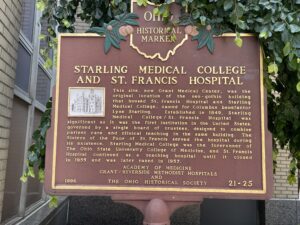
This site, now Grant Medical Center, was the original location of the neo-gothic building that housed St. Francis Hospital and Starling Medical College, named for Columbus benefactor Lyne Starling. Established in 1849, Starling Medical College/St. Francis Hospital was significant as it was the first institution in the United States, governed by a single board of trustees, designed to combine patient care and clinical teaching in the same building. The Sisters of the Poor of St. Francis served the hospital during its existence. Starling Medical College was the forerunner of The Ohio State University College of Medicine, and St. Francis Hospital continued as a teaching hospital until it closed in 1955 and was later razed in 1957.
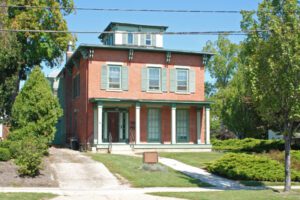
Aluminum pioneer Charles Martin Hall was born in 1863 in Thompson, Ohio (Geauga County), and moved with his family to Oberlin in 1873. Hall graduated from Oberlin College in 1885, studying chemistry under Professor Frank Fanning Jewett (1844-1926). Jewett, who lived in this house from 1884 to 1923, encouraged Hall’s interest in chemistry and aluminum, then a semi-precious metal. Hall discovered an electrochemical reduction process for producing metallic aluminum from aluminum oxide dissolved in molten cryolite in his woodshed laboratory at his family’s home at 64 East College Street on February 23, 1886. This process, the culmination of research with Jewett, became the basis for the aluminum industry in America. In 1888 Hall co-founded the Pittsburgh Reduction Company, later the Aluminum Company of America (ALCOA). Upon his death in 1914, Hall left one-third of his estate to Oberlin College.
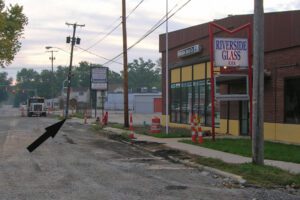
In 1884, the first natural gas well was successfully drilled in Findlay, and when The Great Karg Well, then the largest in the world, was drilled in 1886, the boom was on. Many industries, especially glass, were attracted to Findlay, lured by free or cheap gas for fuel. They included eight window, two bottle, two chimney lamp, one light bulb, one novelty, and five tableware glass factories. Famed manufacturing pioneer and inventor Mike Owens (later associated with Owens Illinois) managed the Richardson Glass Works, located at this site in 1891-1892. Tableware glass companies included Bellaire Goblet (1888-1892), Columbia Glass (1886-1892), Dalzell, Gilmore & Leighton (1888-1901), Findlay Flint Glass (1889-1991), and Model Flint Glass (1888-1893). Tableware companies employed women as decorators and packers. Hundreds of skilled glassworkers came from the eastern states of America, as well as Europe, especially Belgium, France, and Germany. Bottle glassworkers were among the first workers to unionize and to use collective bargaining.
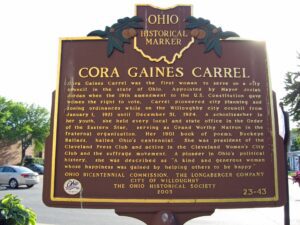
Cora Gaines Carrel was the first woman to serve on a city council in the state of Ohio. Appointed by Mayor Josiah Jordan when the 19th amendment to the U.S. Constitution gave women the right to vote, Carrel pioneered city planning and zoning ordinances while on the Willoughby city council from January 1, 1921 until December 31, 1924. A schoolteacher in her youth, she held every local and state office in the Order of the Eastern Star, serving as Grand Worthy Matron in the fraternal organization. Her 1901 book of poems, Buckeye Ballads, hailed Ohio’s centennial. She was president of the Cleveland Press Club and active in the Cleveland Women’s City Club and the suffrage movement. A pioneer in Ohio’s political history, she was described as “A kind and generous woman whose happiness was gained by helping others to be happy.”
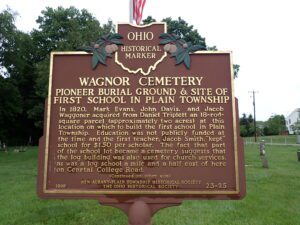
In 1820, Mark Evans, John Davis, and Jacob Waggoner acquired from Daniel Triplett an 18-rod-square parcel (approximately two acres) at this location on which to build the first school in Plain Township. Education was not publicly funded at the time and the first teacher, Jacob Smith, “kept” school for $1.50 per scholar. The fact that part of the school lot became a cemetery suggests that the log building was also used for church services, as was a log school a mile and a half east of here on Central College Road. (continued on other side)
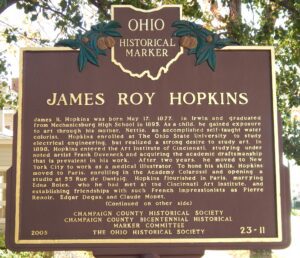
James R. Hopkins was born May 17, 1877, in Irwin and graduated from Mechanicsburg High School in 1895. As a child, he gained exposure to art through his mother, Nettie, an accomplished self-taught water colorist. Hopkins enrolled at The Ohio State University to study electrical engineering, but realized a strong desire to study art. In 1898, Hopkins entered the Art Institute of Cincinnati, studying under noted artist Frank Duveneck and acquiring the academic draftsmanship that is prevalent in his work. After two years, he moved to New York City to work as a medical illustrator. To hone his skills, Hopkins moved to Paris, enrolling in the Academy Colarossi and opening a studio at 55 Rue de Dantzig. Hopkins flourished in Paris, marrying Edna Boies, who he had met at the Cincinnati Art Institute, and establishing friendships with such French Impressionists as Pierre Renoir, Edgar Degas, and Claude Monet. [continued on other side]