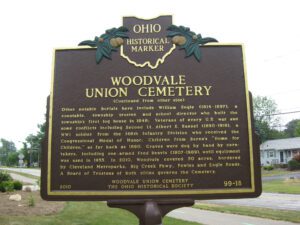
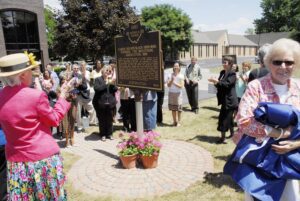
Woodvale Cemetery was established in the mid-1800s, in Middleburgh Township, Ohio. The oldest marked grave holds Fred G. Klink (1835-1858), whose family donated a half acre of land for burials. In 1876, Frank M. Stearns (1832-1911) suggested the unnamed cemetery be called Woodvale, after the wooded vale beside it. In 1908, a fire destroyed the caretaker’s house and many cemetery records. Woodvale became a non-profit, union cemetery in 1931, owned by Berea and the Village of Middleburg Hts. and covering 35 acres at 7535 Engle Road. Pioneer families buried here: Fowles, Kraft, Lovejoy, Sprague, and Stearns. Also buried here: John Baldwin (1799-1884) founder of Baldwin University and James Wallace (1878-1953) founder of German Wallace College (merged in 1913 to become Baldwin Wallace College) (Continued other side)
The Breathing Association was founded in 1906 as the Tuberculosis Society under the leadership of public health advocate Carrie Nelson Black. The society provided nutrition, medical care, and sanitorium services to people who could not afford proper medical care. A tuberculosis dispensary was operated at 40 South Third Street in Columbus for Ohioans needing consultation and treatment. Tuberculosis, known as the White Plague, killed one out of nine persons in Columbus during the early 1900s. An Open Air School was established on Neil Avenue in 1913 for children in homes where there were one or more cases of tuberculosis. In 1931, the Nightingale Cottage was opened on Brice Road as a tuberculosis preventorium for children. As tuberculosis became controllable, the agency became focused on emerging lung health issues. Today, The Breathing Association continues as a leading resource on lung health issues and preventing lung disease.
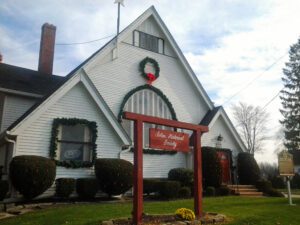
In 1845, the Disciples of Christ built the first of three churches to occupy this site. They built a second, larger structure, to replace the original in 1858. On August 6th, 1860, 29 year-old circuit minister Brother James A. Garfield, the future 20th President of the United States, was paid $250.00 to speak here every other Sunday for one year. An arsonist destroyed both the second church and the Solon Village Hall. Erected in 1899, this building replaced the second church and was occupied by the Disciples of Christ until 1920, when it merged with two local churches to establish the Federated Church of Solon. In 1951, the Pioneer Memorial Church split from the Federated Church to move into the abandoned Disciples Church, which they renovated. The City of Solon purchased the building in 1968, and it has since been the home of The Solon Historical Society.
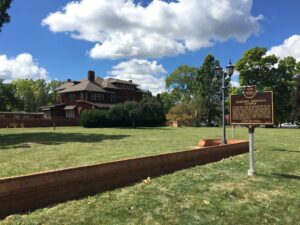
The Harding Hospital, initially called the Columbus Rural Rest Home, was founded in 1916 by George T. Harding II, MD (1878-1934) and his associates, many of whom shared his commitment to service and his Seventh-day Adventist Christian faith. The psychiatic treatment center moved to Worthington in 1920. The hospital’s goal was to provide treatment with attention to the person’s physical, mental, social and spiritual needs. The program, with its emphasis on relational issues and psychotherapy, drew patients from across Ohio and beyond. In 1936 a residency program in psychiatry for physicians was started and educational programs for other mental health professionals followed. The campus’ beauty contributed to its being a place of healing for many. Since 1999, Harding Hospital has been a part of The Ohio State University’s Wexner Medical Center.
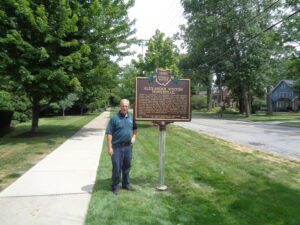
On this site, Alexander Winton (1860-1932), an American automobile pioneer, built and lived in a lakefront estate named Roseneath. Winton was born in Scotland and immigrated to the United States as a young man, settling in Cleveland. In the early 1890s, Winton founded the Winton Bicycle Company; six years later, he incorporated the Winton Motor Carriage Company. In 1903, Winton’s auto plant on Berea Road was one of the largest in the world, and he produced the first car to cross America from coast to coast. These business successes enabled him to build the 25-room Roseneath. In 1912, Winton founded the Winton Gas Engine & Manufacturing Company, which would eventually become part of General Motors Corporation. Winton is buried in Lakeview Cemetery. A fire in 1962 destroyed Roseneath.
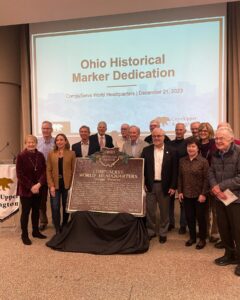
The world headquarters of CompuServe was located on the six-acre site at 5000 Arlington Centre Boulevard from 1973 to 2009. Incorporated in 1969, Compu-Serve Corporation (later CompuServe Inc.) was the first major online information services provider. Its subscribers were the first to have access to email, online newspapers and magazines, the ability to share and download files, and a variety of popular chat forums. One especially successful CompuServe innovation was the GIF graphics format. Increasing competition and a succession of corporate owners pressed CompuServe into the fate of many tech start-ups and it ran its course. It did, however, introduce millions of people to online connectivity, social networking, and laid the foundation for the widespread use of the internet.
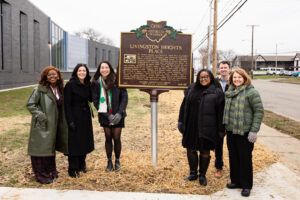
Dr. Harley Manuel and Charles E. Jones were frustrated by the restrictive covenants and redlining that kept Black residents from purchasing homes in desirable Columbus neighborhoods. Deciding to create their own neighborhood, the two men purchased 10.5 acres of farmland in March 1945. They divided it into 42 lots that became Livingston Heights Place. The first lots were sold to pharmacist Waldo W. and Harriet Tyler in 1946. Other early residents included Edward J. Cox, William and Esther Toler, David D. White, Dr. William K. Allen, and Dr. Harry Jefferson. Later residents were Dr. John H. Rosemond, Llewellyn (Jack) A. Coles, Captain Amos A. Carter Jr., Sammy Hopkins, William “Bill” Willis, and Dr. Richard Ruffin. Twenty homes were built between 1948 and 1967 within the subdivision’s boundaries of Johnson Park, Livingston, Byron, and Waverly.
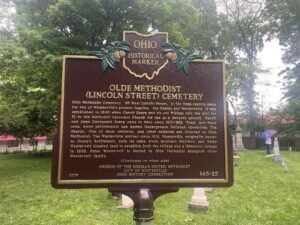
Olde Methodist Cemetery, 66 West Lincoln Street, is the final resting place for two of Westerville’s pioneer families, the Sharps and Westervelts. It was established in 1849 when Garrit Sharp and his son William sold the plot for $1 to the Methodist Episcopal Church for use as a burying ground. Garrit and Anna Goodspeed Sharp came to Ohio circa 1810-1812. They, and their sons, were abolitionists and known Underground Railroad operatives. The Sharps, five of their children, and other relatives are interred in Olde Methodist. The Westervelts arrived circa 1818. Westerville, originally known as Sharp’s Settlement, took its name when brothers Matthew and Peter Westervelt donated land to establish both the village and a Methodist college in 1839. Peter Westervelt is buried in Olde Methodist alongside other Westervelt family. (Continued on other side)