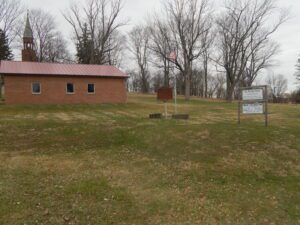
About a mile south in St. Paul’s Cemetery, the Reverend Father Edward J. Fenwick, “Pioneer Apostle of Ohio,” organized the first Catholic parish in northern Ohio. The first mass was celebrated in the log house of Daniel McCallister. A century and a half later the cabin was dismantled, moved here, rebuilt, and rededicated in May, 1967 as the Log Cabin Shrine of Dungannon.
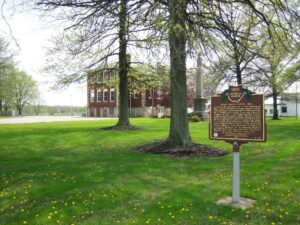
Myron T. Herrick, Governor of Ohio from 1904 to 1906, was born in Huntington Township in 1854 and lived here until age 12. A respected Cleveland attorney and businessman, Herrick was a friend and confidant to Senator Mark Hanna and Presidents McKinley, Taft, and Harding. His public service career culminated in two appointments as ambassador to France, from 1912 through the outbreak of World War I in 1914, and again from 1921 until his death in 1929. Enormously popular with the French people, Herrick escorted Charles Lindbergh in Paris after his historic 1927 transatlantic flight.
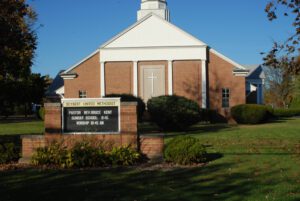
Born in Pennsylvania in 1791, Bishop John Seybert came to Ohio in 1822 and preached throughout the mid-west. Seybert served the faith for forty years as an itinerant preacher, a presiding elder, and the first bishop of the Evangelical Association, one of the original denominations that is now part of the United Methodist Church. As a circuit rider, he traveled on foot, horseback, and spring wagon a distance of 175,000 miles, preached 9,850 sermons, held 8,000 prayer and class meetings, and made about 46,000 pastoral calls and 10,000 calls on the sick. Seybert often paid his own expenses on the meager salary of $100 per year. He died in 1860 and is buried in the Bellevue – Flat Rock area.
The pioneer village of Vistula is now bounded by Walnut, Champlain, Chestnut, Magnolia, and Summit streets. Established in 1833 by Benjamin F. Stickney and Edward Bissell, Vistula was merged with its rival, Port Lawrence, and in 1837 both villages were incorporated as Toledo. The Vistula Historic District, Toledo’s oldest neighborhood, was listed on the National Register of Historic Places in 1978.
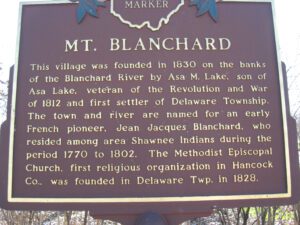
This village was founded in 1830 on the banks of the Blanchard River by Asa M. Lake, son of Asa Lake, veteran of the Revolution and War of 1812 and first settler of Delaware Township. The town and river are named for an early French pioneer, Jean Jacques Blanchard, who resided among area Shawnee Indians during the period 1770 to 1802. The Methodist Episcopal Church, first religious organization in Hancock Co., was founded in Delaware Twp. in 1828.
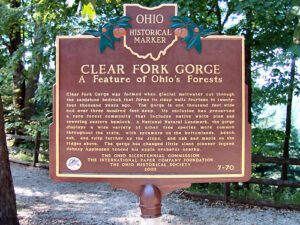
Clear Fork Gorge was formed when glacial meltwater cut through the sandstone bedrock that forms its steep walls fourteen to twenty-four thousand years ago. The gorge is one thousand feet wide and over three hundred feet deep. Its seclusion has preserved a rare forest community that includes native white pine and towering eastern hemlock. A National Natural Landmark, the gorge displays a wide variety of other tree species more common throughout the state, with sycamore on the bottomlands, beech, ash, and tulip farther up the slopes, and oak and maple on the ridges above. The gorge has changed little since pioneer legend Johnny Appleseed tended his apple orchards nearby.
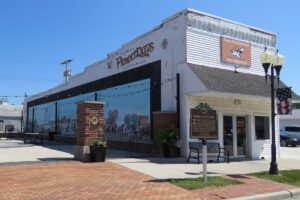
The Putnam County Pioneer Association was organized September 6, 1873, at a meeting in Kalida, Ohio. Its stated purpose was to “perpetuate the early history of our county.” Members gathered oral histories from early residents and published two volumes of Pioneer Reminiscences in 1878 and 1887. The all-day annual meeting, held every year in September, grew into a larger festival. In 1970, the Kalida Lions Club, with funds generated from the event, purchased the former Kalida Methodist Church at 201 E. Main Street and “sold” it for $10 to the Pioneer Association for use as a museum. The Pioneer Association adopted a revised constitution and changed its name to The Putnam County Historical Society in 1971. It continues to hold its annual meeting during the “Pioneer Days” weekend.
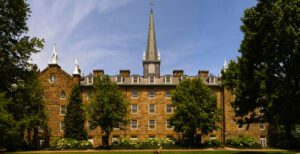
The state’s oldest private institution of higher education, Kenyon College was founded in 1824 in Worthington by Philander Chase, first Episcopal bishop of Ohio, and relocated to Gambier four years later. Both college and village are named for British benefactors, statesman Lord Kenyon and naval hero Lord Gambier. Throughout its history, Kenyon has prepared men and women for leading roles in society, including nineteenth-century graduates Edwin M. Stanton, Abraham Lincoln’s secretary of war, and Rutherford B. Hayes, Ohio governor and U.S. president. In the twentieth century, Kenyon educated such literary luminaries as poet Robert Lowell and novelist E.L. Doctorow. Kenyon has also been an innovator in education-the Advanced Placement Program began as the Kenyon Plan in the 1950s.