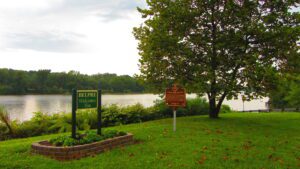
801 E. Pete Rose Way, Bicentennial Commons at Sawyer Point
Cincinnati
, OH
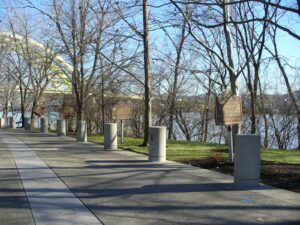
In memory of the Irish people who left a country where only their rivers run free. The Irish came to Cincinnati where they contributed to housing, education, employment, religious freedom, medical care and recreation, and embraced all aspects of life in the city. The descendants of Irish immigrants hope that our hands will ever be extended in friendship and never in want.
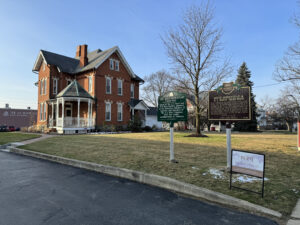
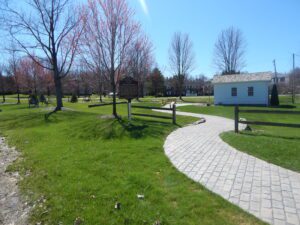
The Root Homestead was built in 1879 by Amos Ives Root, founder of the A. I. Root Company, shortly after he moved his business from the town square. The homestead housed several generations of the Root family until 1953 and was listed on the National Register of Historic Places in 1975. A pioneer of the beekeeping industry, Root helped to standardize such beekeeping equipment and tools as the Langstroth removable frame hive and the centrifugal honey extractor. As a result, beekeepers were able to harvest more honey every season without harming the bees. A prolific author and publisher, Root educated beekeepers across the globe and built a sense of community within the profession. (Continued on other side)
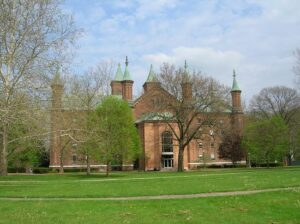
Chartered in 1852 by the Christian Church and later a Unitarian institution, Antioch College opened with educational pioneer Horace Mann as its first president. One of the earliest co-educational colleges in the United States, from its inception Antioch promoted humanistic and egalitarian values. In 1920 Arthur E. Morgan became president and initiated a widely emulated cooperative work-study program. The Antioch Review, one of the oldest literary magazines in America, began publication in 1941. In 1978 the college reincorporated as part of Antioch University, a multi-campus system headquartered in Yellow Springs.
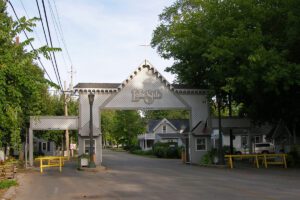
Established in 1873, Lakeside is a pioneer of the American Chautauqua Movement, one of the greatest revival movements in United States history which flourished in the late nineteenth and early twentieth centuries. Founded by the Methodist Church, Lakeside is one of the few existing Chautauqua communities that remain and thrive today. Each summer, the late-Victorian community provides spiritual, cultural, intellectual, and recreational programs designed to nurture the mind, body, and spirit. It draws visitors from across the country and around the world for its Chautauqua program. Lakeside is recognized on the National Register of Historic Places.
Born in Massachusetts in 1805, Sala Bosworth spent all but nineteen years of his eighty-five years in Washington County. After studying at the Philadelphia Academy of Fine Arts, he returned to the county to paint many full size and miniature portraits of prominent Washington County citizens. His historical drawings were used in Samuel P. Hildreth’s Pioneer History. He is also known for his mural in what is now the Unitarian Universalist Church in Marietta. Bosworth moved to Cincinnati late in life and started to paint with watercolors. He died there in 1890. Charles Sullivan also studied at the Philadelphia Academy and became a fast friend of Bosworth after coming to Washington County in 1833. While he also painted portraits, he excelled in his landscapes, including views of Blennerhassett Island, the Blennerhassett mansion, and the mounds at Marietta. Sullivan died in Marietta in 1867.
Ebenezer Sheldon (1754-1825) was born in Suffield, Connecticut. On April 19, 1775, he answered the “Lexington Alarm,” fought in the Revolution, and, in 1789, was appointed a captain in Connecticut’s militia. Following the Revolution, Sheldon, like many others, suffered financial hardships and sought a new beginning in the Western Reserve. In 1799, he established a homestead in Aurora and returned to Connecticut the following year to bring his wife Lovee and their six children to the area. A family legend relates that when Lovee saw the family’s home she “shed a few tears over the cheerless prospects” of her new life in the wilderness.
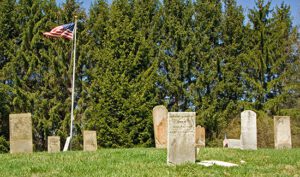
Smith’s Burying Ground was established in 1814 when John Smith (born 1742), Revolutionary War Veteran, died and was buried here. John Smith and four of his sons and their families made the six week, six-hundred-mile journey from New Jersey with ox teams the previous year. John Clouse (1758-1822), Dutch immigrant and Revolutionary War veteran, is also buried here. (Continued on other side)
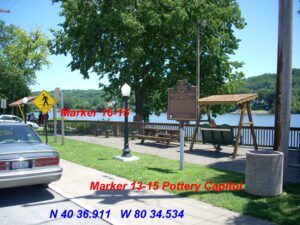
Fawcettstown, later to become East Liverpool, marked the first Ohio community to be encountered by early river travelers as they headed toward new challenges and new lives in the expanding nation. Indian canoes, flatboats, and steamboats carried increasing traffic, both passenger and freight, along these Ohio “Gateway” shores. Many of these early craft were built locally and local residents served as crewmen. Products from farms and ceramics from this city’s pioneer potteries were shipped from this site. The wharf area also served as a landing place for many of the early English potters who came here to ply their trades and, in the process, create a defining industry. The river continues to play an important role in industrial and recreational capacities.