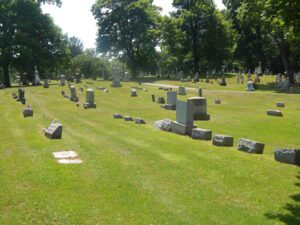
For more than two centuries, this burial ground has been a final resting place for those individuals whose lives represented the community history of Canfield. The earliest existing tombstone marks the death of Huldah Tanner in 1803. Seven earlier deaths in Canfield Township are recorded from 1798 to 1803, but the gravesites are unknown. Elijah and Rhoda Hopkins Wadsworth formally deeded the cemetery to the citizens of Canfield in 1810 with a first edition of land donated by Matthew B. Whittlesey in 1811. In 1862-1863, the graveyard was again enlarged. For seventy years the cemetery and fencing were maintained on a volunteer basis. When the Village of Canfield was incorporated in 1869, the care and management was vested in a board of trustees. (continued on other side)
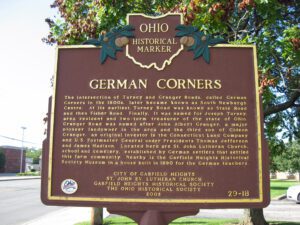
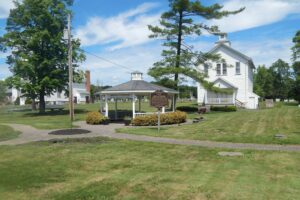
The intersection of Turney and Granger Roads, called German Corners in the 1800s, later became known as South Newburgh Centre. At its earliest Turney Road was known as State Road and then Fisher Road. Finally, it was named for Joseph Turney, area resident and two-term treasurer of the state of Ohio. Granger Road was named after John Albert Granger, a major pioneer landowner in the area and the third son of Gideon Granger, an original investor in the Connecticut Land Company and U. S. Postmaster General under Presidents Thomas Jefferson and James Madison. Located here are St. John Lutheran Church, school and cemetery, established by German settlers that settled this farm community. Nearby is the Garfield Heights Historical Society Museum in a house built in 1890 for the German teachers.
The Connecticut Land Company surveyed Vienna Township as Township 4, Range 2, in 1798. The Township’s proprietors were Ephraim Root, Uriel Holmes, Jr., and Timothy Burr. Survey members Dennis Clark Palmer, Isaac Flower, and Samuel Hutchins and their families were the first to settle here in 1799. Between 1810 and 1840, Vienna was a center for the wooden works clock industry in Trumbull County and the Connecticut Western Reserve, with six factories located amid farms, sawmills, and quarries. After coal was discovered in 1866, over twenty mines were opened, bringing boom times for two decades. Vienna’s miners helped to bring about Ohio’s first mining safety law in 1874. Vienna was the birthplace of abolitionist and attorney John Hutchins (1812-1891), who represented Trumbull and Ashtabula counties in the United States Congress (1859-1863) and raised troops during the Civil War.
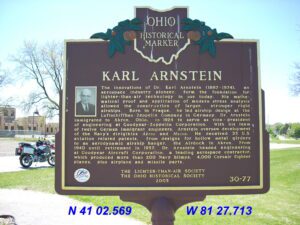
The innovations of Dr. Karl Arnstein (1887-1974), an aerospace industry pioneer, form the foundation for lighter-than-air technology in use today. His mathematical proof and application of modern stress analysis allowed the construction of larger, stronger rigid airships. Born in Prague, he led airship design at the Luftschiffbau-Zeppelin Company in Germany. Dr. Arnstein immigrated to Akron, Ohio, in 1924 to serve as vice-president of engineering at Goodyear-Zeppelin Corporation. With his team of twelve German immigrant engineers, Arnstein oversaw development of the Navy’s dirigibles Akron and Macon. He received 35 U.S. aviation related patents, from designs for hollow metal girders to an aerodynamic airship hanger, the Airdock in Akron. From 1940 until retirement in 1957, Dr. Arnstein headed engineering at Goodyear Aircraft Corporation, a leading aerospace contractor, which produced more than 200 Navy blimps, 4,000 Corsair fighter planes, plus airplane and missile parts.
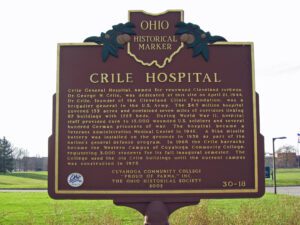
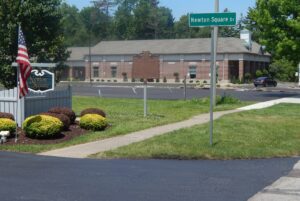
Crile General Hospital, named for renowned Cleveland surgeon, Dr. George W. Crile, was dedicated at this site on April 21, 1944. Dr. Crile, founder of the Cleveland Clinic Foundation, was a brigadier general in the U.S. Army. The $4.5 million hospital covered 153 acres and contained seven miles of corridors linking 87 buildings with 1725 beds. During World War II, hospital staff provided care to 15,000 wounded U.S. soldiers and several hundred German prisoners of war. The hospital became a Veterans Administration Medical Center in 1945. A Nike missile battery was installed on the grounds in 1956 as part of the nation’s general defense program. In 1966 the Crile barracks became the Western Campus of Cuyahoga Community College, registering 3,000 students for its fall inaugural semester. The College used the old Crile buildings until the current campus was constructed in 1975.
On this site stood the home of Elisha and Polly Mygatt Whittlesey and their ten children. Also here was his law office and a records office that was moved in 1965 to Pioneer Village at the Canfield Fairgrounds. Already an attorney in his home state, Elisha (1783-1863) with Polly (1787-1855) emigrated from Danbury, Connecticut in June 1806 to Canfield in the Western Reserve where he was admitted to the Ohio bar and was prosecuting attorney from 1807 to 1823. During the War of 1812, Whittlesey was adjutant to Maj. Gen. Elijah Wadsworth and later a secretary to Gen. William Henry Harrison. Whittlesey opened a law office in Canfield in 1813, specialized in land cases, and was one of the founders of Norwalk, Ohio in 1815. In 1820, he was elected to the first of two terms in the Ohio General Assembly. (Continued on other side)
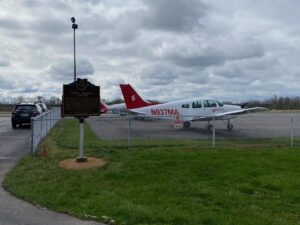
Lewis Albert Jackson (December 29, 1912-January 8, 1994) was an African American aviator remembered for training Tuskegee Airmen during World War II. As a teenager in Indiana, he began flight lessons and soloed in 1932, flying his own Waco 10. Jackson spent 1932-1937 barnstorming to save money for college while earning his Transport Pilot’s License. He re-rated to a Commercial License with Instructor Rating in 1939, and then completed advanced acrobatic training at Coffey School of Aeronautics. In late 1940, he was appointed Director of Training in the Army Air Force 66th Flight Training Detachment at Tuskegee Institute. After the war he moved to Ohio and served as an FAA Flight Examiner from 1947 to 1960. The Lewis A. Jackson Greene County Regional Airport was posthumously renamed to honor this true aviation pioneer.
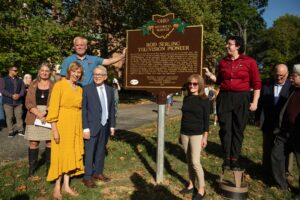
Rodman Edward Serling (1924-1975) enrolled at Antioch College in 1946 following military service in World War II. He began college as a physical education major, but soon discovered writing as a way of working through his war experiences. As a student, he contributed short fiction to The Antiochian literary magazine, managed the student-run Antioch Broadcasting System, and wrote and produced award-winning radio dramas. In July 1948, Serling married classmate Carolyn “Carol” Kramer. Shortly after earning his degree in 1950, he took a copy writer job at Cincinnati’s WLW radio. Serling quickly focused on selling scripts to national television networks. After eight years in Ohio, he and his wife moved to Connecticut. He returned to Antioch after the third season of The Twilight Zone to teach writing, drama, and media during the 1962-1963 academic year.